
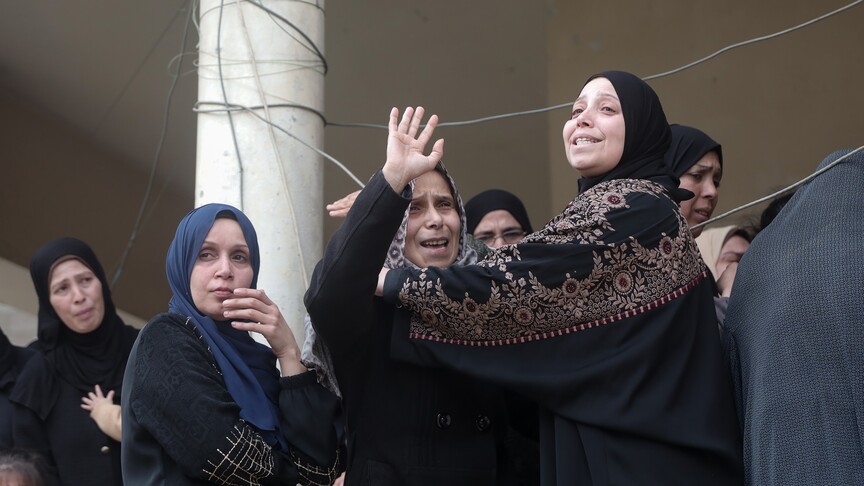
Three years into Israel’s genocide in the Gaza Strip, Palestinian and UN data show sweeping consequences for women and girls, from deaths, injuries and disappearances to rising miscarriage rates, unsafe births and malnutrition.
The collapse of Gaza’s health system has also deprived pregnant women of medical care, forcing some to give birth at home or in displacement shelters, while changes in family structures have left tens of thousands of women responsible for supporting their households.
Data released by the Palestinian Central Bureau of Statistics on July 18, 2026, showed that 12,400 women, excluding girls, had been killed in Gaza since Oct. 7, 2023.
The bureau also said women and children accounted for 4,700 of the 11,200 people reported missing, with the fate of many still unknown amid fears that some remain under the rubble of destroyed buildings.
Human toll
UN Women, in an April 2026 report titled The Cost of War on Women and Girls, estimated that more than 38,000 women and girls were killed between October 2023 and December 2025 — an average of nearly 47 per day.
The report added, “there are close to 11,000 women and girls with lifelong injury.”
Survivors continue to face daily risks from bombardment, hunger, repeated displacement and restrictions on access to essential services, the report said.
According to the report, more than 71,200 Palestinians were killed during the period it covered, with women, children and older persons together representing more than half of all fatalities.
It cautioned that the figure was likely lower than the actual death toll “given the collapse of health information and reporting systems.”
The highest proportion of deaths among women and children was recorded during the first six months of the war, when they accounted for nearly two-thirds of documented fatalities.
The report said that despite a ceasefire agreement that took effect on Oct. 10, 2025, women and girls continued to be killed and injured, while humanitarian and health conditions threatening their lives showed no significant improvement.
Reproductive health deteriorates
From the early months of the genocide, rights and health organizations documented a sharp deterioration in women’s reproductive health amid attacks on medical facilities, lack of access to health care, repeated displacement and malnutrition.
In July 2024, the International Planned Parenthood Federation said miscarriages in Gaza had risen by at least 300% during the first nine months of the war.
Physicians for Human Rights said in January 2026 that its report, Destroying Hope for the Future: Reproductive Violence in Gaza, documented 2,600 miscarriages during the first half of 2025.
The report also documented 220 pregnancy-related deaths and 1,460 premature births, while more than 2,500 newborns required intensive care.
Earlier data from Gaza’s Health Ministry showed that 57.1% of registered pregnant women in 2025 suffered from anemia.
Unsafe births
Rights reports said pregnant women in Gaza faced growing difficulty obtaining prenatal and delivery care as the health system deteriorated.
UN Women said Gaza was recording about 130 births per day as of March 2025, with more than a quarter delivered by cesarean section, placing additional strain on an already weakened health system.
The collapse of health services forced many women to give birth at home and in displacement sites, away from emergency medical care, the report said.
Even after the ceasefire, around 15 births per week continued to take place outside hospitals, often without skilled midwives and in unsafe conditions.
Hunger and malnutrition also heightened risks for pregnant women and newborns, including low birth weight, premature delivery, stillbirths and maternal deaths.
By July 2025, 40% of pregnant and breastfeeding women in Gaza were suffering from malnutrition, while around half a million women and girls faced the risk of famine, according to UN Women.
The report estimated that 37,000 pregnant and breastfeeding women, along with 50,000 girls, would require treatment for acute malnutrition during the year following the ceasefire.
In another report issued on June 19, 2026, UN Women said 1 million women and girls in Gaza lacked access to clean water, 690,000 were living in overcrowded shelters and 328,000 girls were out of school.
Miscarriage rate triples
The latest figures from Gaza’s Health Ministry show that risks facing pregnant women continue despite the ceasefire.
The ministry recorded around 3,958 miscarriages between January and June 2026.
An infographic published by the ministry on July 20 showed the miscarriage rate reached 208.5 per 1,000 live births during the first half of 2026, compared with 64 per 1,000 live births in the second half of 2025 — about 3.3 times the previous rate.
April recorded the highest monthly miscarriage rate at 377.25 per 1,000 live births, while June recorded the highest number of miscarriages at 790.
The data show that 73.6% of miscarriages occurred during the first trimester, before the completion of 13 weeks of pregnancy, while 26.4% occurred during the second trimester, between 13 and 24 weeks.
More households headed by women
The war has also reshaped thousands of families in Gaza, forcing more women to assume responsibility for supporting their households following the deaths, injuries or disappearance of their husbands and the loss of income.
According to UN Women, the proportion of Palestinian households in Gaza headed by women rose from 9% before the war to 14%.
The report said 58,600 households were now headed by women as a result of the war.
It said the shift has placed long-term economic and social burdens on women and girls, alongside caregiving responsibilities and protection needs stemming from displacement, poverty and the loss of family members.
Israel continues to violate the ceasefire that took effect on Oct. 10, 2025, with 1,460 Palestinians killed and 5,116 injured in attacks through Monday, according to Gaza’s Health Ministry.
Since the genocide began in October 2023, more than 74,000 Palestinians have been killed and over 175,000 injured, while around 90% of Gaza’s infrastructure has been damaged or destroyed.