
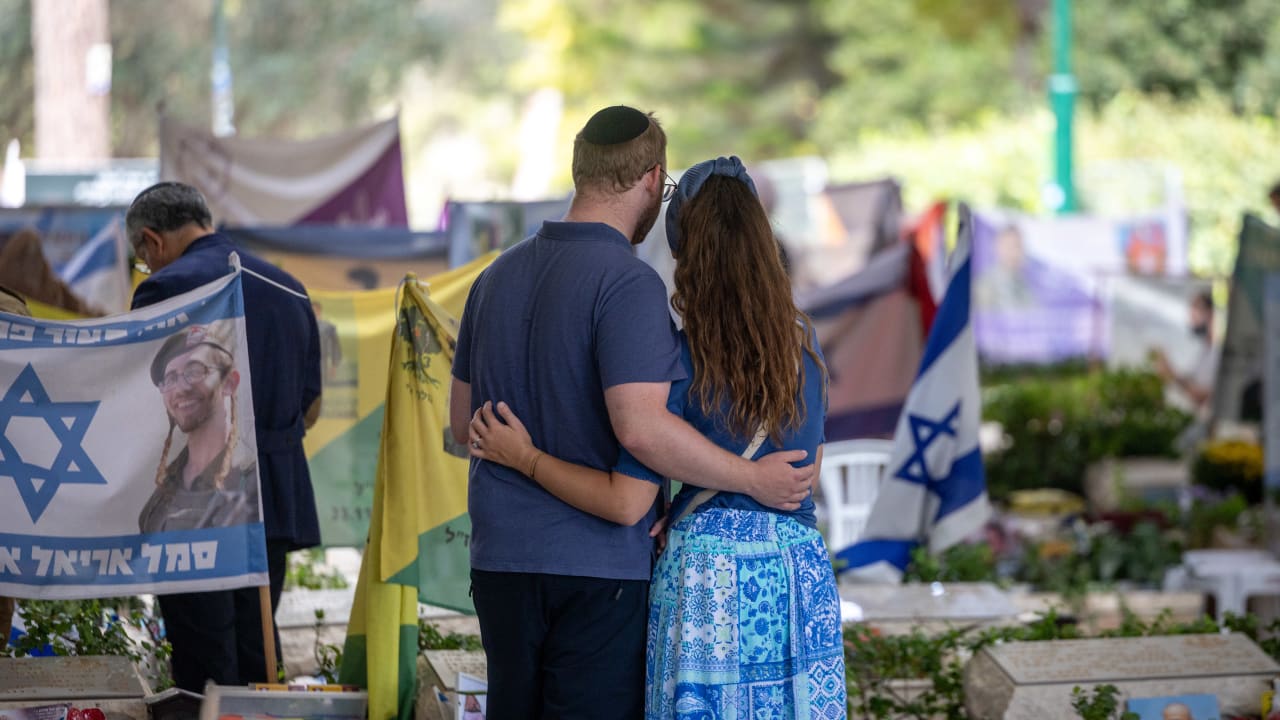
Sadly, Israel knows how to mourn.
It knows how to commemorate the tragedies that have befallen it and the Jewish people. Holocaust Remembrance Day. Remembrance Day for the Fallen of Israel’s Wars.
The country knows the drill: the somber ceremonies, the melancholy music, the radio interviews, the kaddish, and the cloud of sadness that descends over the country.
For decades, two central national days of mourning punctuated the civic calendar, alongside religious days of mourning such as Tisha B’Av. Now, there is a third: October 7.
But with this one, even the calendar is complicated.
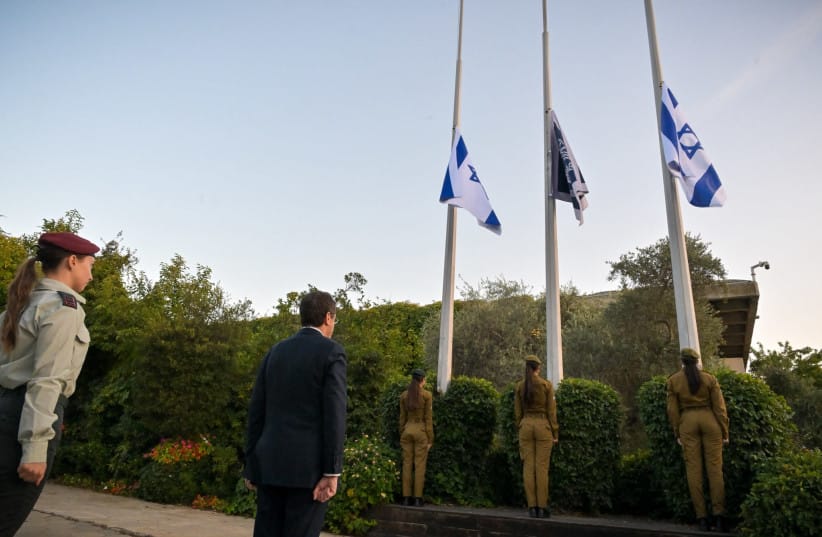 IDF soldiers lower Israeli flags to half-mast at the President’s Residence in Jerusalem to commemorate the October 7 massacre, October 5, 2026. (credit: ISAAC HERZOG)
The massacre took place on Simchat Torah, the 22nd of Tishrei. The official day of remembrance falls two days later, on the 24th of Tishrei – this year, October 5. Civilian commemorations take place on October 7 itself, including Wednesday’s large ceremony at Ganei Yehoshua.
Disagreements over who should lead the mourning
The different dates have a practical explanation. Commemorating the massacre on Simchat Torah would turn a religious holiday into a national day of mourning. But the separation between the official and civilian ceremonies also reflects something deeper: disagreement over who should lead the mourning, who can speak for the bereaved, and what place a government that presided over the catastrophe should have in commemorating it.
The country experienced a shared catastrophe. Yet, mourning it together has proven difficult.
There are echoes here of the anniversary of Yitzhak Rabin’s assassination – a national tragedy whose commemoration also exposes the country’s divisions.
It would be tempting to conclude that the separate October 7 ceremonies reflect a country that experienced the same disaster but drew entirely different lessons from it.
Tempting, but too simple.
Israel has absorbed more common lessons about security than its fractured public life – a fracture all the more visible during an election campaign – would suggest. The problem is that those shared lessons have not translated into shared obligations.
There is considerable agreement about the dangers facing the country, and substantial agreement about the need to confront them. Take Prime Minister Benjamin Netanyahu out of the picture, and the differences between Likud, Yashar, B’Yachad, and Yisrael Beytenu – especially on fundamental security questions – become much harder to discern than the heated political rhetoric would suggest.
That does not mean there are no differences. Disagreements remain over priorities, the timing and scope of military operations, and how to best leverage military achievements into diplomatic ones.
But the broad understanding that Israel cannot allow an enemy to build an army on its borders, rely on assurances that the enemy is deterred, and wait for the danger to materialize, is not confined to one political camp.
Israel’s post-October 7 mindset
Chief of Staff Lt.-Gen. Eyal Zamir’s call on Monday for an assertive offensive posture and pledge not to rely on deterrence but to prevent Israel’s enemies from building up their strength and capabilities unchecked finds support well beyond the governing coalition. The notion that Israel must act against developing threats, rather than believing they would not dare to act or merely preparing to absorb the next attack, has become part of the country’s post-October 7 mindset.
The same is true of the deep skepticism toward Palestinian statehood.
Much of the international community still presents a Palestinian state as the solution to the problems in the Middle East. For many Israelis, however, October 7 points in the opposite direction: relinquishing control would simply create another territory from which an armed enemy could organize, prepare, and eventually attack.
Many point to Gaza and conclude that there is no reason at this time to believe that an independent Palestinian entity in Judea and Samaria would look any different. The burden of demonstrating that it would is much, much heavier than it was before October 7.
So where do the country’s divisions lie, three years after October 7?
First, there is Netanyahu himself. He remains as much of a fault line after the massacre as he was before it. For some, the subsequent military achievements – the new Middle East emerging from decisions he took – show why he must remain in office. For others, the failure that made those campaigns necessary demonstrates why he must leave.
But the divisions are not only about Netanyahu. They are also about whether agreement on the dangers facing the country carries with it agreement on the obligations those dangers impose.
Two stand out: the obligation to help protect the country, and the obligation to take responsibility when that protection fails.
On the first, October 7 drove home the country’s need for soldiers and reservists. Yet, that lesson has not translated into agreement that the burden must be shared more broadly.
And therein lies the disconnect. If the danger threatens everyone, how can confronting it remain the responsibility of only some? How can one family be expected to send its children to the army and repeatedly to the reserves, with all the risks and disruption that entails, while another family’s sons remain exempt?
On the second question, accountability, the country remains divided over what taking responsibility requires, who must do so, and how the failures should be investigated.
The military achievements since October 7 matter enormously. They have changed Israel’s strategic position. But they do not answer the questions about the decisions, assumptions, and failures that preceded the massacre.
A leader can deserve credit for what happened afterward and still owe an accounting for what happened before. The two are not mutually exclusive.
The overarching issue is reciprocity.
Citizens owe something to the country and to one another. The state and its leaders owe citizens protection, competence, and accountability. October 7 exposed how indispensable those obligations are.
Three years later, it is fair to ask: are these reciprocal obligations being honored?
Are all citizens doing their part, or have extraordinary sacrifices by some become a convenient substitute for participation by others?
Has the state restored its ability to protect its citizens, and have its leaders acted competently and accepted responsibility?
Three years on, the jury is still out. In another three weeks, for the first time since October 7, that jury – the nation – will have its say via the ballot box.