
I don’t agree with her position on the new permitting reform bill, but I think Genevieve Guenther perfectly captures the disagreement between the left and center-left: The bill would facilitate the deployment of clean energy, but many of its changes also apply to the deployment of natural-gas infrastructure, so the question comes down to whether you think this is good on balance.

Dr. Genevieve Guenther (she/they) 🪬@DoctorVive
It’s too bad that the bill’s NEPA exemptions for upgrading existing transmission (good!) also apply to the replacement, upgrades, expansion, or extension of existing natural gas pipelines & associated infrastructure such as compressor stations (disastrous!).

Josh Freed @jsfreed
Rob is the authority on transmission. His backing of these provisions speaks volumes for the impact permitting reform could have.
11:46 AM · Oct 2, 2026 · 1.09K Views
1 Reply · 1 Repost · 6 Likes
A huge swath of the institutional environmental movement is committed to the view that the most important thing is blocking new gas infrastructure. This position is a little bit embarrassing, which is why green groups explained on their internal strategy call that the plan is to say they’re pushing to improve the bill while actually working to kill it.
And I do think one must admit that permitting reform as climate policy is a bet.
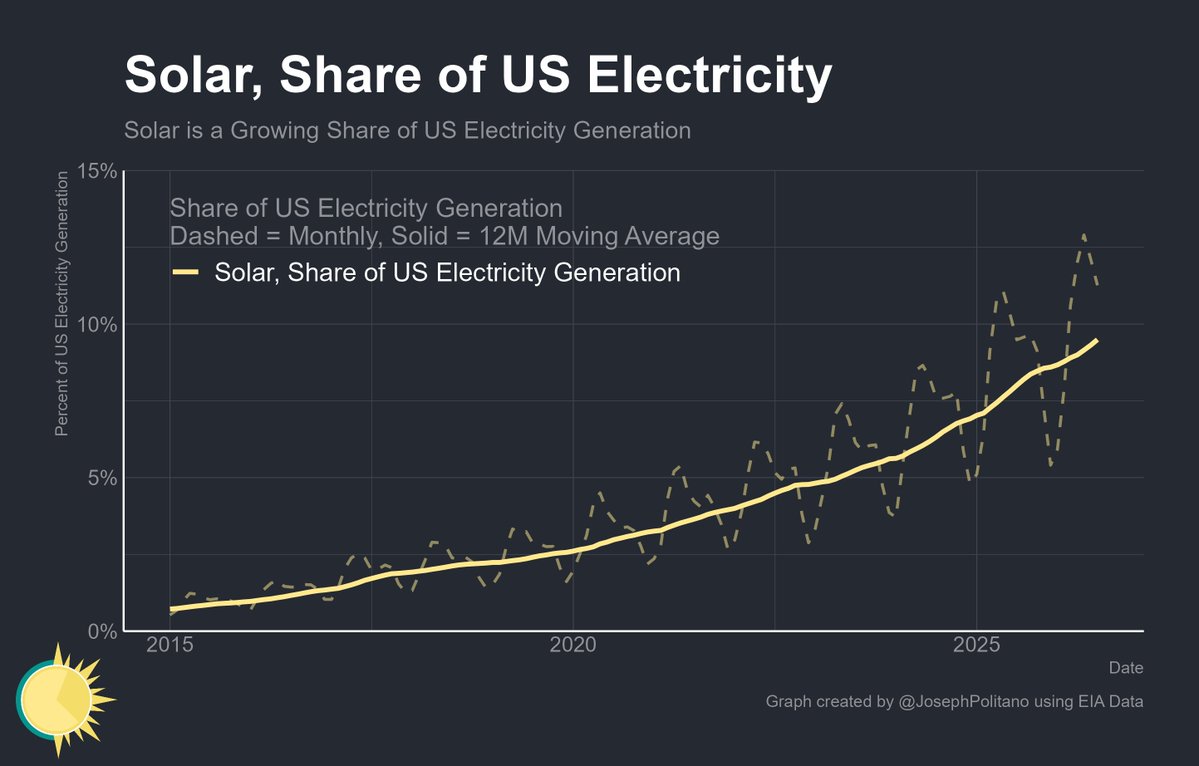
It’s a bet that the battery optimists are correct that storage technology will keep getting better and cheaper so that this line will keep going up rather than hit a wall when the summer market gets saturated. It’s a bet that voters will continue to care about environmental issues and that future Democratic administrations will be able to enact substantive air-pollution regulations rather than relying on procedural shenanigans to handicap fossil-fuel infrastructure.

Joey Politano 🏳️🌈@JosephPolitano
Solar power made up 11.3% of US electricity this July, up from 9.5% last year
Over the last twelve months, solar has made up 9.5% of US electricity, another record high!
9:16 PM · Sep 29, 2026 · 3.4K Views
2 Replies · 3 Reposts · 125 Likes
These bets might not pay off, but they are bets that most people in the climate movement say they believe in, and the people who actually do believe them are willing to take the bet.
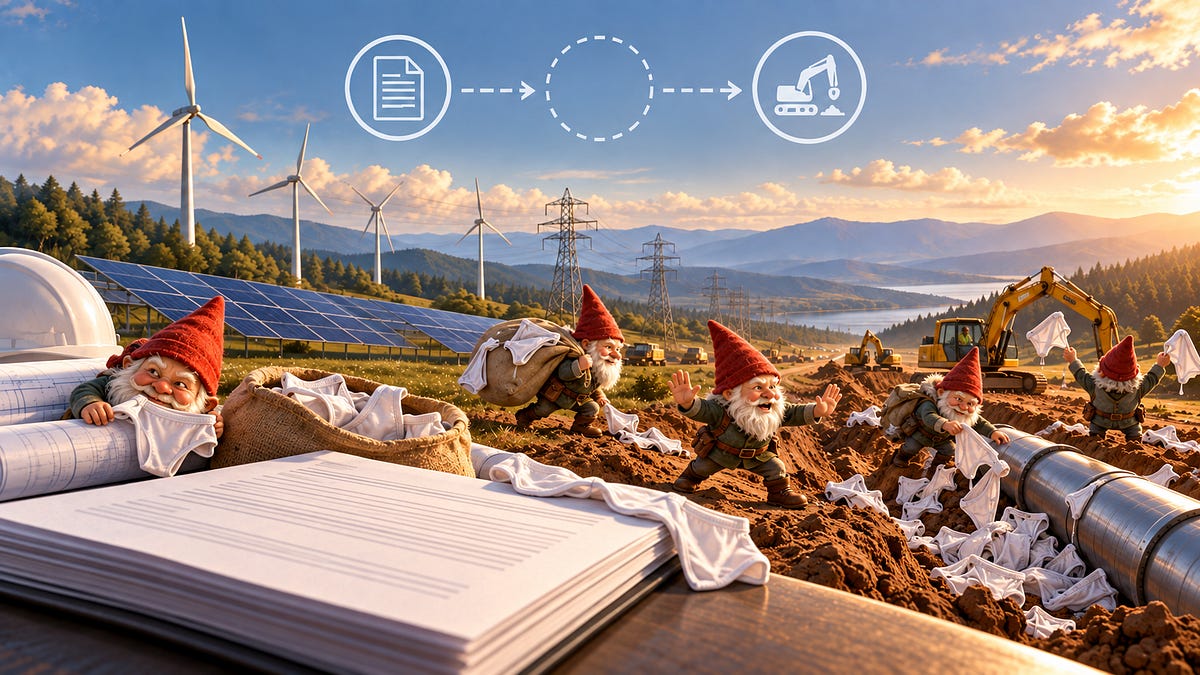
On the other side, meanwhile, we have what I would characterize as the underpants gnome climate policy:
Block new natural-gas infrastructure
???
Net zero!
It’s just not clear how this is supposed to work technically or politically. We only need to look to New England, where they’ve been attempting this policy for the past generation and it’s just not working.
The United States is a land of abundant methane, which means that in most of the country, burning natural gas is a low-cost way to generate electricity. In the parts of the country that are dense enough to have the requisite infrastructure, it’s also a low-cost way to heat homes and a convenient way to operate stoves.
But the northeastern United States does not have enough pipelines to fully meet New England’s demand for gas. As a result, the region imports liquefied natural gas (L.N.G.), which trades on global markets at a higher price than pipeline gas. This gas scarcity has not caused abundant clean energy to magically materialize in New England.
These are the underpants gnomes.
In the real world, renewables deployment has less to do with the ideological complexion of states and more to do with the physical fundamentals. The Great Plains are very windy, so there’s lots of wind power there. The Southwest is very sunny, so there’s lots of solar power there. Both the price of land and the ease of accessing it are also important variables. One reason Texas has become such an extraordinary solar champion is that Texas features many large parcels of privately owned low-value agricultural land.
None of this is true of New England. It’s less sunny, it’s less windy, the land is more expensive, ownership is dramatically more fragmented, and the terrain is much more forested.
None of these are insurmountable obstacles to building utility-scale wind and solar facilities, but they are definitely obstacles. If you want to surmount them, you need to take affirmative policy steps to do so.
I think there are obvious reasons why local elected officials are not incredibly eager to have the state use eminent domain to assemble big parcels of land and cut down trees and build solar panels, but you definitely could do this. And if you did it, the New England grid would get greener. Blocking new gas infrastructure, by contrast, does not solve the problems of renewables deployment. Instead, it has two main consequences.
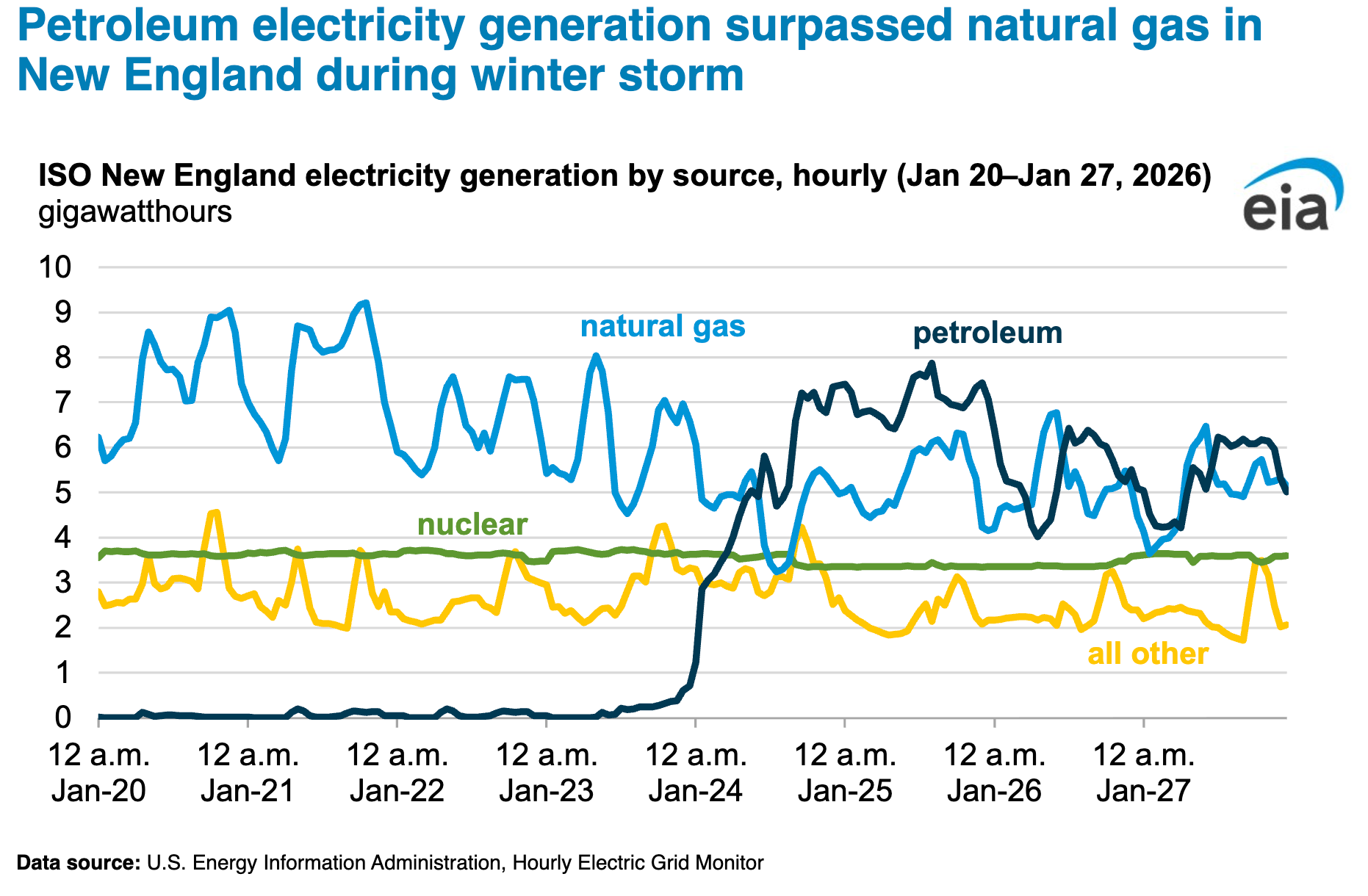
One is that during adverse weather events, a lot of New England power stations switch to burning oil, which is dirtier than gas.
The other is that electricity is relatively expensive in New England.
This is good for encouraging conservation, but it’s bad for the local economy and also has perverse consequences from an environmental viewpoint.
The New York Times published a piece about the price of an electric car versus a gasoline car in every state. The two states with the best E.V. savings are Washington and Oregon, two politically progressive states with above-average gasoline prices and below-average electricity costs. Then there’s swing state Nevada, followed by two red states.
But the five worst states are all politically progressive states in the Northeast, where electricity is expensive.
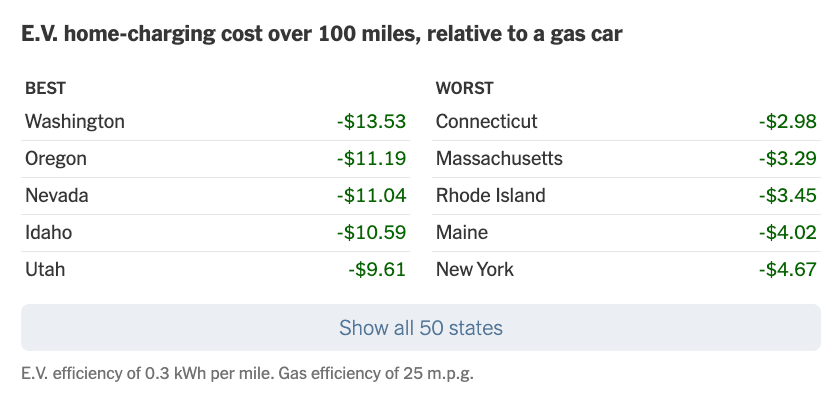 The cheapest and most expensive places to charge an E.V. (Source: New York Times)
You of course could make E.V.s attractive in these states by imposing really high gas taxes. But in practice that’s not happening, just like large-scale renewables construction isn’t happening. The upshot of the lack of gas pipeline infrastructure is just that electricity is expensive, so electrification is unattractive.
The home heat situation is even worse. New England is quite cold in the winter, and people often rely on heating oil (which, again, is dirtier than gas) or at times wood. It would be good to see more people switch to electric heat pumps, which are very efficient and will also let people cool their homes in the increasingly warm New England summers. Again, though, how attractive this is as an option is largely a function of the price of electricity. New England electricity is already expensive, and if price-insensitive green enthusiasts go out and switch to heat pumps anyway, that will only push prices higher unless electricity generation expands.
Obviously to solve climate change, you need that expanded electricity generation to be as clean as possible. But what I’m saying here is that blocking pipelines does not summon clean electricity into existence. A permitting deal, by contrast, actually does increase the amount of clean electricity.
It’s true that it will also expand gas infrastructure, but the actual impact of this on environmental outcomes is ambiguous, while the pure underpants gnome strategy is totally failing.
There are also non-climate interests at play in this debate.
Most politicians these days say that they care about affordability and the cost of living. Clearly, a law that makes the infrastructure of both gas and renewables easier to build is good for affordability and the cost of living.
Now a lot of politicians who say they care about this are clearly lying (see Trump on tariffs), but I think that’s bad. Democrats who are on the fence about this bill ought to look in the mirror and ask themselves if they’re lying when they say they care about affordability or if it’s a real concern of theirs. You have disagreements over impact within the climate camp, but the cost-of-living impact is unambiguous.
There’s also politics to consider.
Bill McKibben, writing against the permitting deal, analogizes it to a 2015 legislative deal that paired an expansion of clean-energy tax credits with the re-legalization of crude oil exports. At the time, proponents of the deal said that this was a win-win for the American economy and for clean energy. McKibben disagrees because he conceptualizes the entire climate issue as a kind of endless war of position against the oil industry, so anything that’s good for them is by definition bad:
As we lobbied via email, I exchanged opinions with a Senator deeply involved in that fight, and in this one. He assured me I was wrong—that the compromise would be “big, and net carbon reducing.” As it turns out, it’s possible that the disastrous bill may have been more important than the Paris climate accords. Over the course of a decade they turned America into the world’s largest hydrocarbon exporter, and rewrote the shape of global energy markets. They gave American oil interests the power to, among other things, help install Trump back in office. It was a well-meaning and utterly and profoundly disastrous compromise, one that the Serious People in DC and the press supported, as they will this one.
This read of the politics is silly. If the Obama administration had refused to do this deal in 2015, that wouldn’t have stopped Trump from winning in 2024. In the real world, a repeal of the export ban would probably just have passed in 2017.
But play out McKibben’s counterfactual and now you have Democrats — including vulnerable ones like Jon Tester and elected officials from states like Pennsylvania, Colorado, Ohio, and New Mexico with oil and gas industries — spending that year filibustering the bill. This makes Democrats’ political problems worse, not better.
Here in the real world, we’re looking at a potential Democratic Senate win that hinges on seats in Alaska and Texas. There’s a tradeoff between the desire to build a big tent coalition to check MAGA and the desire to engage in a relentless twilight struggle against the American fossil-fuel industry. I know people in the green movement don’t want that to be true and don’t subjectively understand themselves and their organizations to be undermining the fight for American democracy, but it’s the reality of the situation.
Speaking of democracy, imagine a world where McKibben had gotten his way and there’d been no American oil and gas exports over the past 10 years. Sanctioning Russia would be impossible and unthinkable. European dependence on Putin’s energy exports would be complete. It’s true that Europeans would be scrambling to invest in renewables and green technology, but in the real world, they’ve been doing that while also relying on American exports as a bridge. In the McKibben timeline, Ukraine is thrown to the wolves and Russia’s budget for military rebuilding and information operations is unlimited.
It’s in the geopolitical arena that the green analysis keeps falling down.
Efforts to influence global fossil-fuel consumption by constraining American fossil-fuel production have a terrible cost-benefit profile and always will. Democrats who understand how destructive Trump’s war in Iran has been to the global economy need to understand that green absolutists want to do to the United States of America what Trump has done in the Strait of Hormuz. It doesn’t make any sense.
The good news is that nothing in this compromise prevents a future Democratic administration from pursuing substantive Clean Air Act regulation of fossil fuels or a future Democratic trifecta from imposing a price on carbon dioxide emissions (perhaps one limited to the deeply unpopular data-center industry). And it won’t stop us from investing in innovative technologies that might reduce the world’s need for fossil fuels in key areas like aviation, maritime shipping, cement, steel, and agriculture.