
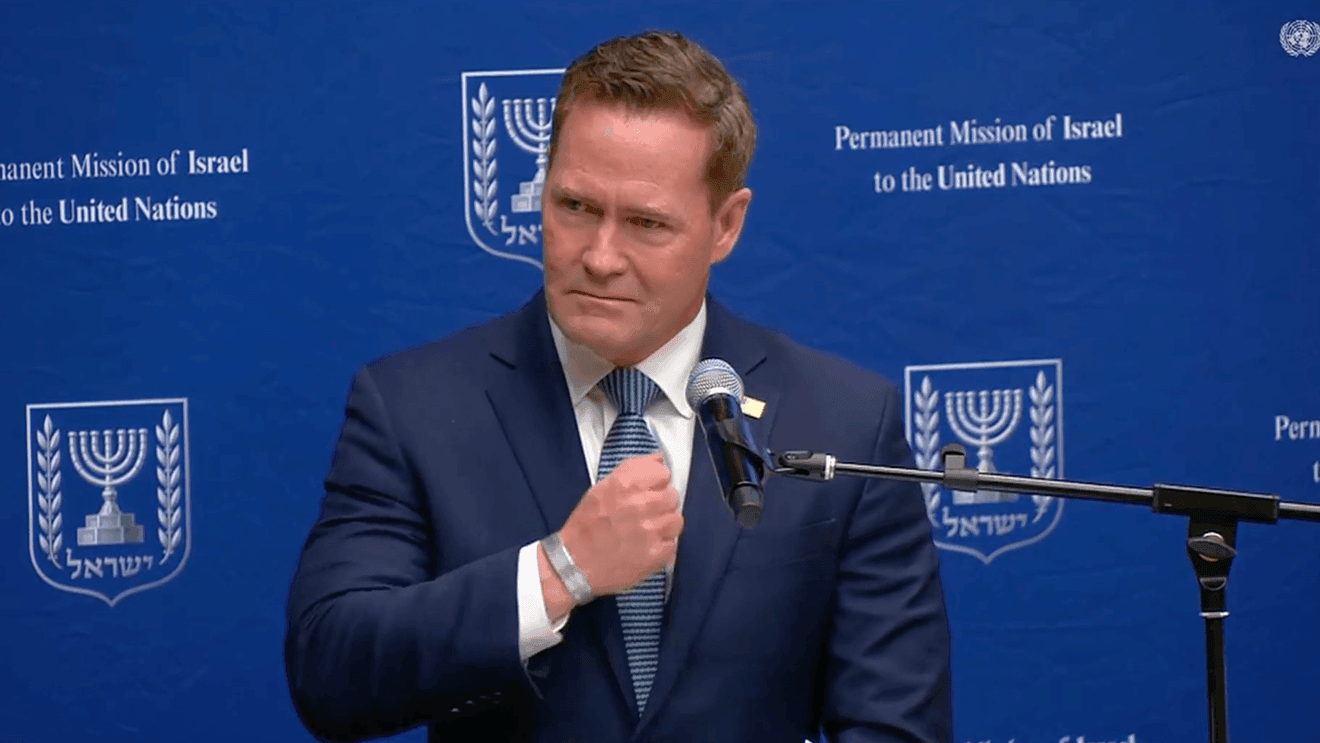
NEW YORK (TNND) — U.S. Ambassador to the United Nations Mike Waltz praised the return of every hostage taken during Hamas’ Oct. 7, 2023, attack on Israel on Tuesday, calling an anniversary commemoration in New York a moment to honor survivors while insisting that the attack must “never, ever happen again.”
Speaking at the U.N. event marking the third anniversary of the attack, Waltz highlighted the stories of former hostages and survivors in attendance, including Eliya Cohen and Ziv Abud. Cohen was held captive for 505 days, Waltz said, while Abud survived the Nova music festival massacre and spent more than a year not knowing whether Cohen was alive.
Waltz said Cohen resisted Hamas attempts to use him in propaganda videos before his release.
He refused. He held firm. He said no,” Waltz said. “You are a proud, strong Jew. You’re undefeated.”
He also remembered Abud’s nephew, Amit, who Waltz said died after repeatedly throwing back grenades Hamas militants had thrown toward civilians at the Nova festival.
The ambassador said the return of the final hostages, including the remains of those killed, marked a sharp change from a year earlier, when he said 48 hostages, including two Americans, remained held in Hamas tunnels.
“The living are back with their families. Those who were sadly murdered are home for a proper burial,” Waltz said.
Waltz credited President Donald Trump with directing administration officials to keep pressing for the hostages’ return. He said Trump remains focused on preventing a return to what he called a cycle in which Hamas rearms and Iran supplies its regional proxies.
October 7th can never, ever happen again, and it will not ever happen again. Certainly not under this president’s watch,” Waltz said.
He pointed to Trump’s 20-point peace plan and said U.N. Security Council Resolution 2803, which he said passed 13-0, provided a framework for a Gaza without Hamas rule, the strip’s demilitarization, an international stabilization force, reconstruction and peaceful coexistence.
“It’s not guaranteed to work,” Waltz said. “But everything we’ve tried in the past was guaranteed to fail and had failed.”
Waltz also argued that Iran and its allied groups had been weakened since the attack and said the Abraham Accords were expanding.
Look, folks, October 7, completely, and I think irreversibly has backfired on Iran and all of their terrorist proxies,” Waltz said.
He cited cooperation between Israel and Arab countries, including the use of Iron Dome technology to protect cities in the United Arab Emirates, as well as growing ties between Israel and Morocco.
Peace is possible. America will stand with the Jewish people,” he said. “The terrorists are on their back foot.”
Television host Dr. Phil McGraw also addressed the gathering, focusing on the lasting psychological toll of the attack and the rise of antisemitism. He said Oct. 7, 2023, was the deadliest day for the Jewish people since the Holocaust and called it a dividing line for Israelis and Jewish communities worldwide.
You don’t just get over what happened on October 7th,” McGraw said. “It can actually change who you are.”
McGraw said he grew up in Texas and Oklahoma without exposure to Jewish culture or Israel, describing himself as a poor Christian child who had never met a Jewish person or learned about the country. Since Oct. 7, he said he has traveled to Israel and met with Israeli leaders, hostage families, released hostages and Holocaust survivors to better understand their experiences.
He also said he had visited college campuses, where he criticized what he called “youthful idiots” who had been “brainwashed by the activists for Hamas and other Iranian proxies.” McGraw said the conversations and travel were meant to help him speak “firsthand” to his audience about the conflict and Jewish communities.
McGraw said trauma can leave long-term effects even after hostages return or families bury loved ones, urging survivors to seek support rather than treating resilience as a reason to ignore pain.
“Being strong doesn’t mean you don’t need help, and getting professional help doesn’t mean you’re weak,” McGraw said. “Therapy can help. Appropriate medication can help. Faith, family, community all can help.”
He said compassion for Israeli victims and for Palestinian civilians did not have to be mutually exclusive, while condemning antisemitism and urging the audience to reject what he described as revisionism about the attack.
“We cannot undo the deaths. We cannot erase what survivors endured,” McGraw said. “But we can refuse to allow the suffering of one population to become an excuse for hatred of another.”