
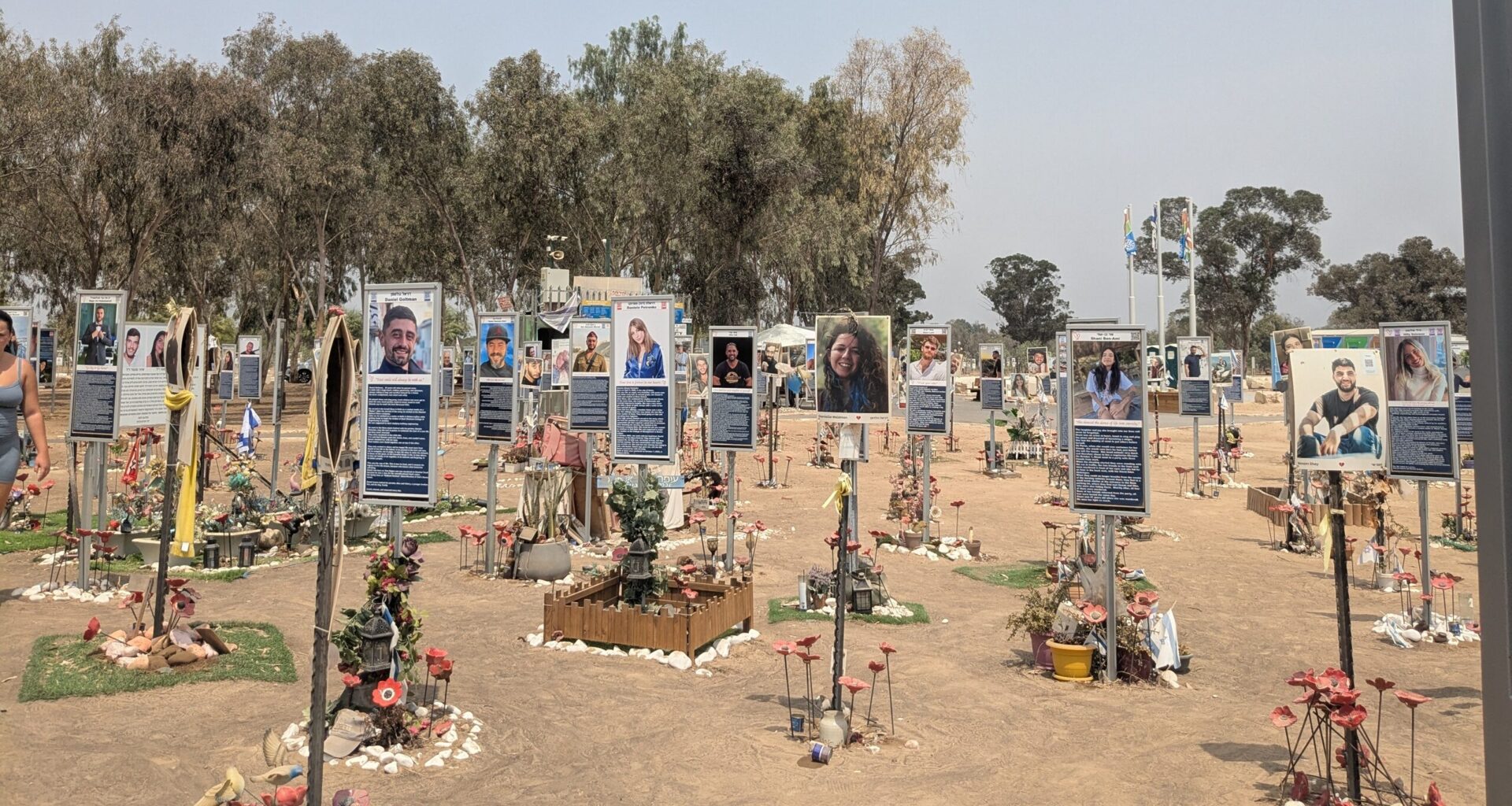
Many Israelis feel that three years after the worst attack on the Jewish state, there are still no full answers. For many, that remains a shock to the system and makes it more difficult to move forward.
Ruby Chen’s 19-year-old son, Itay, was murdered on October 7, 2023, when Hamas attacked the tank in which he was serving. The terrorists then took his body into Gaza, where it was held for 760 days.
Three years later, although the Chen family knows what happened inside the tank that day thanks to its black box, Ruby Chen told The Media Line that it still pains him that so many other questions remain unanswered, including how, “in the love of God, Hamas was … enabled to murder 1,200 people in one day.”
They still do not know how Hamas was strengthened, how the Israel Defense Forces (IDF) failed, what role the government played, and many other specific details about accountability on that painful day because a national commission of inquiry was never formed.
The national commission of inquiry should never have been part of some political calculation
“The national commission of inquiry should never have been part of some political calculation,” Chen said. “It should have been above politics and for the benefit of the families of the victims, as well as to make sure that this does not happen again.”
He continued, “Unfortunately, it has become a tool for politicians, and I think that is the highest level of disrespect that any government official can give to a family that is in grief without supplying them with the answers that they’re looking for.”
The country began a period of mourning over the weekend following the Jewish holiday of Simchat Torah, which marked three years since the Hamas massacre on the Jewish calendar. On Wednesday, October 7, it will mark three years on the secular calendar.
As memorials and state ceremonies are held throughout the country, many Israelis are murmuring—some quietly and others loudly—that three years after the worst attack on the Jewish state, there are still no full answers. For many, that remains a shock to the system and makes it more difficult to move forward.
“It’s in a way more symbolic, and you do need some kind of a closure,” explained Tamar Hermann, a senior research fellow at the Israel Democracy Institute. “Without any kind of inquiry, we will not be able to move forward properly.”
Without any kind of inquiry, we will not be able to move forward properly
However, she said that after IDF reports and investigations, the civil inquiry, and other investigations, many details are better known than people want to admit. The issue, she argued, is therefore more about symbolism and accountability than about uncovering critical new information that could shape the state’s future.
“I don’t think that anyone really expects to have some major facts that we didn’t know about,” Hermann told The Media Line. “The expectation of most people who demand to have such a commission is to find [Prime Minister Benjamin] Netanyahu responsible.”
She said that while she still believes a commission of inquiry should be pursued after the October 27 Israeli election, the demand for such a commission has become political.
“Half of the voters, meaning on the right, will not believe in any report that will be published by what we refer to as a national commission of inquiry headed by whoever from the Supreme Court,” Hermann explained.
On the other hand, anything spearheaded by the government would be difficult for the Left to respect.
“Any commission will be suspect,” she said.
Any commission will be suspect
“We would like to have some kind of executive summary of what happened and why it did happen,” she said. “But we all know the answer to why; it is very political.”
She added that she is concerned that, three years later, an inquiry might not be as accurate as it should be. Some evidence may no longer be available, some papers may have been shredded, and people’s memories may be less clear than they once were.
“So it is more of a statement rather than something that can help us really to prepare better for the future, unless you say that pointing a finger at Netanyahu will change the entire political game,” she said. “But anyway, the anti-Netanyahu camp sees him as responsible without any commission.”
A petition is currently pending before the Supreme Court seeking to force the government to allow the establishment of a national commission of inquiry, as provided for under Israeli law, explained jurist and professor Barak Medina, former rector of the Hebrew University of Jerusalem. However, the court has said it will make no decision on the petition until at least 60 days after a new government is appointed.
Medina explained the government has argued that it would not allow the president of the Supreme Court to appoint the commission because it does not trust the president to select its members. The fact that “the Israeli government explicitly publicly says that they have no trust in the person who holds the highest position in the Israeli judiciary is something that is very troubling,” Medina told The Media Line.
But Hermann, who has been polling the public on trust in government for decades through her role at the Israel Democracy Institute, said the lack of trust between the Right and Left, between the Supreme Court and the government, and in the system more broadly began long before October 7, 2023. She said polls showed trust declining even before the COVID pandemic, and then a big spike during the crisis when the government fell, and Israel entered a period of five elections in roughly three years.
“I can’t say that October 7 did not leave any mark, but it just justified people’s sense that something is wrong with the system,” Hermann said.
Medina noted that an inquiry is nonetheless needed. On the one hand, he said, Israel needs to understand what went wrong within the military and government before that fateful day so that the same failures are not repeated. On the other, he argued that a commission should examine how the war itself was conducted by the IDF, including allegations by international bodies concerning war crimes and harm to civilians.
“We have no argument by Israel that is not produced by the army or by the government, but by an independent body of inquiry” to the accusations being leveled against Israel, Medina said. “I think it harms us a lot. It harms us in the international tribunals in The Hague. It harms us in the informal sanctions against Israel, such as an academic boycott, economic boycott, cultural boycott. And of course it harms us internally, morally speaking, as we don’t really know what the policies were.”
But will the failure to establish an inquiry before the October 27 election affect the results? Medina said he does not believe it will.
According to him, “people already formed their opinions even without a committee and, unfortunately, I would say that most people formed a decision regarding Netanyahu regardless of the findings of any committee.”
He said Netanyahu’s refusal to allow such a committee suggests the prime minister believes its findings could work against him.
Dr. Dan Diker, president of the Jerusalem Center for Security and Foreign Affairs, said he believes that once the election is over, a commission of inquiry will be established, regardless of who wins, including if Netanyahu is reelected.
“It’s gonna be at the top of the national schedule,” Diker maintained.
However, he told The Media Line that Israel’s current position should also be kept in perspective. In his estimation, the country is considerably stronger than it was on October 6, 2023. Not only are all the hostages home, but Israel controls much of Gaza, has an agreement with the Lebanese government, and the Iranian regime is on the cusp of collapse. Therefore, he cautioned that people should consider Israel’s broader position as the country commemorates the massacre and moves toward election day.
Chen disagrees. He said it is “highly unfortunate” that Netanyahu was unable to bring citizens together after October 7 and move the country forward by understanding what happened for the good of the country, rather than focusing on his own political or personal needs.
What was required, Chen said, was “thinking about the betterment of this country and its people, looking ahead 20, 30, 40 years and what is required for us to begin our rehabilitation, not just us, the families of the victims, but the country as a whole.”
For Chen, however, the question of an inquiry is ultimately less about politics than about ensuring that the lessons of his son’s death, and the deaths of so many others, are not lost.
I want to look at ways to make sure that our son’s sacrifice was not in vain
“I want to look at ways to make sure that our son’s sacrifice was not in vain,” Chen concluded. “How do we prevent other families from needing to go through the same type of tragedy that we needed to go through? If we go back to additional cycles of violence, then what happened on October 7 suddenly has no meaning.”