
The billions of shekels the state has paid in compensation for damage since October 7 tell part of the story of the past three years. They reflect destroyed buildings, burned vehicles, businesses that were forced to shut down or lost revenue, and an economy that has learned to operate under fire.
Updated data from the Tax Authority, covering three years of fighting across the “Swords of Iron,” “Rising Lion”, and “ Roaring Lion” campaigns, reveal an unprecedented price tag: NIS 38.6 billion ($12.7 billion) paid to date on approximately 1.18 million claims for direct and indirect damage. The figure is equivalent to roughly 39% of all households in Israel. While claims can be filed by businesses and a single individual may submit multiple claims, the ratio illustrates the vast economic exposure created by the war.
To grasp the scale of the compensation, it is useful to look back at previous conflicts. During the Second Lebanon War, compensation for damage totaled approximately NIS 3.67 billion ($1.2 billion), while Operation Protective Edge saw payouts of about NIS 1.66 billion ($544 million). In nominal terms, the compensation paid since October 7 is therefore more than ten times the amount paid during the Second Lebanon War.
1 View gallery
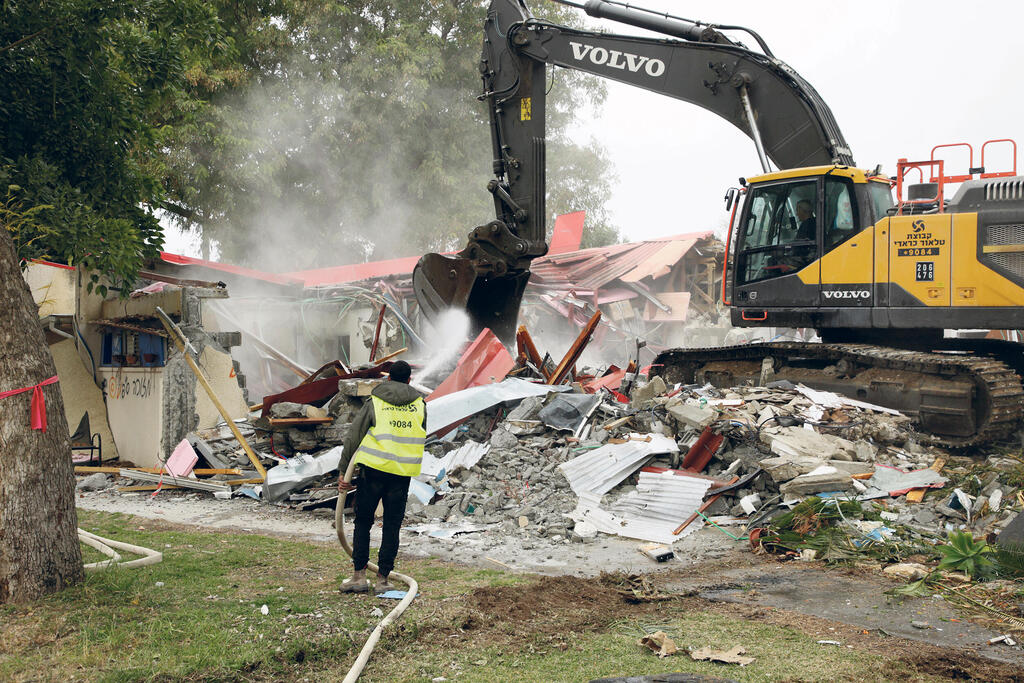
Reconstruction in Beeri.
(Photo: Reeyan Preuss)
Meanwhile, the balance of the Compensation Fund, administered through Property Tax, has fallen from NIS 17.7 billion ($5.8 billion) on the eve of the war to NIS 3.1 billion ($1.02 billion) today, a drop of more than 80%, despite the billions of shekels injected into the fund during this period.
A chronological breakdown of compensation payments illustrates how the nature of the damage evolved. “Swords of Iron” was characterized by widespread disruption to business activity, driven by factors including the evacuation of communities, extensive reserve call-ups and operational restrictions. As a result, NIS 22.4 billion ($7.3 billion) was paid for indirect damage, including lost revenue and other financial losses, compared with NIS 3.3 billion ($1.08 billion) for direct damage. A significant portion of the direct damage occurred on October 7 itself and in the immediate aftermath.
In “Rising Lion”, the picture was reversed. It was the only one of the three campaigns in which compensation for direct damage exceeded compensation for indirect damage, at approximately NIS 4 billion ($1.31 billion) versus NIS 2.9 billion ($951 million).
In “Roaring Lion”, indirect economic damage once again dominated, amounting to roughly NIS 5 billion ($1.64 billion).
The distribution of indirect damage also reveals significant disparities. In the Gaza Envelope, only about 12,400 claims were filed, but the average compensation per claim reached approximately NIS 186,000 ($61,000). The figure reflects the severity and duration of the impact on the region, as well as the “Red Track” mechanism, which allows businesses in border communities to receive more extensive compensation for the economic damage they sustained.
Along the northern border, more than 63,600 claims were filed, with average compensation of approximately NIS 64,300 ($21,100) per claim, reflecting the prolonged disruption to business activity throughout the war.
In the rest of the country, more than 930,000 claims were filed, but average compensation was significantly lower, at approximately NIS 25,700 ($8,400) per claim.
For direct damage, approximately NIS 6.37 billion ($2.09 billion), or 77% of total direct-damage compensation, was paid for structural damage across some 114,000 claims. An additional NIS 613 million ($201 million) was paid for 37,000 claims involving vehicle damage.
The geographic distribution of damage also shifted over the course of the war. The Ashkelon area, which accounted for a significant share of damage claims in the south, was the primary source of claims at the start of the war. Over time, however, the Tel Aviv area surpassed it in cumulative figures, recording approximately 62,800 direct-damage claims compared with about 61,100 in Ashkelon.
Some 77% of the claims filed at the Tel Aviv center were recorded during the two campaigns against Iran. The centers in Acre, Tiberias and Kiryat Shmona accounted for a combined total of approximately 42,700 additional claims.
The final tally is not yet in. More than 40,600 claims for indirect damage are currently being processed, with some 35,500 of them, or about 87%, related to “Lion’s Roar.”
Against the backdrop of a Compensation Fund balance of just NIS 3.1 billion ($1.02 billion), the outstanding claims underscore that even three years after October 7, the economic bill from the war continues to mount.