
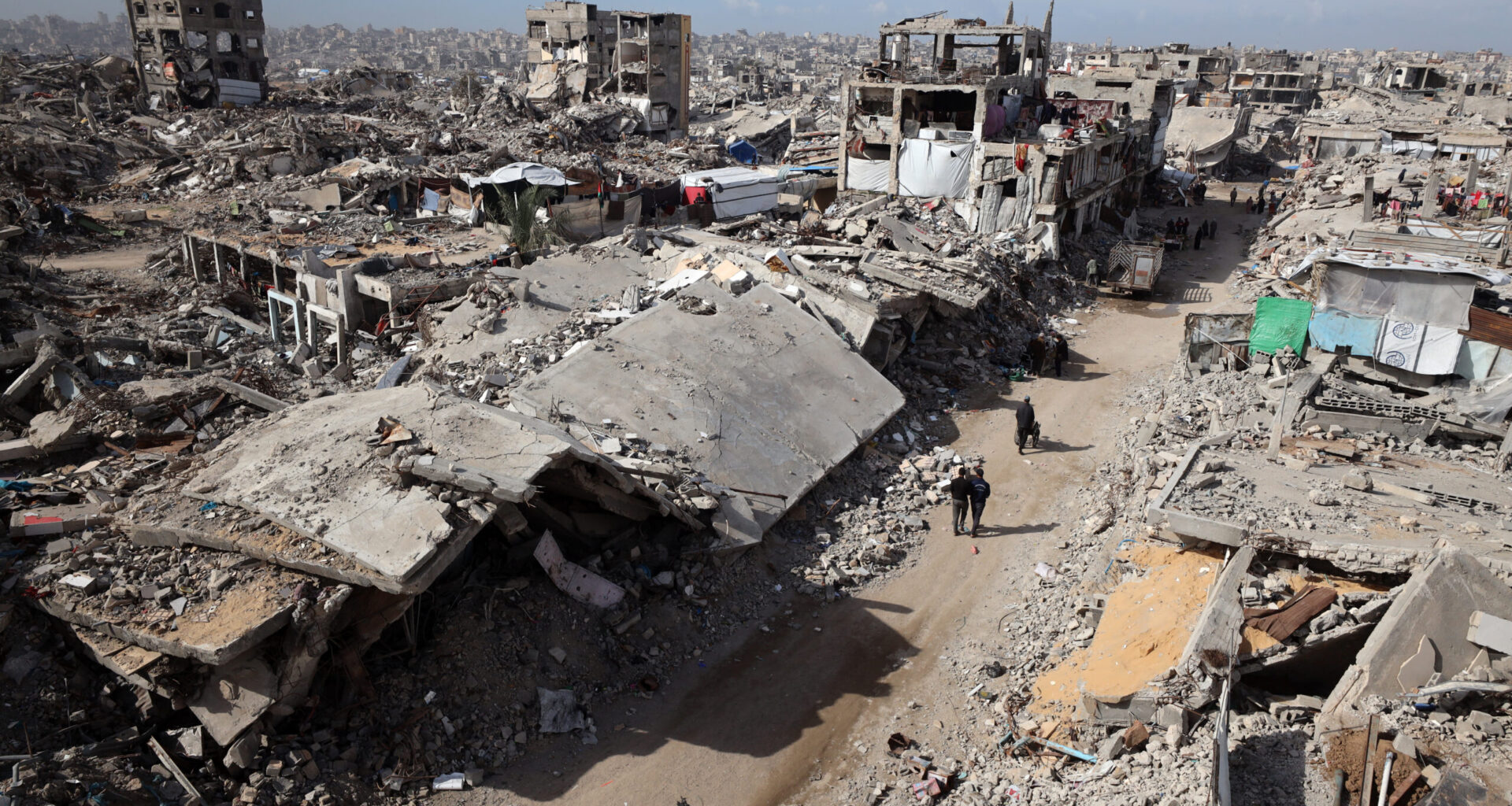
A group of 73 military leaders is pushing back against allegations that Israel has committed genocide in Gaza, arguing in a letter released Wednesday that the accusation is unsupported by the legal standard for genocide and contradicted by the conduct of the Israeli military during the war.
“As retired senior military leaders and legal experts, on this, the third anniversary of Hamas’s October 7, 2023 brutal attack on Israel, we reject claims that Israel committed genocide in Gaza,” the letter, released by the Jewish Institute for National Security of America, says. “The allegations that Israel committed this crime do not meet the established definition and standards of genocide, are unsupported by established facts, nor do they stand up to common sense scrutiny.”
The signatories argue that a finding of genocide requires evidence that a protected national, ethnic, racial or religious group was targeted for destruction, in whole or in part, and contend that Israel’s actions in Gaza do not meet that standard.
“Israel has neither intended to, nor destroyed, Palestinians as a group in Gaza,” the letter reads. “All the evidence, in fact, points to the contrary conclusion: that, after suffering a barbaric, indiscriminate massacre by Hamas terrorists on October 7, 2023, the Israel Defense Forces (IDF), acting in justified self-defense, went to extreme lengths to protect civilians in Gaza, including from Hamas.”
The authors also dispute arguments that the number of civilian deaths establishes genocide, saying casualty figures from Gaza are unreliable.
“Genocide is not a quantitative crime; there is no number of civilian casualties that constitutes genocide,” the letter says. “Nor are the claimed casualty numbers from Gaza credible. Issued by Hamas themselves and, at the very least, not distinguishing between civilians and combatants, they cannot be relied upon.”
They argue that the war must be viewed in the context of fighting an enemy that operates among civilians, drawing on their own experiences commanding U.S. forces in similar combat environments.
“We understand that the loss of civilian life in Gaza is tragic, but we also know that such tragic outcomes do not necessarily violate the law of armed conflict,” the letter says. “Further, established legal precedent makes clear that civilian deaths occurring during combat, however tragic, are insufficient, by themselves, to support a finding of genocidal intent.”
“Many of the signatories to this letter have commanded United States armed forces in combat against enemies who regularly hide behind civilians and put those civilians intentionally in harm’s way,” the letter continues. “Fighting under those complexities is especially difficult.”
The letter then points to the extensive measures taken by the IDF to reduce civilian casualties as evidence that the military took precautions and lacked genocidal intent during its operations in Gaza.
“The IDF has provided civilians with numerous advance warnings, leaflets, phone calls, text messages, radio and TV broadcasts, and social media notices, evacuation instructions, protected corridors, and tactical pauses to help move them out of harm’s way,” the letter says. “Repeatedly, Israel has called off strikes because of the presence of civilians.”
The authors also cite Israel’s provision of humanitarian and medical assistance to Gaza as evidence that its conduct is inconsistent with an intent to destroy Palestinians as a group.
“More than 3.5 million tons of food, 48,000 tons of medical supplies, 5,000 tons of baby food, and up to 15,000 cubic meters per day of water desalinated by Israel have been sent into Gaza,” the letter says. “Over half a million Gazan children were vaccinated during the war and some 5,000 Gazans evacuated for medical treatment abroad.”
“These are not the actions of a genocidal state but of a professional military ethically and legally committed to the protection of civilian life,” the authors add.
They condemned “inflammatory statements” by some Israeli political officials that have been cited as evidence of genocidal intent, while arguing that those remarks do not reflect the conduct of the Israeli military. The letter did not point to any specific officials, though leaders including former Israeli Defense Minister Yoav Gallant, Finance Minister Bezalel Smotrich and National Security Minister Itamar Ben-Gvir have been accused of such incitement.
“Such inflammatory statements are disgraceful,” the letter says. “Yet, while it deserves unequivocal condemnation, rhetoric from politicians uninvolved in military decision-making is in no way reflective of actual IDF operations.”
The signatories warn that how the Gaza war is judged could affect the way the U.S. and its allies conduct future conflicts, urging readers to apply what they describe as the established legal standards of the 1948 genocide convention.
“Failure to do so incentivizes future adversaries to deliberately endanger civilians and then exploit civilian suffering to portray lawful operations as genocide, weaken public support, and divide our alliances,” the letter says. “The precedent established today regarding Israel will shape the conditions under which American forces fight tomorrow.”