
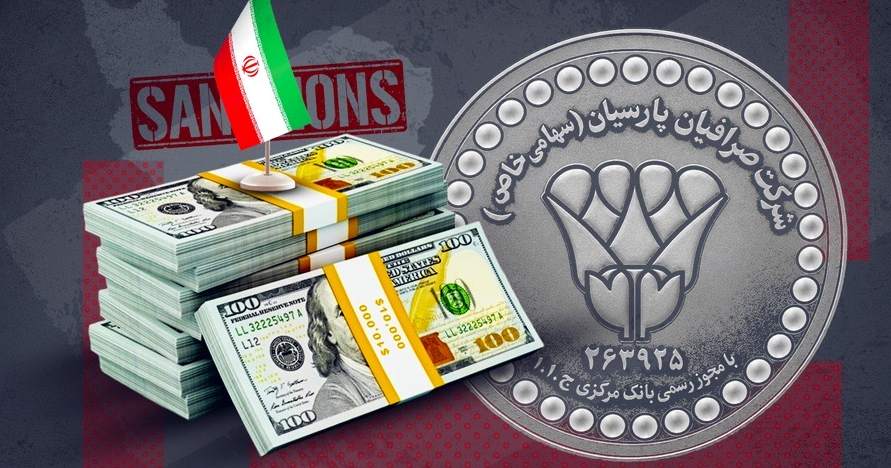
The documents, covering the period from November 2022 to May 2023, show how Iran’s central bank and other financial institutions used Parsian Exchange, also known as Sarrafi Parsian, to facilitate payments outside Iran.
The transactions involved multiple layers of banks, companies and individuals, according to the records.
Bank Parsian is a private-sector Iranian bank that the US Treasury designated in October 2018, in an action against a network of companies financing the Basij paramilitary force.
The correspondence shows that four years after the designation, Bank Parsian was still arranging international payments through layered channels.
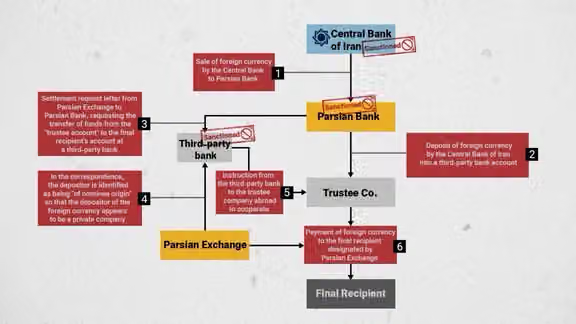
In most cases, no foreign currency actually left Iran. Foreign currency proceeds from oil, petrochemical and other exports were held in accounts overseas. At Bank Parsian’s instruction, Parsian Exchange transferred funds held in those accounts to overseas bank accounts designated by Iranian importers.
But the payments did not appear to come from the Iranian government, sanctioned banks or the Central Bank of Iran (CBI). Instead, they appeared to originate from private companies, with Parsian Exchange acting as an intermediary.
The process
In a typical transaction documented in the files, an Iranian importer—such as carmaker Iran Khodro—sought foreign currency from the CBI to pay a supplier overseas.
The CBI sold the foreign currency to Bank Parsian, according to the documents. The funds were then held at another Iranian bank in an account belonging to a separate individual or company, described in the records as a “trustee”.
Many of the accounts identified in the documents were held at banks in the United Arab Emirates, China and Hong Kong.
The documents show that, by structuring the transactions through these layers, Parsian Exchange obscured the money trail.
In August 2025, the US Treasury said Parsian Bank secretly owned Cyrus Offshore Bank and had used it in 2021 to route Iranian oil revenues to the IRGC.
Iran International found no evidence that the banks in the UAE and China knowingly facilitated Iran’s efforts to circumvent US sanctions.
Bank Parsian and Parsian Exchange did not respond to Iran International’s requests for comment.
People behind the letters
Parsian Exchange is a subsidiary of Bank Parsian. The bank directly owns 90% of the company, with the remaining roughly 10% held through Parsian Financial Group, its investment arm.
Iran International identified 33 instruction letters in the leaked documents that directed the movement of UAE dirhams, Chinese yuan and US dollars, with a total value of roughly $36 million.
Almost all the letters were signed by Alireza Alaei, Bank Parsian’s head of international affairs. He joined Parsian Exchange’s board as vice chairman in early 2020 and has served as chairman since mid-2020.
Many of the letters were addressed to Rasoul Salehi Oskouei, Parsian Exchange’s chief executive. Official records show he joined the company’s board in early 2018 and has served as vice chairman and chief executive since early 2020.
Salehi Oskouei had also served at another bank-owned exchange company. More than 12 years before joining Parsian Exchange, he sat on the board of Sepehr Exchange, an affiliate of Bank Saderat, from early 2006 to mid-2008
A review of Parsian Exchange’s current and former executives shows a recurring pattern of ties to Bank Parsian and Setad, the economic conglomerate controlled by Iran’s supreme leader.
Alaei joined the company’s board in early 2020 as a representative of Tamin Andish Pars, a Bank Parsian affiliate, and remains on the board. He also served on the board of Parsis Kish starting in 2015, representing Parsian Insurance.
Hesam Shams Alam, who served on Parsian Exchange’s board from 2010 to 2014, had also sat on the board of Bank Parsian. In 2013, he joined the board of Tadbir Investment Group as a representative of Tadbir Industry and Mine Development, an affiliate of Setad.
Instructions for payments
The letters follow a consistent pattern. Alaei sent them to the international departments of other Iranian banks, including Saman, Shahr, Eghtesad Novin, Tourism Bank, Bank Melli and Bank Mellat, all sanctioned by the United States.
The letters were typically sent about 10 days after the banks purchased foreign currency from the Central Bank of Iran. In its letters to the other banks, Bank Parsian said the foreign currency had been “purchased from the central bank” and was being held “in a trustee account” at the recipient bank.
This is where Parsian Exchange came in. Bank Parsian asked the third-party bank to transfer the funds through Parsian Exchange to the ultimate beneficiary.
The subject line of each letter described the funds as being transferred via an intermediary, meaning the payment abroad was made in the name of a private individual or company rather than an Iranian bank or the state.
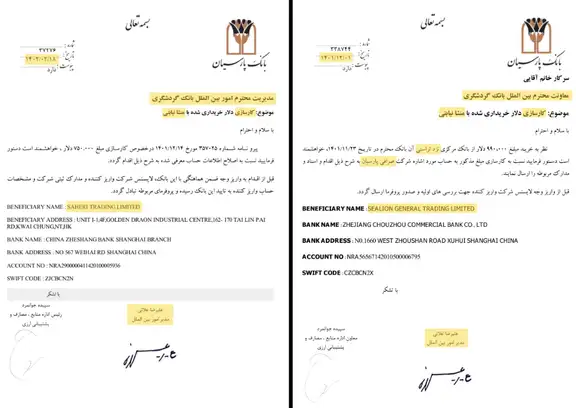
In a letter dated early 2023, Alaei sent a letter to the international division of the Tourism Bank. He asked the bank to transfer $990,000 held in a trustee account to an account belonging to SEALION General Trading Limited. A review of public records shows the company was active in Hong Kong.
In May 2023, Alaei asked Tourism Bank’s international affairs division to transfer $750,000 to an account held by SAHERI TRADING LIMITED, also registered in Hong Kong.
Bank-owned exchanges
More than 500 licensed exchange companies are currently registered in Iran, 28 of them owned by banks.
By revenue, Parsian Exchange ranks second among them.
Adjusted to September 2026 prices, Melli Exchange, affiliated with Bank Melli, reported annual operating revenue of 1,253 trillion rials. Parsian Exchange ranked second with 1,168 trillion rials, followed by Omid Sepah Exchange, affiliated with Bank Sepah, with 1,129 trillion rials.
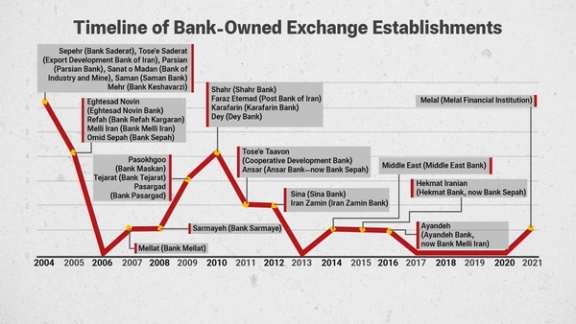
Iranian banks began setting up exchange companies more than two decades ago.
Sepehr Exchange, owned by Bank Saderat, was the first exchange company established by an Iranian bank on 25 July 2004. Parsian Exchange followed two weeks later.
Sepah, the state-owned bank with long-standing ties to the armed forces, owns three separate exchange companies. Bank Melli also operates Melli Exchange.
Sanctions
Parsian Exchange has never been named on the US sanctions list. Under US rules, however, a company owned 50 percent or more by a sanctioned entity is automatically covered by the same sanctions, so US persons are already barred from dealing with it.
In April 2026 the U.S. Treasury sanctioned a company it identified as Bank Parsian’s “rahbar”—a private firm that manages the bank’s overseas payments—and in July 2026 an exchange house it said had contracts with the bank.
The United States has targeted bank-owned exchange companies since 2008, when it sanctioned the exchange arm of the Export Development Bank of Iran.
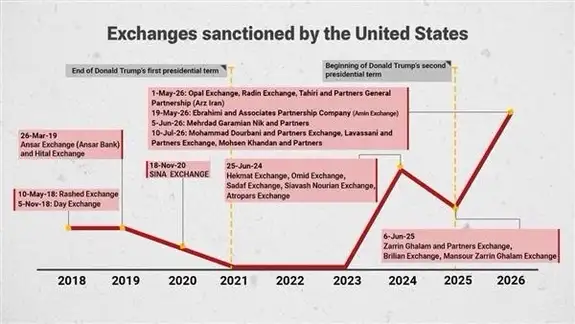
For about a decade, no new sanctions were imposed targeting exchange companies linked to the Islamic Republic until 2018.
By September 2026, the United States had sanctioned a total of 20 exchange companies based in Iran, including six bank-owned exchanges: Export Development Exchange, Dey Exchange, Sina Exchange, and Hekmat Iranian, Ansar and Omid exchanges, all three of which are subsidiaries of Bank Sepah.
More than three years after Joe Biden took office as president, Washington sanctioned five Iranian exchange companies on June 25, 2024: Hekmat Iranian Exchange, affiliated with the former Hekmat Iranian Bank; Omid Exchange, affiliated with Bank Sepah; Sadaf Exchange; Siavash Nourian Exchange; and Atropars Exchange.
It was the largest round of sanctions targeting Iranian exchange houses since Trump left office.
After Trump returned to the presidency, a new wave of sanctions on Iranian exchange houses began in 2025. By September 2026, the United States had sanctioned 11 more exchange houses.