
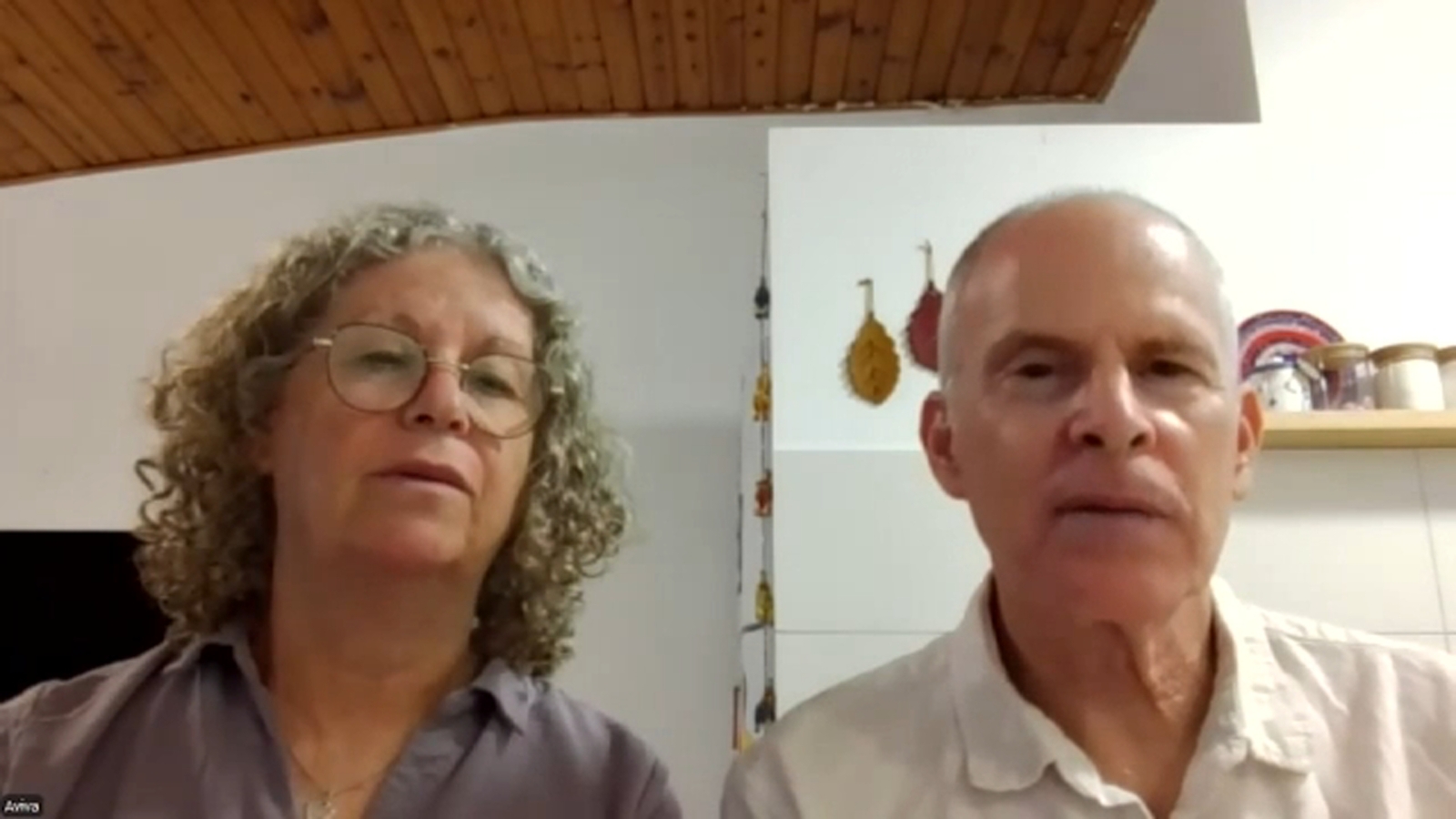
NORTH CAROLINA (WTVD) — Three years after the October 7 attacks in Israel, former hostages Keith and Aviva Siegel are sharing their experiences in captivity and reflecting on the lasting impact of a day that changed their lives.
“Around 15 armed terrorists broke into our house and brutally forced us through the window of the back of our house. Aviva’s knee was injured. Her meniscus was torn. My ribs were broken. They shot at us. I was injured, hit by one of the bullets. They kidnapped us in our car at gunpoint, holding knives in front of us and aiming weapons at us,” said Keith Siegel.
The couple was among the 251 hostages taken during the attacks, in which Hamas militants killed more than 1,200 people, marking the deadliest day for the Jewish people since the Holocaust.
“(Aviva and I) both experienced violence and abuse and horrific living conditions,” Keith Siegel said. “Lack of hygiene, lack of food, water, lack of air to breathe. We were held in a tunnel. We were gasping for breath. Literally huffing and puffing because we were so deep underground in the tunnel, we literally touched death.”
Aviva Siegel was released after 51 days as part of a temporary ceasefire agreement. She spent the following months advocating for the release of the remaining hostages, including her husband.
“I came back and fought for Keith and tried to spread the truth all over the world. I used to go and walk around and see so many people standing up for Hamas. I just wanted to say to them, ‘you don’t understand what you are standing for, because they are just even so mean to their own people,'” said Aviva Siegel.
Keith said he was initially told he would be freed shortly after Aviva’s release, though that did not come to fruition. He would remain in captivity for a total of 484 days, a period which he was moved often within Gaza, including held at a school and in the home of a family with young children present. He said his captors provided no information about Aviva or his family’s condition.
“For almost two weeks, I was only allowed to go to the to the toilet twice a day, because we had to go down three flights of stairs outside to the toilet, and the school was full of people and they said I could only go to the toilet when it’s dark because people might recognize me,” Siegel said.
“I have a feeling that Hamas used the children,” Aviva Siegel said. “They didn’t really care about the families and the children. They let them be in the middle of a war.”
Keith Siegel’s release came as a result of a deal brokered in part by the Trump administration. Images of a frail Siegel being paraded on stage by the terrorists who held him captive made international headlines, though he worked to assuage his family’s concern.
“I was thinking I must make it clear to them that fine. I’m the same Keith that I was 484 days prior to that. But I was worried about them worrying about what condition I am in physically and mentally. I was really, really focused on trying to convey that to them,” said Keith Siegel.
“I’ll always carry this feeling of being lucky,” Aviva Siegel said. “Lucky that Keith is next to me. That he’s alive, that he came back.”
Upon his release, they continued to advocate for the remaining hostages to be freed.
“Four of my friends remained in captivity for a total of 738 days. There were among the last 20 live hostages released. I was having a very, very hard time dealing with the fact that I was released, and they remained behind,” Keith voiced.
Despite their release, both said the emotional effects remain.
“It’s like a heaviness of feeling for others, and it’s also a heaviness of what we’ve been through, and our kids went through, and the grandchildren and families,” Aviva Siegel said. “And it’s also feeling lucky that Keith is here with me.”
Keith Siegel said he continues to think about those who did not survive.
“I think a lot about those that we lost,” he said. “And it’s hard for me to think about them. I mean, we were fortunate and we are grateful to be back alive. But so, so many didn’t get that and my heart goes out to them.”
Aviva says the mental anguish lingers three years later.
“I’m carrying what happened in Gaza all the time. I’m triggered by so many things that I think nobody would even imagine. If it’s a noise that happens suddenly, I’ll jump or an airplane that comes by, I’ll get worried (even though) I know that nothing will happen to me. Waking up in the middle of the night having a dream again that Keith and I are kidnapped,” said Siegel.
She says those feelings extend to family.
“Looking at my grandchildren and thinking that’s what they went through when Keith and I were in captivity this terrible, terrible time that they’re carrying. One of my grandchildren is very, very scared that terrorists might come to his house, even though we can tell him again and again that it won’t happen to him because he’s in a safe place. You can’t wipe something like what happened to us and just take it out of our feelings,” said Siegel.
He said sharing his story remains important.
“I feel like it’s my responsibility to tell my story because there’re not a lot of hostages that came back alive and are able to do that,” Keith Siegel said.
Keith grew up in Chapel Hill, before he moved to Israel when he was 20 years old. Following his release, he visited his former synagogue, Beth El Synagogue in Durham, with Aviva and his brother Lee where he discussed his experience.
“My parents were very, very involved in Beth El Synagogue. My father passed away many years ago, (but) until he passed away that was a very, very meaningful, part of his life – Beth El Synagogue and Judaism. My mother was the first woman that became president of Beth El Synagogue. My mother was very, very active in Beth El. Beth El was very, very important, meaningful and a huge part of her life. She was loved by so many people in the synagogue and in the community, not only Jewish, but the community of Chapel Hill, by being such a giving, caring person. It was very special and very moving, and I’m very, very grateful to have had that opportunity,” Siegel said.
As the anniversary is marked, Aviva Siegel is also releasing an English-language edition of her book, Survived to Tell, which documents the family’s experience.
Copyright © 2026 WTVD-TV. All Rights Reserved.