
Direct government war-related expenditures through the end of 2025 totaled NIS 231 billion ($75.7 billion): NIS 166 billion ($54.4 billion) for defense, NIS 27 billion ($8.9 billion) in compensation for direct and indirect damages, and another NIS 38 billion ($12.5 billion) categorized as “miscellaneous civilian expenses.” Yet this figure is far from complete. It excludes tens of billions more that have already been, and will continue to be, spent under the 2026 budget.
For instance, total compensation paid to date stands at NIS 38.6 billion ($12.7 billion), according to figures announced yesterday by the Tax Authority. This figure excludes lost tax revenue, estimated at approximately NIS 40 billion ($13.1 billion) through the end of 2025. It also excludes lost economic output, meaning the GDP the Israeli economy would have generated had there been no war. The Bank of Israel estimates that loss at NIS 177 billion ($58.0 billion) through the end of 2025.
These are figures that are difficult to fully grasp. Yet the real challenge is not understanding the magnitude of what has already been spent, but understanding the impact it will have on our lives in the years to come.
1 View gallery
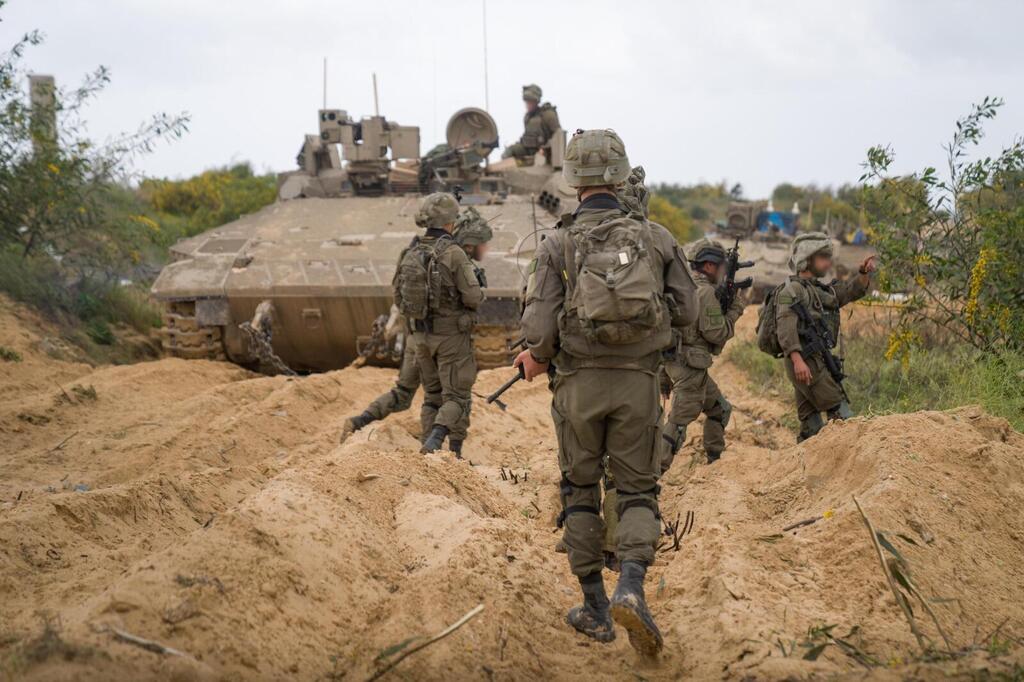
IDF in Gaza
(IDF Spokesman’s Office)
According to a calculation by the Bank of Israel in April 2026, the total cost of the war reached NIS 405 billion ($132.8 billion). Just how massive is that sum? It is enough to build the Gush Dan Metro, even after its estimated cost rose to NIS 185 billion ($60.7 billion), as well as the Jerusalem and Gush Dan light rail networks. There would still be money left to develop the electricity transmission grid, build desperately needed desalination plants, extend Highway 6 northward, electrify Israel Railways, construct a railway line to Eilat, and build an additional airport to supplement Ben Gurion Airport. With the remaining funds, it would even be possible to relocate the Haifa oil refineries and build two or three large hospitals in the periphery.
In short, the cost of the war could have been used to transform Israel’s transportation, water, and healthcare infrastructure.
And to make the figure even more tangible, if the money the war has cost were distributed among the public, every family would receive more than NIS 130,000 ($42,600).
There are two problems with these illustrations. First, it is not certain that they produce a genuine “wow” reaction. The figures remain somewhat abstract. It is difficult to imagine what might have been, or to mourn the loss of an unfunded Metro project, when we are likely to build it anyway. Second, what is the value of discussing money that has already been spent?
There is a twofold answer.
First, vast sums have yet to be spent. These include long-term compensation for people harmed by the war and the massive expansion of the defense establishment driven by new security doctrines.
Second, the hundreds of billions we have already spent were not, in effect, money that we had sitting in a bank account. We have not yet fully paid for them. We will do so in the years ahead. That is why we need vivid illustrations and concrete figures to understand how the war has changed, and will continue to change, our economic standard of living.
Israel’s defense spending is projected to rise by tens of billions of shekels a year. While the precise figures are disputed, it is clear that the increase is likely to be at least NIS 40 billion ($13.1 billion) annually compared with the pre-war period, when the defense budget was less than NIS 70 billion ($23.0 billion) a year.
Interest payments on the additional debt have also risen sharply, by tens of billions of shekels. The precise figure remains uncertain, but if we assume that the war has increased public debt by NIS 200 billion ($65.6 billion), then at an annual interest rate of 5%, the additional interest burden would amount to NIS 10 billion ($3.3 billion) a year.
Beyond these new fixed costs, there will be spending on reconstruction in the north and south, as well as compensation for affected civilians. Compensation for soldiers is included in defense spending. These costs are likely to amount to several billion shekels annually for the next 10 to 20 years.
These figures do not really mean much until we realize that the NIS 65 billion to NIS 70 billion ($21.3 billion to $23.0 billion) required annually for additional defense spending, reconstruction, and interest payments must ultimately come from us or our children.
In other words, we will either pay higher taxes, receive fewer services from the state, or leave our children with higher taxes to pay.
Let’s assume we want to “streamline” government spending and fund all the additional interest payments and security costs by cutting what might be described as unnecessary or controversial government expenditures.
Suppose we eliminate all coalition funds, close unnecessary ministries, and abolish child allowances altogether. Even that would yield only about NIS 15 billion ($4.9 billion).
If we also eliminate the tax benefit on advanced training funds, effectively raising taxes on the middle class, and halve municipal tax discounts, we would reach only about NIS 27 billion ($8.9 billion).
To raise another NIS 30 billion ($9.8 billion), we would have to cut deeper and deeper into government spending, eliminate additional tax exemptions, and reduce welfare, education, and healthcare services. For example, reducing the school week to four days and increasing class sizes to 40 or 50 students could save another NIS 5 billion ($1.6 billion) a year. We could also reduce the allowances paid by the National Insurance Institute to the elderly, sick, and disabled.
It is unlikely that such measures would be implemented overnight. They would be extremely difficult to enact, and rightly so. Yet after years in which Israelis had grown accustomed to improvements in healthcare, education, and welfare, that trajectory is now likely to change in the wake of the war.
Part of the cost of the war will be a slower expansion of the basket of subsidized medicines and slower improvements in teacher quality and salaries, if those improvements happen at all.
The government could also choose to defer the problem to the next generation by increasing the deficit. That is a dangerous path if taken too far, and there are limits to how much additional debt the country can sustain. Israel can rely on international markets to finance its deficits to some extent, but not indefinitely. Investors need to see a credible plan for reducing public debt.
It is also worth remembering that the tens of billions of shekels required annually in the aftermath of the war come on top of billions already cut from government budgets and tax increases on the Israeli public totaling NIS 37 billion ($12.1 billion) a year.
Consider, for a moment, the one-percentage-point increase in VAT. That amounts to roughly NIS 1,000 ($328) a year for an average family. There is currently no clear prospect of VAT returning to 17%. On the contrary, it may have to rise further, potentially costing the same family another NIS 1,000 ($328) a year.
That family could also face reduced municipal tax discounts and a more limited basket of subsidized medicines, while knowing that its children will be paying part of the war’s cost decades from now.
Is there a bottom line to all this? Not exactly. There is more than one way to look at it.
One person might conclude that Israel needs to scale back the welfare state. Another might argue that the figures highlight the urgency of integrating the ultra-Orthodox and Arab women more fully into the economy.
Yet there is one conclusion that should be difficult to dispute: this troubling picture demands a competent civil service and reasonably capable elected officials.
Many nations have won wars only to lose the peace that followed. Israel is already deep into that “day after,” even if we sometimes fail to notice it.