
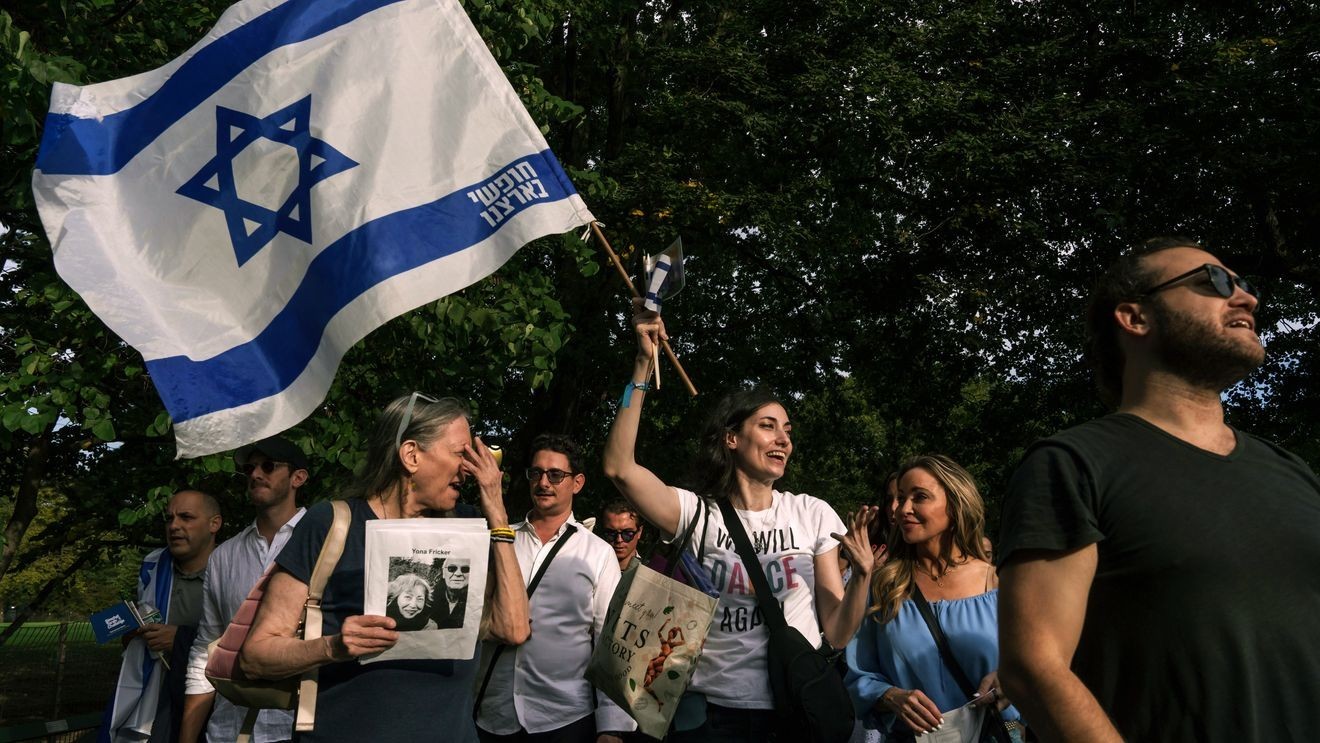
Israelis are marking three years since the Hamas-led Oct. 7 attack that killed roughly 1,200 people and saw 251 others taken hostage, as the country continues confronting the trauma and security consequences of the deadliest attack in its history.
On Oct. 7, 2023, Hamas-led militants crossed into southern Israel from Gaza, attacking communities, military installations and the Nova music festival. More than 350 people were killed at the festival alone. The assault triggered a war that has reshaped Israel, Gaza and the wider Middle East.
Three years later, Israelis gathered Wednesday to remember those killed and reflect on the attack’s lasting impact.
Former Shiloh Mayor David Rubin joined The National News Desk to discuss how Israeli communities have responded to the trauma and what he believes Americans should understand about the country’s resilience.
“Israeli people are very resilient people,” Rubin said. “We may suffer. We may hurt. We may mourn. But we don’t cave.”
“When it’s time to stand up, we step up to the plate,” he added.
Rubin said the scale of the Oct. 7 attack inflicted lasting trauma across Israeli society.
“After October 7th, after that horrible, horrible massacre … it was such a traumatic experience for Israel,” Rubin said. “But we bounce back.”
The anniversary comes after three years of war and dramatic changes across the region.
Israel’s military response devastated large portions of Gaza and has killed more than 74,000 Palestinians, according to Gaza’s Health Ministry, whose figures do not distinguish between civilians and combatants. Most of Gaza’s population has been displaced, and large numbers of Palestinians continue to live in tent camps and damaged communities.
The conflict also expanded well beyond Gaza, drawing in Hezbollah in Lebanon, the Houthis in Yemen and ultimately Iran itself. The United States became directly involved militarily as the regional conflict escalated.
Rubin said security awareness has long been ingrained in everyday Israeli life.
“We’ve always been very security conscious,” Rubin said.
He recalled noticing the difference after moving to Israel from the United States roughly 35 years ago.
“In the United States, when you leave a department store, your bags are going to be checked,” Rubin said. “In Israel, when you go into a department store, your bags are going to be checked because they’re looking for bombs.”
Rubin said Israel’s response to terrorism operates on two levels.
“We bounce back militarily, standing up for our country and our very survival,” Rubin said. “And the second way we stand up is through our self-help projects.”
That second effort is deeply personal for Rubin.
In 2001, Rubin and his 3-year-old son were driving home from Jerusalem when terrorists opened fire on their vehicle. Rubin was wounded in the leg, while his son was struck in the head.
“The bullet that went into his head and through his neck missed his brain stem by one millimeter,” Rubin said.
Both survived.
“Thank God we survived that attack,” Rubin said. “It was a miraculous survival and recovery.”
Rubin’s organization says the experience led him to establish the Shiloh Israel Children’s Fund, which provides therapeutic, educational and recreational programs for children affected by terrorism.
“Out of that trauma came the Shiloh Israel Children’s Fund, which I established for the purpose of healing the trauma of terror-victim children,” Rubin said.
The organization says its programs include art, music, animal and other forms of therapy, along with services delivered directly to communities coping with terrorism and war.
“We use music therapy and art therapy and agriculture therapy, horticulture and multisensory safe-room therapy,” Rubin said. “And we have mobile therapy teams that go out to where the terror victims are.”
The need for those services increased dramatically after Oct. 7.
The Shiloh Israel Children’s Fund says it expanded its work following the attack to help children evacuated from communities near Gaza and other areas affected by the war.
Rubin said the Israeli Defense Ministry reached out to his organization as residents were being evacuated from areas facing fighting with Hamas, Palestinian Islamic Jihad and Hezbollah.
“They wanted us to come and treat those victims,” Rubin said. “And we’ve been doing that ever since.”
The organization says its teams have provided trauma-focused therapy to displaced children, survivors of terrorist attacks and families who lost loved ones.
Rubin said treating the psychological consequences of terrorism is an essential part of rebuilding communities.
“We’re coping. We’re contending with the trauma,” he said.
The conversation also turned to the U.S.-Israel relationship and the expanded American military role in the region under President Donald Trump.
The United States has been directly involved in the conflict with Iran in 2026, including military operations against Iranian targets. Six American soldiers were killed in an Iranian drone strike in Kuwait on March 1, and the Pentagon has continued deploying additional forces to the region amid the possibility of further confrontation.
Rubin said he views close cooperation between Washington and Jerusalem as important to the security of both countries.
“President Trump understands the global threat to the values of freedom,” Rubin said.
He described Israel’s relationship with the United States in both strategic and religious terms.
“That partnership is important,” Rubin said. “It’s important for Israel. It’s important for the United States.”
Rubin also invoked his understanding of the biblical history of Israel and the Jewish people while discussing the relationship.
“Israel is the prototype biblical nation,” Rubin said, describing the Jewish people’s exile and eventual return to the land.
“We rebuilt our nation, and we turned it into a global powerhouse, even though we’re only about the size of New Jersey,” he said.
Rubin said he hopes the U.S.-Israel partnership remains strong despite political divisions over the war and the broader Middle East.
“That partnership is the greatest thing happening today,” Rubin said. “And I hope that partnership will continue.”
The anniversary comes at a complicated moment for Israel.
All of the hostages taken during the Oct. 7 attack, both living and deceased, have now been returned, making this the first anniversary since the hostage crisis ended. But the war’s consequences remain visible across the region, particularly in Gaza, where widespread destruction and displacement continue.
Inside Israel, the attack remains central to the country’s political debate, including questions about the security failures that allowed it to happen and how the government handled the subsequent war.
For Rubin, the anniversary is also a reminder that the consequences of terrorism do not end when an attack is over.
His organization says thousands of Israeli children continue to experience trauma, anxiety and other psychological effects linked to terrorism and war.
Rubin said his own family’s experience taught him how long that recovery can take.
“Thousands of children in Israel have not been so fortunate,” Rubin said.
More than two decades after the attack that nearly killed his young son, Rubin said helping those children recover remains his response to the violence his own family experienced.
“We may hurt, we may mourn,” Rubin said. “But we don’t cave.”