
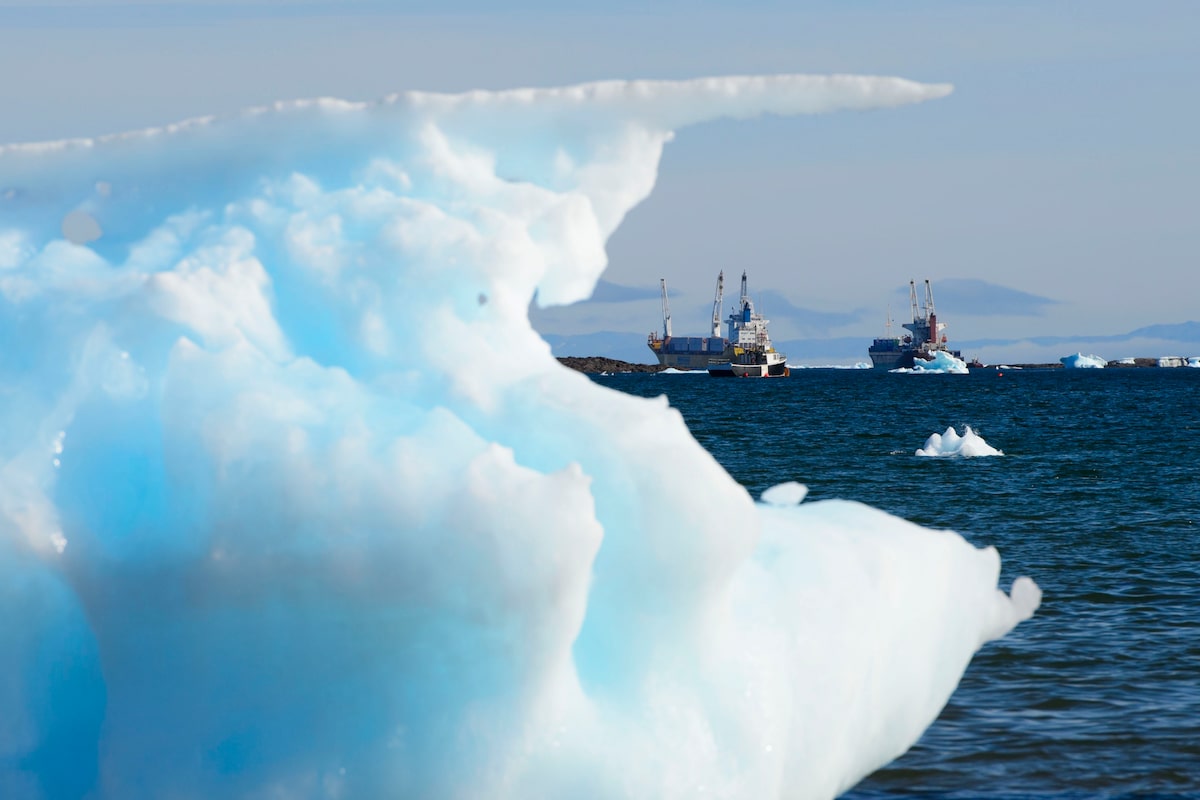
Ships are framed by pieces of melting sea ice in Frobisher Bay in Iqaluit in 2019. A Canadian official was slated to chair a session on disinformation in the Arctic.Sean Kilpatrick/The Canadian Press
The Canadian government has withdrawn its sponsorship of an anti-disinformation conference in Lithuania that feature panels talking about the United States as a foreign interference threat.
Samantha Lafleur, a spokesperson for Global Affairs, said the government wasn’t comfortable with the framing of some of the panels and Canadian officials will still take part in the conference but will not chair any discussions.
“Following changes to the framing of several panel discussions, Global Affairs decided to revise its participation in those sessions at the EU DisinfoLab 2026 conference,” Ms. Lafleur said in an e-mailed statement.
Disinfo2026 is an annual conference on countering disinformation, with this year’s taking place in Vilnius this week. It attracts researchers, people who work in counter-disinformation, journalists, think tanks, academics and government officials.
One of the featured attendees this year was Kimberly Prost, the Canadian jurist sanctioned by U.S. President Donald Trump for her work on an International Criminal Court case involving American troops in Afghanistan. She was one of five judges who decided unanimously in 2020 to authorize an investigation into war crimes committed in Afghanistan by the Taliban, Afghan forces and members of the U.S. military and Central Intelligence Agency, which operated secret detention facilities.
The event is organized by EU DisinfoLab, a non-profit based in Brussels.
More than one panel discusses the U.S. as a source of foreign information manipulation and interference (FIMI), in which state-backed actors conduct co-ordinated and deceptive behaviour to sway public debate and undermine elections and institutions.
The conference program frames one session, slated for Thursday, as a provocative discussion on “growing evidence that the United States has, in specific Arctic contexts, operated as a FIMI actor.”
Saliou Babou, the director of a Global Affairs Canada unit that was set up to counter foreign state-sponsored disinformation, was slated to chair a session on disinformation in the Arctic. The Rapid Response Mechanism was set up several years ago.
The Lithuanian government said it also withdrew its sponsorship. “Lithuania has cancelled its participation in ‘Disinfo 2026′ as several parts of the conference programme differ from the official position of the Government,” the Ministry of Foreign Affairs of Lithuania said in an e-mailed statement.
Participants also told The Globe that the European External Action Service, the EU’s diplomatic service, also withdrew its sponsorship.
The conference organizers declined to comment.
The Global Affairs spokesperson said Canada remains committed to combatting disinformation.
“We respect the right of the organizers to frame discussions as they see fit and recognize the independence of civil society actors and speakers at the conference,” Ms. Lafleur said.
Benjamin Shultz, a lead researcher at the American Sunlight Project and a conference participant, said posters at the conference listing sponsors now feature white stickers covering the logos for Canada, Lithuania and the EU.
Mr. Shultz disputed the Canadian government’s statement that panel subjects had been “reframed,” saying the description of the panels is unchanged from a June, 2026, version.