
Jiminy Christmas!
Once on the brink of extinction, the world’s heaviest insect — the wētāpunga — is staging a remarkable comeback thanks to an extraordinary breeding program.
“This species was endangered at the start of the program, it is now not endangered – it is recovering,” Dr. Chris Green, an honorary research associate at New Zealand’s Department Of Conservation, told RNZ.
He co-authored a report in the New Zealand Journal of Zoology describing the conservation campaign, which culminated in the release of over 11,000 of these colossal creepy crawlies into the wild.
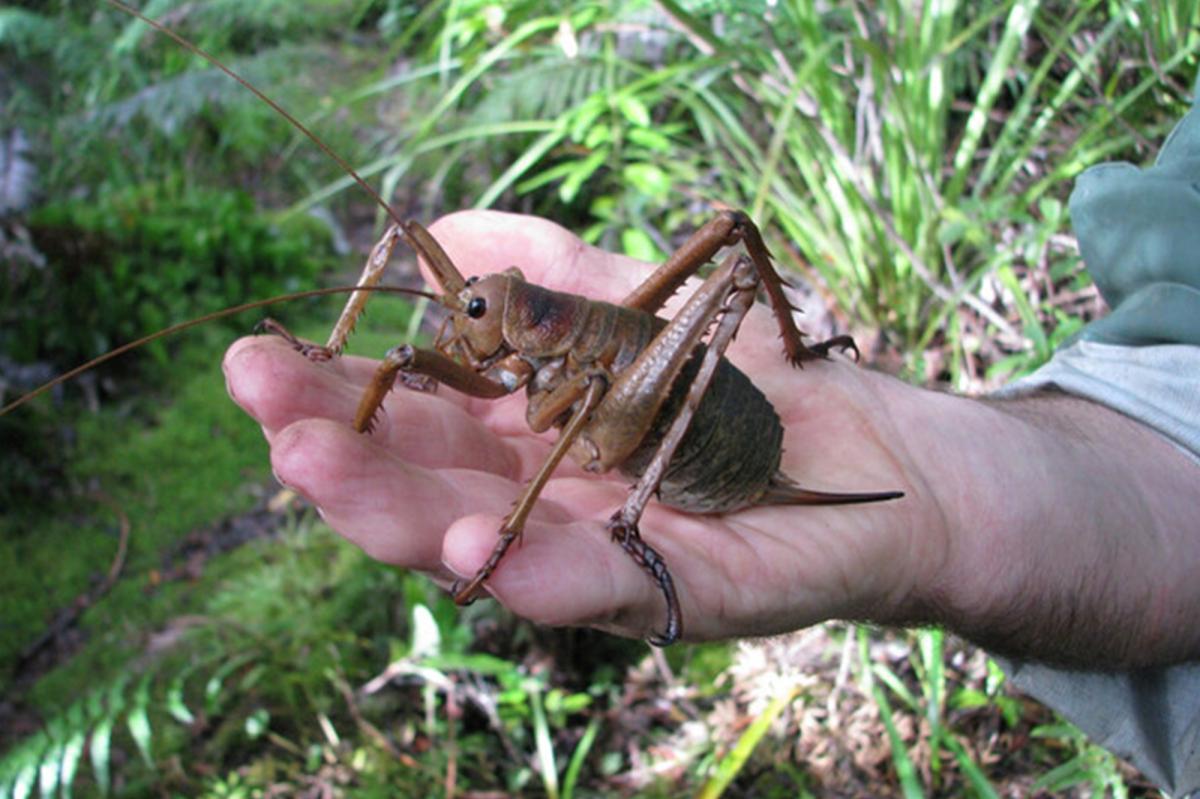
A wētāpunga, or Little Barrier giant wētā, is shown in someone’s palm. Auckland Zoo
It’s safe to say they’ve made a big return. Also known as the Little Barrier Island giant wētā, this colossal cricket tips the scales at up to 35 grams — heavier than a sparrow or a mouse — while a pregnant female clocked in at a record 71 grams.
“The size of adult females would sit nicely on the entirety of your hand,” exclaimed Green.
These behemoth bugs, which belong to the cricket or grasshopper family, can also grow to 4 inches long and boast a maximum leg span of eight inches.
Giant wetas once scuttled across all of New Zealand’s North Island, before they were nearly wiped out by settlers, who cut down their forests and introduced cats and rats. Like many flightless wonders such as the dodo, these entomological heavyweights were defenseless against these invasive predators.
A Stephens Island weta, or Cook Strait giant weta, is shown on a hand for scale. Gary – stock.adobe.com
By the 1990s, the chonky critters had vanished from NZ’s mainland with the only remaining wild population residing on Hauturu/Little Barrier Island.
To bring the thick crickets back from the brink, experts at Butterfly Creek and Auckland Zoo had to rely on novel husbandry techniques, including feeding the nymphs fresh foliage, fish flake protein and leaf litter, the Guardian reported.
A king cricket, Australostoma australasiae, a close relative of the giant weta. Universal Images Group via Getty Images
They were also able to rear large numbers of the cumbersome crickets by keeping them in communal mesh cages.
When the wetas were big enough to fend for themselves, the conservationists started releasing them into the wild starting in 2010.
Since then, 11,214 wētāpunga have been set in loose in predator-free islands and two fenced sanctuaries on mainland NZ. What’s more, the deluxe bugs have established successful breeding populations spanning multiple generations.
During one survey of their new habitat, researchers reported finding 28.5 insects per person per hour of searching, compared to just 1.4 on the Little Barrier Island.
The program was so successful that, in 2022, the species was downgraded from “Endangered” to “Threatened —Nationally Increasing,” meaning these jumbo Jiminies are seeing a colossal second-coming.
“The future of wētāpunga is looking bright,” said Dr. Green, who hopes they can replicate the success with other endangered species.
“By documenting this amazing conservation success story, we can share valuable knowledge on husbandry, release methods, and population persistence,” he declared. “There are many more critically endangered invertebrates that could benefit from similar programs, for example the Canterbury knobbled weevil (Hadramphus tuberculatus) and several native stag beetle species.”