

Listen to this article
Estimated 4 minutes
The audio version of this article is generated by AI-based technology. Mispronunciations can occur. We are working with our partners to continually review and improve the results.
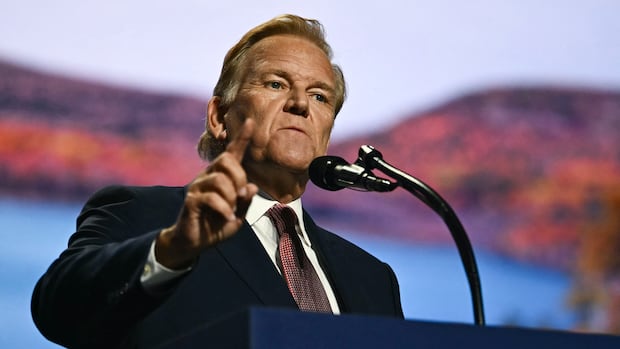
The Republican candidate in a pitched battle for Michigan’s open Senate seat is calling on U.S. President Donald Trump to end the trade war with Canada.
Mike Rogers released a new 30-second ad criticizing the tariffs while sitting in a sports bar with a Labatt beer, a Canadian brand popular in border states like his.
“Here in Michigan we know that Canada is not on our enemy. We need to end this tariff war now,” Rogers says in the ad, as an image of the Ambassador Bridge, which connects Windsor and Detroit, appears on screen.
“As Michigan’s senator, I’ll bring both parties together to lower your prices. That’s job No. 1,” Rogers says in the spot.
Speaking to reporters in the Oval Office later Wednesday, U.S. President Donald Trump was dismissive of the ad, recasting Rogers’s trade war message.
“Well, I viewed it as though he wanted Canada to make a deal,” Trump said.
“We don’t want them to make cars for us…. It’s a long story, but they’ve been ripping us off. Canada has been ripping us off for many, many years and they’re not going to rip us off anymore,” he said.
WATCH | Reporter asks Trump about Rogers: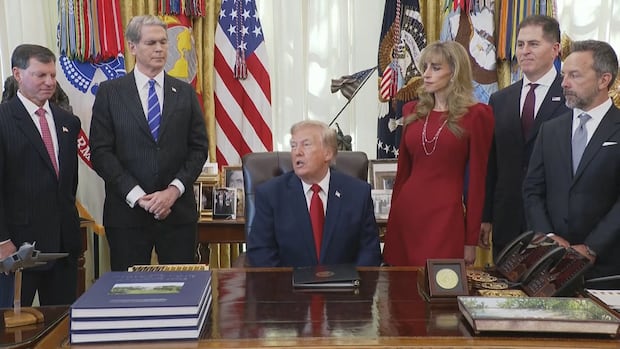
Trump reacts to anti-trade war ad from Republican candidate
U.S. President Donald Trump was asked by a reporter about a new ad from Michigan Republican Senate candidate Mike Rogers that called for an end to the trade war with Canada. Trump said he ‘viewed it as though [Rogers] wanted Canada to make a deal’ and repeated his claim that Canada has been taking advantage of the U.S. for ‘many, many years.’About-face for Rogers
This is an about-face for Rogers, who earlier had endorsed the tariffs Trump levied on Canadian goods.
In an interview with Fox News this summer, Rogers said Trump’s trade policy designed to “reindustrialize” the U.S. was “huge for us … all of these things are really positive.”
He said Canada wants to sell hundreds of thousands of cars into Michigan and that should be “absolutely unacceptable” because those exports “undercut the people who build cars and car parts.”
“The Canadians have not been good partners on this,” he said.
WATCH | Trump adviser warns Canada against election interference: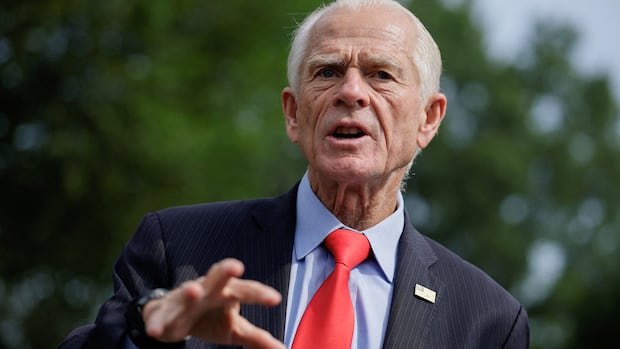
‘You will pay’: Trump adviser warns Canada not to ‘interfere’ with U.S. midterms
White House trade adviser Peter Navarro warned Canada not to ‘interfere’ with U.S. midterm elections in border states such as Maine and Michigan by lobbying against the Trump administration’s tariffs. Navarro said Canada would ‘pay even more dearly’ for doing so.
Rogers has long been closely associated with Trump. When the U.S. president endorsed Rogers earlier this year, the candidate said he was “thrilled” to receive it.
“Together, President Trump and I will unleash a great revival in the state of Michigan,” he said at the time of the endorsement.
Tariffs unpopular in U.S.: polls
Rogers’s break with the president on Canadian trade policy comes as polls suggest Trump’s tariffs are deeply unpopular in the U.S.
Only 26 per cent of Americans surveyed for a Politico poll late last month said levying tariffs on Canadian goods was the right thing to do.
LISTEN | Canada’s choices:
Front Burner23:47Should Canada have taken the U.S. deal?
Rogers is also trailing his Democratic opponent, Abdul El-Sayed, in most public opinion surveys. After the ad was released, El-Sayed said Rogers “must have had one too many of those Labatts.”
“You cheer-led this tariff war from the beginning and you’re flip-flopping now because your poll numbers are in free fall. Donald is the reason we’re in a trade war. And he’s the reason you’re running,” he wrote in a social media post.
Canada, U.S. auto industries deeply intertwined
The Canadian and U.S. auto sectors have one of the most deeply intertwined cross-border manufacturing relationships in the world.
Canada does not “undercut” the U.S. industry, as Rogers describes; rather, it supplies critical parts used in assembly plants throughout the U.S.
Some of those components cross the border a half-dozen times or more because these sectors are so integrated after decades of free trade, with Canadian plants specializing in particular parts and powertrains.
WATCH | How tariffs are affecting our auto industry: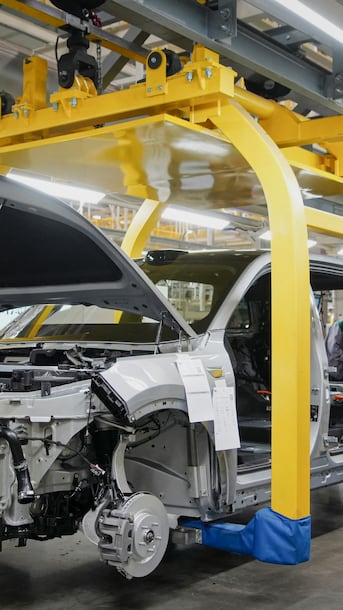
How are tariffs affecting Canada’s auto industry, really?
Car parts can cross international borders six, seven or even eight times before ending up in a vehicle. But amid a trade war, as both Canada and the United States raise tariffs up to 50 per cent, it’s getting more expensive — and complicated — to build cars. The CBC’s Acton Clarkin breaks it down.
It’s a relationship that experts say has helped the North American auto market compete against low-cost overseas manufacturers.
Plus, Canada is a huge customer for what American auto plants churn out every year. About three-quarters of all vehicles sold in Canada are imported, with the majority coming from U.S. plants in Michigan, Indiana and Texas.
Dearborn, Mich.-based Ford has been the No. 1 vehicle brand in Canada for years, with the American-made F-Series being hugely popular among Canadian consumers.
And, despite Republican claims that Trump’s tariff policies are boosting industrial employment, data from the U.S. Bureau of Labor Statistics compiled by the Economic Policy Institute shows that some 62,000 manufacturing jobs have been lost since Trump took office for his second term in January 2025.