
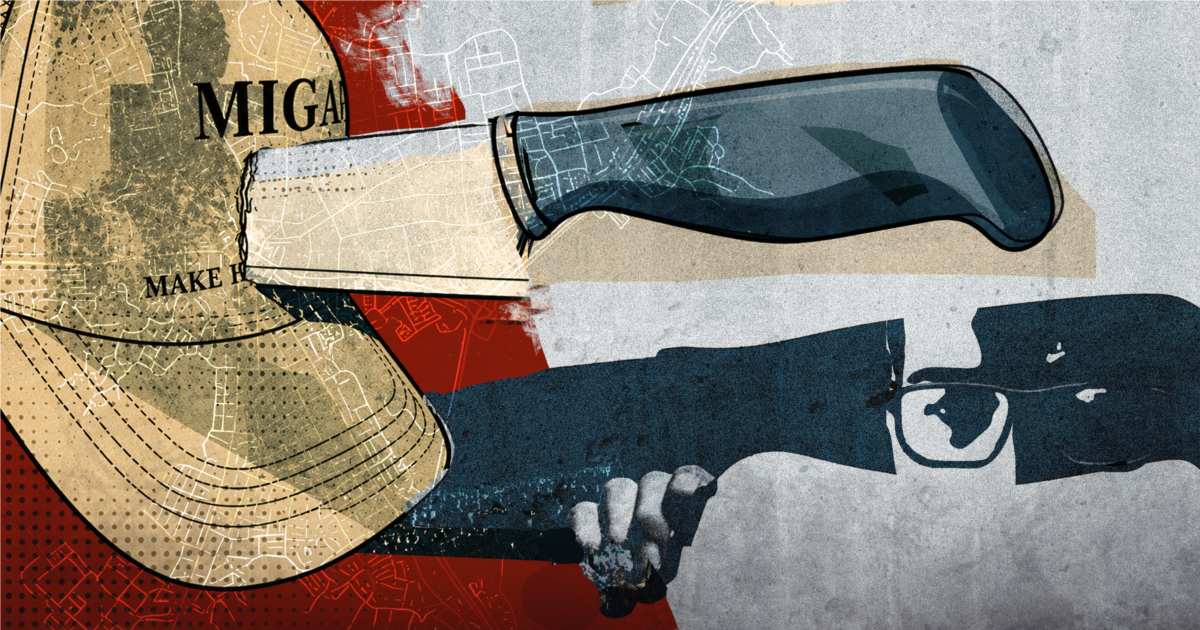
On a Thursday lunchtime in early March, Milad Pourtalebian came home to find his apartment had been broken into and trashed. He then noticed a chilling detail suggesting that this was not a burglary: His “Make Iran Great Again” baseball cap had been skewered to the wall with a large kitchen knife.
Pourtalebian is an Iranian citizen who, since arriving in Canada in 2024, has been organizing exile opposition rallies in his adopted hometown of Saskatoon, Saskatchewan.
The break-in, days after US and Israeli air strikes launched a war with Iran, followed a series of online threats to the 32-year-old relating to his activities. He immediately reported the incident to local police, telling them he had been targeted for political reasons.
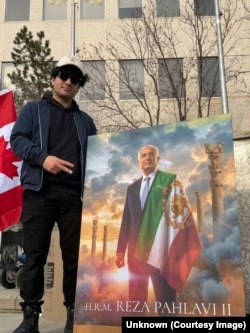
Pourtalebian poses with a portrait of Iran’s exiled former crown prince, Reza Pahlavi. He says his support of Pahlavi has made him a target.
“The incident was initially extremely frightening for me,” he told RFE/RL, adding that he has since overcome this feeling. “I decided not to allow fear to stop me from expressing my political views. I think about the thousands of Iranians who have lost their lives seeking freedom.”
Photos, police documents, and social media screenshots shared by Pourtalebian with RFE/RL give a sense that, despite being thousands of kilometers from Iran, he is not beyond the reach of the country’s security services.
One Telegram post denounces him for “propaganda activities against the political establishment” and supporting “the attack by America and the Zionist regime against Iran.”
It concludes by saying, “This person lives in Saskatoon. A few months ago, we tracked him down and conveyed our message to him at his home.”
This, Pourtalebian said, was “particularly disturbing.” Nothing was taken from his apartment, and nobody has been arrested.
Transnational Repression
Pourtalebian’s experience is specific but appears to be part of a wider phenomenon in which authoritarian states pursue their opponents even after they find shelter in apparently safe Western countries.
Iran has practiced assassinations and attacks for decades, but its global pressure goes far beyond physical threats.
Factnameh, a Persian-language fact-checking service based in Canada, recently noted an increase in “crowdsourced surveillance, doxxing, and cyber-enabled intimidation targeting critics outside Iran.”
The toolbox includes Alaj, a website where people can make denunciations, that reportedly holds files on some 1,600 people. Iranian state TV threatened those named with “seizure of assets, complete suspension of consular services, and Interpol Red Notices,” Factnameh said. Another tool, Goorkan (Persian for “Grave Digger”), publishes personal details of what it calls “traitors.”
US, British, and Dutch intelligence reported last month that Iran was mounting a global cybercampaign. The FBI said malware named Heavygram was used “to conduct malicious cyber activity to target Iranian dissidents, journalists opposed to Iran, and other opposition groups around the world.”
Iran is not an outlier in its pursuit of overseas critics.
Yana Gorkhovskaia, head of research and analysis at Washington-based Freedom House, has spent years studying the phenomenon.
“China, Iran, Russia are among the top 10 perpetrators of transnational repression according to our data. China by far outstrips all other governments,” she told RFE/RL. “Of those three, Russia is by far the most violent in terms of assassinations and assaults.”
Prominent examples include the poisonings of defectors Aleksandr Litvinenko and Sergei Skripal in Britain and a hammer attack on opposition activist Leonid Volkov, an associate of deceased Russian dissident Aleksei Navalny, in Lithuania.
‘A Kind Of Paranoia’
It is something that’s extremely worrying for Mikhail Klimaryov, a Russian cybersecurity expert and Kremlin critic who fled Russia after it launched the full-scale invasion of Ukraine in 2022.
Now living in Berlin, where he collaborates with Volkov, the 53-year-old told RFE/RL he detected “a kind of paranoia” in his behavior owing to the threat.
“I’m overly concerned about security. At least from the perspective of a normal, healthy person. When I’m out and about, I check whether I’m being followed. Before I touch the door handle to my apartment, I examine it first because there was that case where they smeared a door handle with Novichok,” he said.
But Klimaryov said his day-to-day life was also affected by a multitude of smaller pressures, ranging from phishing attacks to administrative difficulties, that amount to “a psychological war” waged by Moscow on people like him.
He cannot, for example, renew his Russian passport, which expires in 2029. This will impact his residency status in Germany.
“It will be an administrative problem, and not as simple as it may seem. I’ll need to hire a lawyer,” he said.
Klimaryov explained he does not have asylum in Germany and does not want to apply for it because this would mean he’d be unable to continue running a business that employs 20 people.
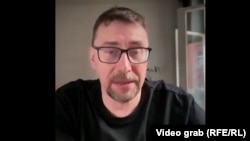
Klimaryov insists that despite the Kremlin pressure, he is not a victim. “I’m not in prison. I can earn a living.”
Travel is another issue. Russia has put him on a terrorist list that can cause a problem at any border. He recalled that while returning from a recent trip to the United States, he was hauled from the boarding line by an officer “with a machine gun and a dog” and questioned for 30 minutes.
The danger of extradition means he needs to be careful about which countries he visits.
Klimaryov is also listed as a foreign agent in Russia and has debts of some $1 million in fines levied on him by the authorities for, he says, political reasons.
In many cases, he was unable to deal with administrative issues mounting against him at home because his Russian phone number was canceled, preventing him from interacting with authorities online or accessing his Russian banking.
Klimaryov says he doesn’t use a phone unless required to by German authorities and doesn’t give the number to anyone else due to hacking fears. He helps other Russians who come under phishing attacks and says he once almost succumbed to one himself.
“I managed to stop myself right at the last moment. It was such a high-level scam,” he said, describing a sophisticated back-and-forth exchange of messages with someone posing as a potential client for his company. After weeks of communication, he nearly entered a code delivered by Telegram that could have compromised his account.
“Does all this affect me psychologically? Of course it does,” Klimaryov said. “I’ve sought medical advice…. I get hit by panic. Panic attacks — do you know what those are?”
Despite this, Klimaryov insisted he doesn’t regard himself as a victim. “I’m better off than many people. I’m not in prison. I can earn a living.”
But Klimaryov added he is considering medical advice to pause his political activities as a result of the pressure. Gorkhovskaia underlined that this was exactly the point of it.
“Surveillance, intimidation, threats to family, digital threats — they do work, to make people at least second guess whether attending a protest or doing something public is worthwhile,” she said.
According to Freedom House, other key perpetrator states include Turkey, Saudi Arabia, and Rwanda. Gorkhovskaia said significant long-term push-back from Western countries is rare. This is owing to both the deniability of such practices as well as broader political considerations.
“Perpetrators of transnational repression don’t pay a cost for targeting dissidents abroad…. They learn from each other that this is a practice you can continue to do,” Gorkhovskaia said.
Pourtalebian indicated he would like to see a tougher response from Canada, arguing it “remains too open to individuals connected to the Islamic republic.”
Saskatoon police told RFE/RL they had closed the file on the case but would reopen it if “further information was brought forward regarding a suspect or additional evidence.”