
The Dutch government’s decision to ban products originating in Israeli settlements in the West Bank, and the retaliatory measures taken by Israel, have deepened tensions between the two countries and revived a question that has troubled Dutch Jews for years: Do they have a future in the Netherlands? Few members of the Dutch parliament in The Hague have a more personal connection to that question than Gideon “Gidi” Markuszower.
Markuszower, 48, was born in Tel Aviv. “My parents made aliyah and then returned to the Netherlands, and I was born in between,” he told ynet. His father was born in British Mandatory Palestine. “My father is a real Palestinian,” he joked.
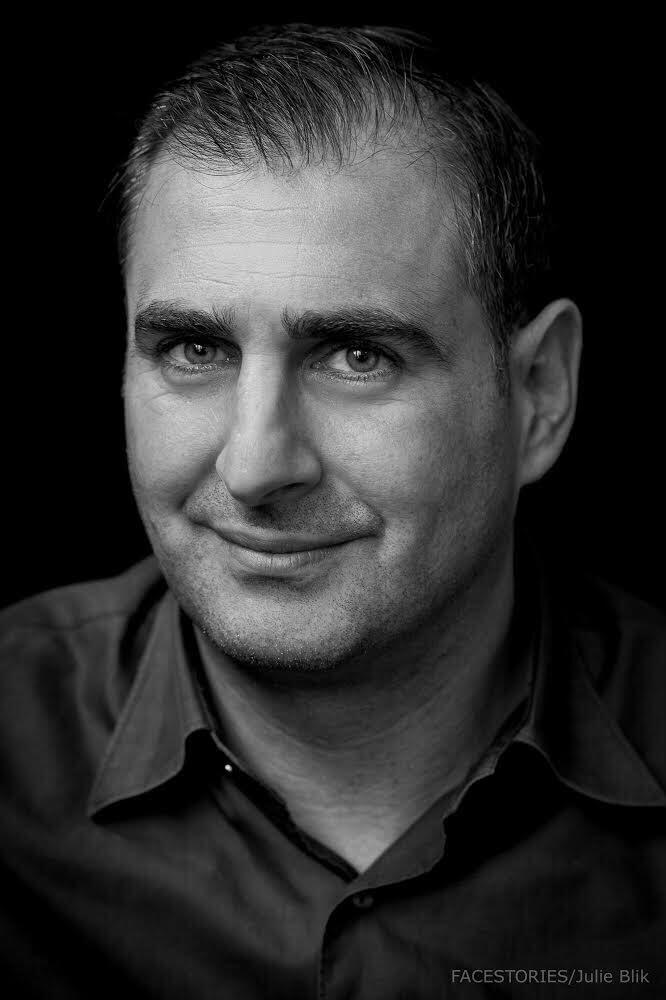
Gideon ‘Gidi’ Markuszower
When Markuszower was a year old, his family returned to the Netherlands, but his connection to Israel remained strong. He visited frequently and, after graduating from high school, spent a year studying at a religious Zionist yeshiva at Kibbutz Ein Tzurim. “It’s very important to know where we come from,” he said.
Markuszower studied law and ran a tax refund business serving financial companies before entering politics. He was elected to the Dutch Senate in 2015 and joined the House of Representatives, the more politically powerful lower chamber, two years later.
Upon entering parliament, he relinquished his Israeli citizenship, although he still holds an Israeli identity number and could apply to restore his citizenship. Today, after 11 years in politics, he is a father of three living in Amsterdam. His eldest son is studying in Israel.
On Thursday, Markuszower is scheduled to participate in the annual Shabtai Shavit International Conference on Counter-Terrorism, organized by the International Institute for Counter-Terrorism (ICT) at Reichman University.
For years, Markuszower was a senior figure in Geert Wilders’ Party for Freedom (PVV), effectively serving as his second-in-command.
In 2024, he was nominated to become deputy prime minister and minister for asylum and migration. But the appointment collapsed following concerns raised during a security screening by the Dutch intelligence service, amid reports involving his connections to Israel and speculation about possible links to Israeli intelligence.
Wilders ultimately withdrew the nomination. “The Dutch security service didn’t want my appointment because of my connections to Israel,” Markuszower said. “I don’t know what they wanted. They didn’t like my ties to Israel.”
Did they really imply that you were connected to the Mossad?
“I never heard what they implied. They thought I was too close to Israel. I don’t think that’s a reason to appoint or not appoint someone as deputy prime minister. That was also antisemitism. If they had said I had connections to Belgium, there wouldn’t have been any problem, because Belgium is a friend of the Netherlands.”
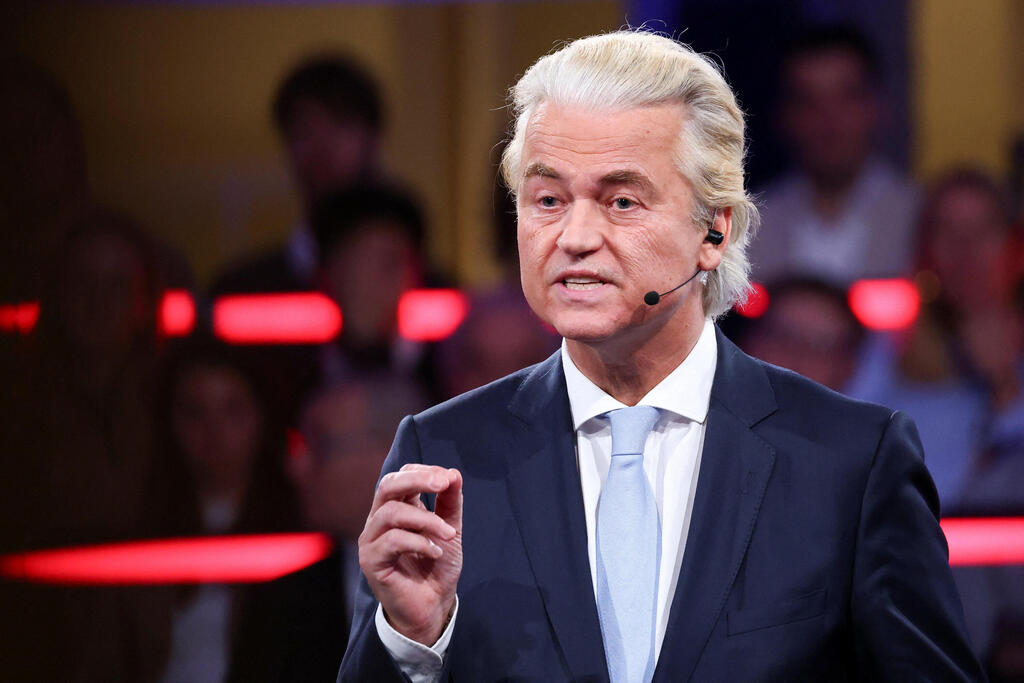
Geert Wilders
(Photo: REUTERS/Piroschka van de Wouw)
Was that why you fell out with Wilders?
“Also because he didn’t stand up for Israel. What’s wrong with someone having connections to Israel? Ultimately, he didn’t support me, but he also didn’t support Israel at that moment. Wilders could have said it was nothing and shouldn’t be a problem. Unfortunately, he folded like a feather in the wind, and not a pro-Israel feather. “In the end, it was against Israel. The Dutch Kaplanists won, and my appointment was canceled.”
Markuszower was referring to critics he associates with the Israeli anti-government protest movement centered on Kaplan Street in Tel Aviv.
His involvement in Jewish communal affairs predates his parliamentary career. He previously worked in security for Jewish institutions and was arrested during an Israeli Independence Day celebration in Amsterdam in 2008 over a firearms violation. Although he held a gun license, he had breached restrictions on carrying the weapon. Prosecutors did not pursue charges.
He was also active in several Jewish communal organizations, including the Nederlands-Israëlitische Hoofdsynagoge (NIHS), the Jewish community security organization Bij Leven en Welzijn (BLEW), and the Central Jewish Consultation (CJO), an umbrella body representing Dutch Jewish organizations.
His political career began in 1999, when he became a spokesperson for Likud in the Netherlands and managed Jewish student youth organizations. He later served as a political adviser to Dutch parliamentarian Anton van Schijndel.
In 2015, he entered the Senate and, two years later, resigned to run for the House of Representatives, taking fourth place on the PVV candidate list. Markuszower speaks fluent Hebrew and has family members living in Israel.
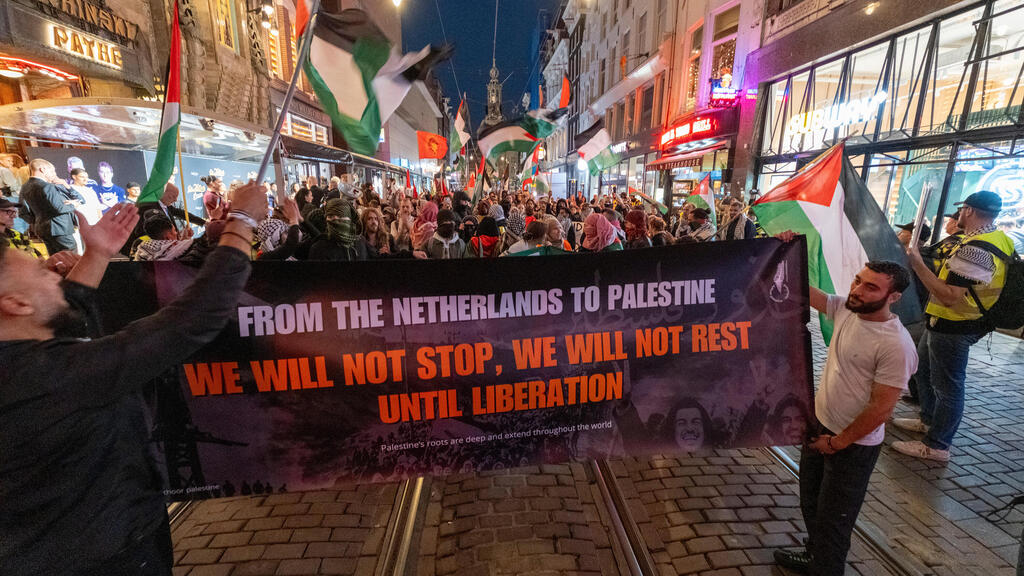
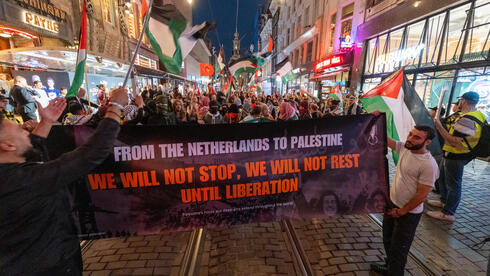
Pro-Palestinian demonstration in Amsterdam marking three years since October 7
(Photo: AP Photo / Patrick Post)
You were Geert Wilders’ right-hand man for years. Why did you leave him?
“It was time. Even though we had many seats, I thought we wouldn’t be able to turn them into real power, including on issues concerning Israel.
“When we were in government, the Netherlands actually moved further away from Israel. Even when we were in government, we weren’t really in power. We wasted our time.”
And now?
“I established my own party called DNA, a smart, right-wing party. We are seven members of parliament who broke away from Wilders’ party. We’re new, and in the polls we’re getting between three and eight seats. There are no elections on the horizon right now.”
The party, De Nederlandse Alliantie, or Dutch Alliance, was founded after Markuszower and six other lawmakers split from Wilders’ PVV earlier this year.
How did the Netherlands reach the point of banning products from Israeli settlements in the West Bank? “It’s a process that started about 10 years ago. Over the past decade, the Netherlands has become increasingly anti-Israel, and my former party is also responsible for that.
“We failed to stop anti-Israel measures, particularly in international organizations such as the United Nations. Even when Wilders’ party was in government, the Netherlands took action against Israel. It didn’t vote in favor of Israel. Sometimes it abstained, and sometimes it voted against. It never stood by Israel.
“The current measure is the icing on the cake. This government is more hostile to Israel than its predecessors because the largest party in the coalition is a left-liberal party, and they’re against Israel.”
What do you think of the Dutch government’s decision and Israel’s retaliatory measures?
“It’s good that Israel took retaliatory measures. It’s very sad to see the Netherlands take such steps against Israel. It’s not smart, and it’s not necessary.
“They package it as international law, but behind that disguise lies antisemitism. Let’s not kid ourselves. It’s antisemitism.”
The Dutch government introduced its ban on imports, purchases and sales of goods from Israeli settlements in the occupied territories on September 22, arguing that the measure was necessary to meet its obligations under international law. The ban applies specifically to settlement goods rather than Israeli products in general.
How does that make you feel as a member of the Dutch parliament?
“I’m not ashamed of what my government did because I’m not responsible for it. I’m against these sanctions. I love Israel, and I think Israel should build more settlements in Judea and Samaria. Israel must win the war against terrorism because that’s what keeps Jews and the world safe. Israel should build as much as possible in its historic homeland, because it’s the homeland of the Jewish people, not of antisemitic Dutch people.”

Dutch Prime Minister Rob Jetten
(Photo: AP Photo/Peter Dejong)
What do you think is driving the Dutch government’s position?
“I think there’s political opportunism involved. Many immigrants have come to the Netherlands, mainly from Muslim countries. Together with the woke left, they’re gaining power, so politically it pays to take an anti-Israel position and appeal to that audience.
“The media are anti-Israel, and among senior civil servants, including in the police, there are many people from immigrant backgrounds or the far left.
“It’s easy for politicians to be anti-Israel because more voters will like them. On the other hand, it’s not very smart to be pro-Israel, because over the past decade the streets have been poisoned against Israel by the media, the woke left and immigrants. They may be 14% of the population, but they’re very vocal in the streets.”
Is it frightening to be Jewish in the Netherlands today?
“It’s not frightening to be Jewish. The gas chambers were worse. Jews have a long history in exile, and we haven’t seen anything yet. It’s still easy to be Jewish in the Netherlands.”
Asked how the Dutch Jewish community is responding to the political climate, Markuszower divided its members into three groups. “There are Jews who don’t identify as Jewish. Then there are Jews who howl with the wolves, the weak Jews who condemn Israel. They think that if they’re more anti-Israel, people will like them.
“But what will happen to them is that they might not be the first to board the trains to Auschwitz, but they’ll definitely be second or third. They’re really stupid. Beyond that, there are Jews who are part of the community and love Israel but live in their own bubble. In our bubble in Amsterdam, we have schools and shops, and things are relatively fine.”
And outside that bubble?
“If you walk around wearing a Star of David and come across an anti-Israel demonstration, they’ll hunt you down.
“They hunted Maccabi Tel Aviv fans back then, and anyone who looked Jewish was in danger.” Markuszower was referring to the violence in Amsterdam in November 2024, when Maccabi Tel Aviv supporters were attacked in the streets after their team’s soccer match in the city.
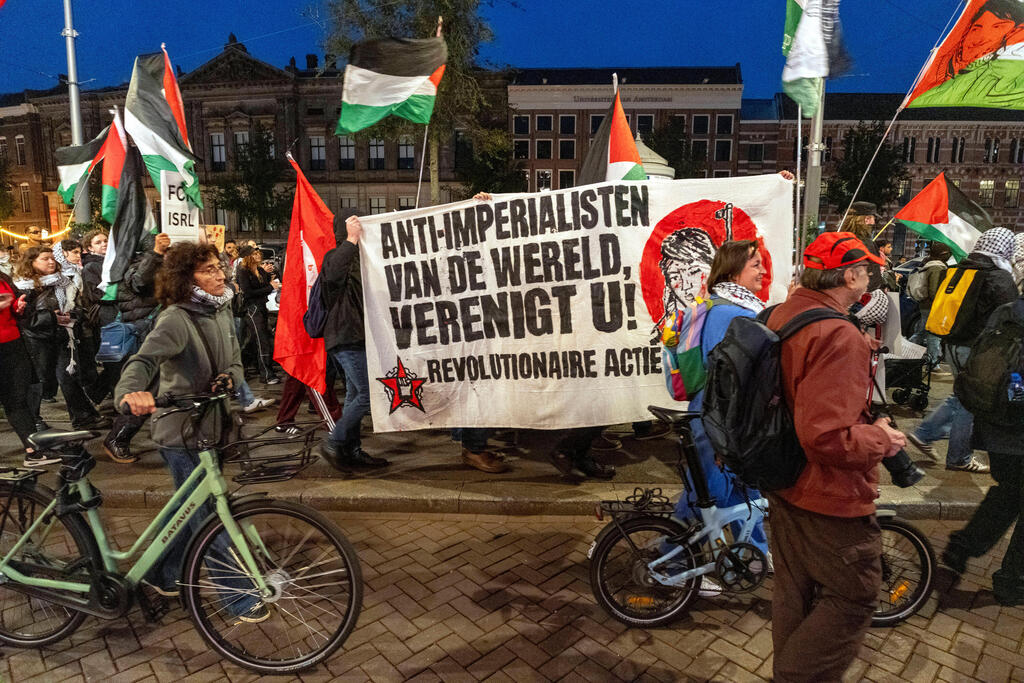
Pro-Palestinian demonstration in Amsterdam marking three years since October 7
(Photo: AP Photo / Patrick Post)
Is there a future for Jews in the Netherlands?
“The future of the Jewish people is in Israel. It’s always been difficult for Jews in the Diaspora. Maybe we’ll have a few more good decades, and maybe we’ll have bad decades, but ultimately it will be difficult for Jews to survive in the Diaspora.
“I don’t know a single Jewish family around me that doesn’t think every day about leaving the Netherlands, mainly for Israel. That’s the conversation Jews in exile have always had. My grandparents had it, and their grandparents had it too: Where is it better to live?
“The conclusion is that life in exile is always worse than life in Israel. Ultimately, Israel is the best place for Jews to live. It’s their natural home.”
What is the difference, in your view?
“If you walk around Israel on Simchat Torah, you’ll see thousands of people dancing in the streets and celebrating the holiday. Go anywhere in the Diaspora. What will you see in the streets? Nothing. In Israel, you see what a Jewish state can do for Jews. In exile, you enjoy equal rights on paper, but in reality, your status isn’t the same as that of your non-Jewish neighbors.”
What is your final message?
“We’ve seen worse situations. It’s not that bad. I’m a pessimistic optimist. Things will get worse, but I believe the Jewish people will survive this too. Am Yisrael Chai. The people of Israel live, and our enemies will not succeed.”