
Nabian, whose legal name is Erfan Hajbonian Dehaghani, is a 26-year-old protester from Isfahan who was sentenced to death after being detained following Iran’s nationwide protests in January.
Speaking to Iran International from an undisclosed location, Nabian described torture, a coerced confession, a mock execution and imprisonment alongside protesters who were later executed.
Minutes after being told to write his will, blindfolded, he was led into another room and ordered to stand on a stool.
Then a noose was placed around his neck.
“All the memories of my life were coming before my eyes,” Nabian recalled. “I thought I would never see my family again.”
Even with the rope around his neck, Nabian said interrogators continued questioning him about the protests, his phone password and allegations linked to the Alikhani Square case, a mass prosecution stemming from deadly clashes during the January 8 protests in Isfahan, which he denied.
The noose remained around his neck for between five and 10 minutes, he said.
A confession under duress
Nabian said he was then placed in front of a camera and ordered to say he had not been beaten or physically harmed.
If he looked away or failed to give the answers his interrogators wanted, he said, they stopped the recording, beat him and started again.
After the filming, Nabian said a man told him: “You’re going to be executed. The sentence has been issued.”
Nabian asked to call his family. Permission was refused.
Minutes later, shackled to a bench, he asked again.
“Please, can you tell them to let me speak to my family? I want to hear my family’s voices for the last time.”
Only then, he said, was he told he would not be executed at that moment and would instead be transferred to prison.
From Alikhani Square to detention
Nabian said he had also joined Iran’s 2019 and 2022 protests.
On January 8, 2026, he joined demonstrations in Isfahan. At Alikhani Square, he said security forces were firing live ammunition at protesters. Four or five pellets struck his right leg.
Fearing arrest if he sought treatment at a hospital, Nabian made his way home. With no knowledge of how to remove the pellets, he cleaned and bandaged the wound himself as his leg began bleeding heavily.
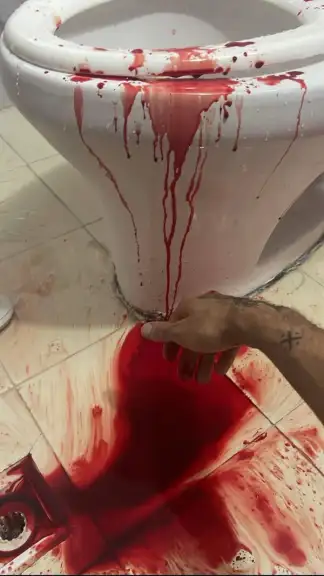 Erfan Nabian removes pellets from his body after being shot during protests in Isfahan on January 8, 2026.
He said he later went back outside to look for a young girl who had become separated from her mother and found the child dead.
Despite what he had seen, Nabian returned to the streets the following day.
“We couldn’t turn a blind eye,” he said, referring to the violence he had seen on January 8 as protesters were shot at.
The events at Alikhani Square later became the basis for one of the most consequential capital cases to emerge from the January protests. Fifty-nine people were initially arrested and 12 were sentenced to death, according to a lawyer who spoke to Iran International.
UN experts led by Mai Sato, the UN Special Rapporteur on human rights in Iran, said the defendants were tried in a single closed hearing that violated fair-trial standards and raised concerns over the use of televised confessions.
Amnesty International separately described the proceedings as a “grossly unfair mass trial” and documented torture, forced confessions and denial of access to lawyers among defendants.
‘The Alef-Ta slaughterhouse’
Nabian said he was arrested on March 6 and taken to Ghaemieh police station.
There, he said, officers demanded the password to his phone and gave him an unidentified substance intravenously.
He was then transferred to a detention facility he identified as Alef-Ta in Isfahan.
Nabian described it as a roughly 10-story building used for solitary confinement and torture.
“I call it the Alef-Ta slaughterhouse,” he said.
He described being stripped, soaked with water and beaten with hoses and batons. At one point, he said, his arms were secured above him while he was beaten for around an hour.
Star of David tattoos and accusations of spying for Israel
Nabian said his tattoos became a particular focus for his interrogators.
They included Hebrew writing, a Star of David on the right side of his neck and ancient Iranian symbols, including the Derafsh Kaviani, on his arm.
He said interrogators repeatedly struck areas bearing the tattoos, including the Hebrew writing on his back.
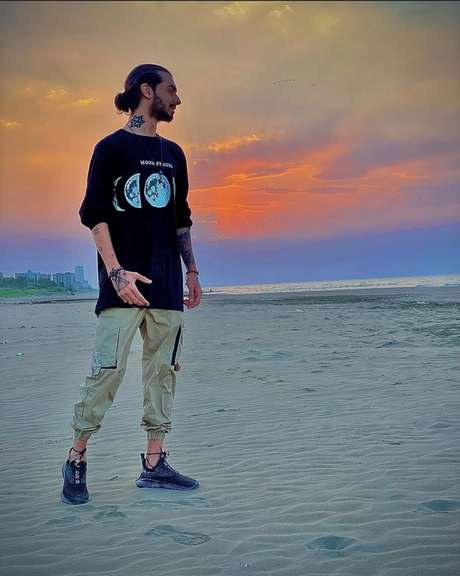 Erfan Nabian is pictured with a Star of David tattoo on his neck in a photo posted on social media in November 2022.
“One of them kept saying, ‘I’ll beat you so much you’ll start speaking Hebrew,’” Nabian recalled.
He said interrogators accused him of being an Israeli spy, receiving money from Israel and undergoing training.
Nabian denied the allegations.
Dastgerd and the sentence
On March 20, Nabian was transferred to Dastgerd prison in Isfahan.
He said intake staff initially refused to admit him because of his injuries, including a broken finger and damaged knees.
His death sentence was later commuted to 11 years in prison, according to a court verdict reviewed by Iran International.
Nabian said the sentence included one year for propaganda and 10 years over alleged psilocybin possession. He denied the drug allegation and said authorities gave differing accounts of the amount.
Iranian authorities have previously faced allegations of bringing fabricated drug charges against political detainees.
Norway-based rights group Iran Human Rights has described the case of Iranian-Dutch protester Zahra Bahrami, arrested after the 2009 demonstrations and executed in 2011, as a fabricated drug case in which she was tortured into confessing.
The US-based Center for Human Rights in Iran, then known as the International Campaign for Human Rights in Iran, said at the time that Iranian security agencies had in several cases planted drugs and added drug-related charges to the cases of political prisoners.
The cellmates later executed in connection with the Alikhani case
Inside Dastgerd, Nabian lived alongside other defendants tied to the Alikhani case.
Among them were Sasan Azadvar and Erfan Esfandiari, both later executed.
Nabian also spent around two days with Abolfazl Sepahi, another Alikhani defendant.
He said Sepahi told him he had been shot from behind with live ammunition in the pelvis during the January 8 protests and described torture he endured in detention, including having a butane torch held near his eye.
Sepahi was later publicly executed alongside Amirhossein Safari in Ali-Khani Square.
He also remembered Shervin Bagherian, another Ali-Khani defendant whom he befriended in Dastgerd, as intelligent and good-natured. Bagherian often came to his room, where he played chess and spent time with fellow prisoners.
It was only after his release that Nabian saw Bagherian’s forced confession, broadcast on state television. “My heart broke,” he said. “I kept thinking about what this kid must have gone through.”
Amnesty International said Bagherian had been forcibly disappeared for 21 days, subjected to torture and denied access to a lawyer before his forced confession was broadcast on state television on January 25.
For Nabian, the names appearing in reports of executions were not strangers. They were men he had lived beside, spoken with and come to know in prison — before watching, from outside, as one after another was taken to the gallows.
Air strike and crackdown inside Dastgerd
Nabian was still inside Dastgerd when an air strike on March 31 hit military facilities immediately behind the prison.
Iran International later reported that a military base and ammunition depot behind Dastgerd were hit by three missiles and parts of the prison were damaged. A judicial document said some prisoners were killed and others died in the ensuing fire.
Nabian said the blasts cut electricity, water and telephone access and were strong enough to throw prisoners from upper bunks.
“Everyone was shouting, ‘Come save us. Open the doors so we can get out.’”
He said some staff left while inmates remained behind locked ward doors. Some doors were later damaged or opened as prisoners tried to reach safety.
Nabian said security forces and IRGC personnel subsequently entered the prison and opened fire.
His ward remained locked. He said other prisoners later told him they had seen bodies and black body bags in corridors.
The following day, Nabian said, he could hear prisoners being beaten and tortured. He also described a “tunnel of terror,” in which prisoners accused of involvement in the unrest were forced between lines of guards who struck them with gun stocks, batons and hoses.
A judicial document later obtained by Iran International listed 75 prisoners as defendants over the unrest and fire. At least 26 were ordered to stand trial, while 18 faced charges that could carry the death penalty.
Nabian was released on bail on April 7. He said he left Iran because he feared rearrest, further torture, a lengthy prison term or another death sentence.
“I really love my country,” he said. “I always believed Iran would be free.”
“I never thought my place would be outside Iran.”