
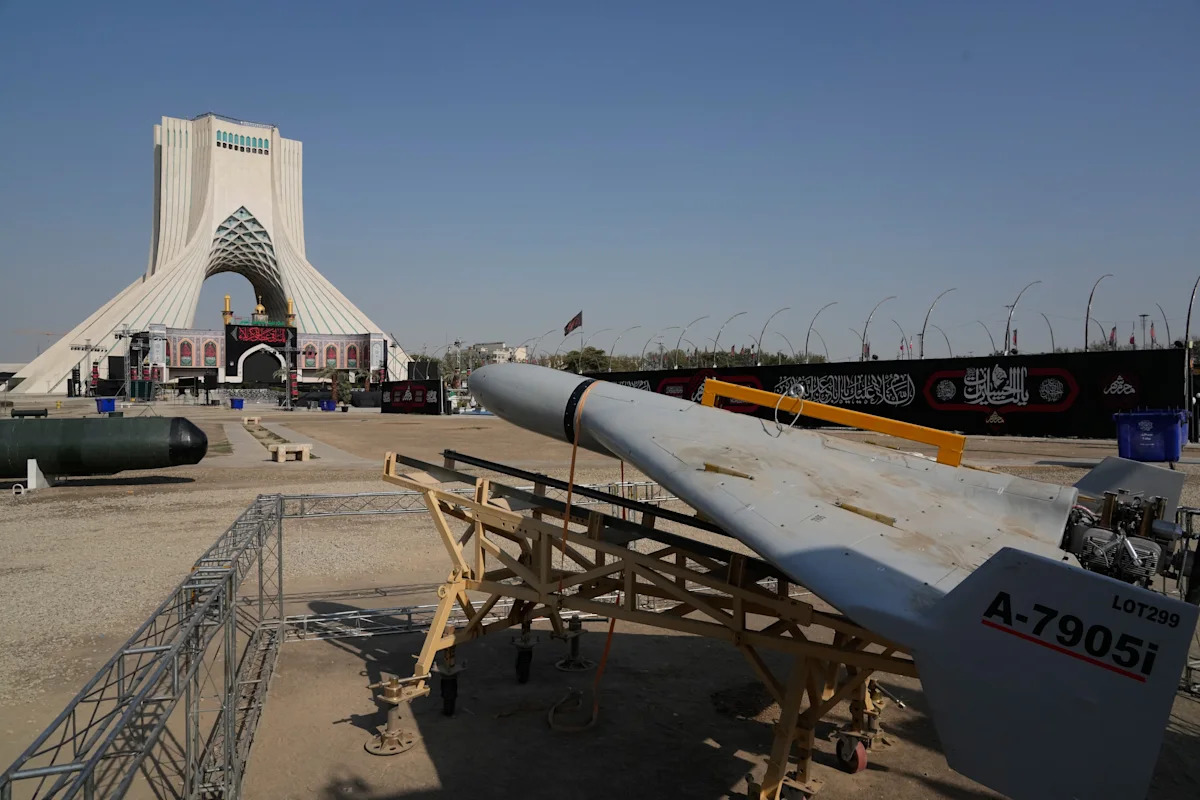
The abrupt evacuation of American bombers from a key U.K. airbase underscores the extreme vulnerability facing the world’s most powerful fighting force and its NATO allies — as cheap drones and off-the-shelf tech transform warfare.
President Donald Trump has insisted Iran’s military is “completely destroyed” due to eight months of attacks from American and Israeli firepower. But Tehran continues to strike back with low-cost Shahed drones that have kept the Navy from returning to U.S.-friendly ports in the Middle East and severely damaged an American airbase near Iran. Warnings about Iranian drones even led to the evacuation of all U.S. bombers from Britain’s Fairford air base this week and sent Trump scurrying into a catering cart in July as he left a NATO summit in Ankara, Turkey.
The actions underscore the pervasiveness of these new threats — and just how unprepared U.S. and European officials are to tackle a new kind of warfare.
“What worries me is a growing possibility of ‘drone terrorism’ and ability of different semiorganized groups and vile individuals to act against our infrastructure by cheap, even household made, means,” said a senior European defense official.
American officials are recognizing similar limitations. Defense Secretary Pete Hegseth recently established a new combatant command focused on drone warfare, but it will likely be years before it yields results on the battlefield.
Iran can “apply all of this asymmetric pressure on us,” which wasn’t the case even a few years ago, said a U.S. official, who like others was granted anonymity to discuss ongoing operations.
But NATO allies in Europe — unable to pull their forces back to North America — are even more vulnerable. They’re warding off an increasing number of drone incursions into NATO airspace and attempted attacks from Russia. And bases across the alliance are within range of Tehran’s ballistic missiles, leading officials to worry about future Iranian reprisals, according to two NATO diplomats and two European defense officials.
The Pentagon and NATO did not respond to requests for comment.
“There were some threats, and rather than tempting the enemy, we’ll capture the enemy and beat the enemy,” Trump said about the decision to move the bombers. “But why should we leave them there? So we moved them around a little bit.”
The increase of relatively cheap technologies made with commercially available parts — such as Shahed drones or AI-enabled devices — is forcing a reckoning at the Pentagon about how to more quickly buy and develop anti-drone weapons and missile interceptors.
Even creative new defense companies have yet to show they can build them at scale to meet the threat.
“Maybe you harden certain bases, and you’re going to put fewer forces on them, or are you going to create a fortress base,” with extra air defenses and buried facilities, said Stacie Pettyjohn, who leads the defense program at the Center for a New American Security, a nonpartisan think tank. “There are some hard questions that need to be answered: Where do you need to be? Why? With what types of forces? How often?”
Military leaders are still weighing whether to rebuild the base in Bahrain — and how to strengthen it if they do. Weeks of ballistic missile and drone attacks damaged the command center, satellite terminals, and logistics warehouses. Some troops had to relocate to Central Command headquarters in Tampa, Florida, and can’t return due to the continuing Iranian threat. Other troops from a Qatar base have been working from Shaw Air Base in South Carolina since the start of the strikes.
“You’ve got to ask, ‘Do we invest a lot to rebuild this, or do we do something else?” the U.S. official said. “I don’t know that we know enough right now to be able to answer that.”
The U.S. military — with its nuclear-powered aircraft carriers, long-range bombers and aerial refueling aircraft — can still operate anywhere on the globe that it chooses. But those powerful ships are all but shut out of the Persian Gulf without the ability to refuel at the Bahrain base. They must get supplies and fuel 2,000 miles away from the Diego Garcia base in the Indian Ocean. And other areas, including an Army logistics hub in Kuwait and the command center in Al Udeid in Qatar are increasingly vulnerable amid dwindling air defense stockpiles and the lack of hardened structures.
Even the Trump White House has felt the pressure. The administration engineered a cloak-and-dagger maneuver to sneak Trump off of a new Air Force One onto another U.S. aircraft — via an airline catering truck — in an effort to avoid any Iranian threats to the presidential plane.
The threat of small, commercially made drones is keenly felt in Europe. The German government recently blamed Russiafor an explosives-leaden drone on a runway in Leipzig, and other alliance members have reported incursions of Russian weapons in their airspace.
Bulgaria’s prime minister said Wednesday that two commercial vessels were struck by drones in the Black Sea, in what marked the first attack on shipping in the NATO member’s exclusive economic zone. It is not clear where the drones came from, but up to 10 crew members form one of the ships that sank remain missing.
“If the threat was indeed credible,” said a second European defense official, “and assets are so highly valued, it is not an overreaction.”