
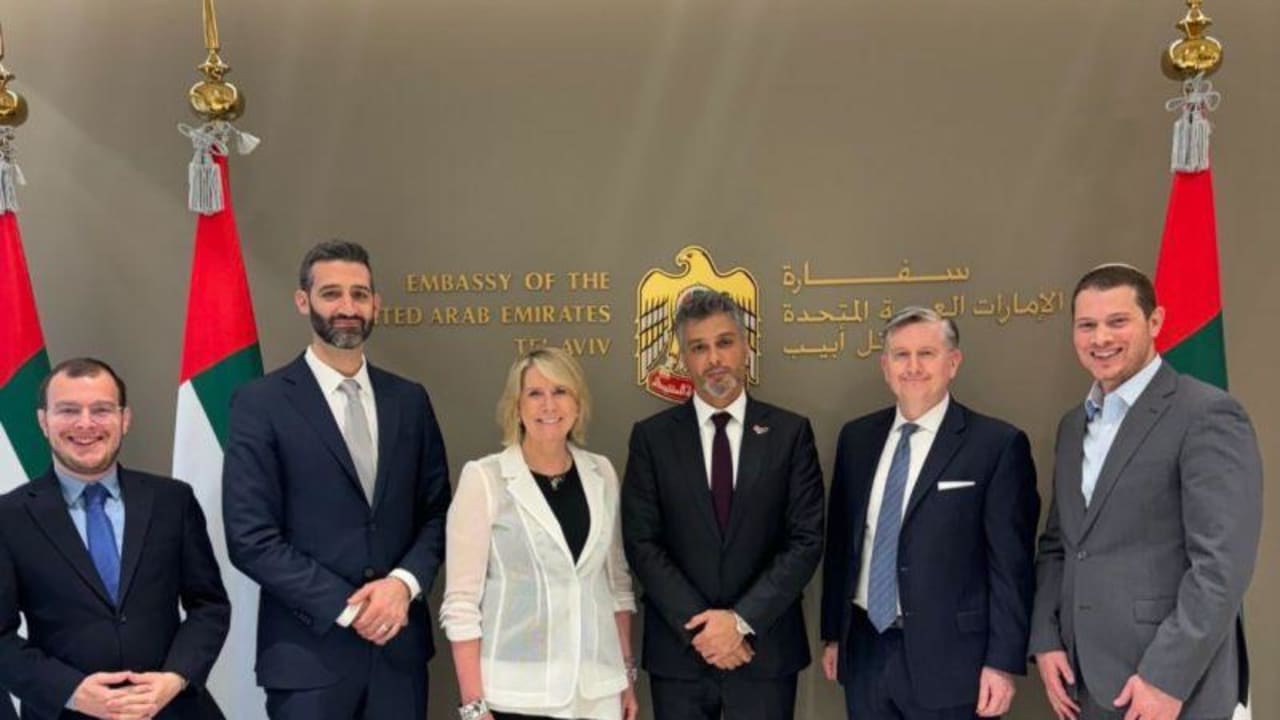
If Kuwait is moving toward normalization with Israel, the consequences could extend far beyond another diplomatic agreement, reshaping calculations from Riyadh to Tehran.
Sometimes, in the Middle East, what is not announced matters more than what is.
Prime Minister Benjamin Netanyahu’s unusually quiet visit to Abu Dhabi to meet UAE President Sheikh Mohamed bin Zayed raises an obvious question: Why now, and why so quietly?
There was no public agenda, no joint press conference, and no diplomatic fanfare. Netanyahu flew to the UAE, met MBZ, and returned to Israel several hours later, with little explanation of what had been discussed.
That silence may be the most interesting part of the story.
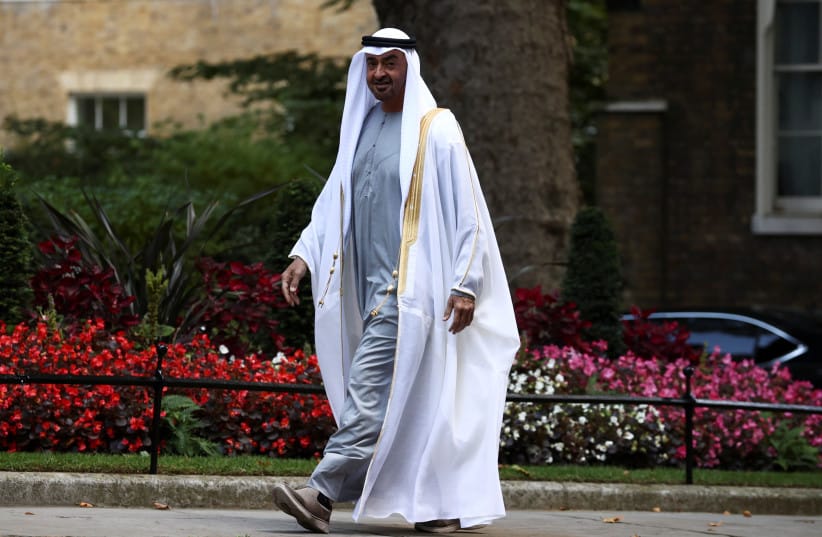 Abu Dhabi’s Crown Prince Sheikh Mohammed bin Zayed al-Nahyan arrives at Downing Street, London, Britain, September 16, 2021. (credit: REUTERS/HANNAH MCKAY)
My suspicion is that the meeting was about more than another bilateral consultation. Kuwait may be part of a larger conversation behind closed doors, possibly involving the next expansion of the Abraham Accords.
Less than two weeks earlier, Israel’s ambassador to the UAE, Yossi Shelley, suggested publicly that another country could join the accords within four to six months. He specifically pointed to Kuwait.
Kuwait has traditionally been among the Gulf states most cautious toward normalization with Israel and has long maintained a public position opposed to it. That is precisely why a Kuwaiti move would matter so much.
Neutrality does not stop a missile
Iran has made the threat facing the Gulf impossible to treat as theoretical.
The events of 2026 showed how quickly a confrontation involving Tehran can spill across borders. Iranian missiles and drones reached Gulf states, including Kuwait, forcing governments that had tried to balance relations with Washington and Tehran to confront an uncomfortable reality.
Neutrality does not stop a missile. Diplomatic caution does not intercept a drone. Geography does not disappear because a government would prefer to remain outside somebody else’s war.
Kuwait sits close to Iran, hosts a major American military presence, and occupies a strategically sensitive position at the northern edge of the Gulf.
That changes Israel’s strategic value in Gulf calculations.
Israel possesses capabilities Gulf governments increasingly need: combat-tested missile defense, sophisticated intelligence, early-warning systems, cyber capabilities, and years of experience confronting Iranian weapons and proxies.
The question is no longer simply whether Gulf capitals approve of Israeli policy. It is whether they can build the next regional security architecture without Israel.
The Abraham Accords began as diplomatic normalization. Their next phase may be about shared early warning, intelligence coordination, missile and drone defense, maritime security, and protection of critical infrastructure.
This is where MBZ becomes central. The UAE maintains deep relations with Washington, has built an extensive partnership with Israel, and keeps channels open to regional rivals. Abu Dhabi also has an interest in a Gulf where security relationships are increasingly interconnected. Bringing Kuwait closer to the Abraham Accords would fit that strategy.
The road from Kuwait City leads to Riyadh
A Kuwaiti move would also change the strategic context surrounding Saudi Arabia, the most consequential potential addition to the Abraham Accords.
This would not mean Riyadh would automatically follow. Saudi Arabia has its own interests and its own position on the Palestinian issue.
But Kuwait would remove another political and psychological barrier. If even Kuwait can establish relations with Israel, the definition of what is politically possible in the Gulf changes.
Saudi policymakers would increasingly have to consider not only what normalization would require, but also the implications of remaining outside a regional network that is gradually becoming more integrated.
Such a network would not be an Arab-Israeli NATO. What could emerge is something looser: states that do not agree on everything but increasingly share intelligence, technology, warning systems, and maritime interests.
The United States would remain indispensable. Washington provides military reach and security guarantees no regional power can replace. The Abraham Accords provide a framework through which regional cooperation can deepen.
Iran’s strategic paradox
For Tehran, this is the greater danger.
An Israeli flag flying over another embassy in the Gulf is symbolic. Israeli radar, intelligence, early-warning systems, and security coordination becoming embedded in the Gulf are something else entirely.
For decades, Iran benefited from a regional structure in which Israel and Gulf Arab states shared concerns about Tehran while remaining politically separated. The Abraham Accords began to close that strategic space. Iran’s own behavior may now be closing it further.
Every missile launched toward a Gulf state strengthens the argument for integrated air defense. Every drone attack strengthens the case for shared early warning. Every threat to shipping strengthens the argument for maritime coordination.
And every demonstration of Iranian reach makes Israeli intelligence and defense technology more relevant to governments that once saw relations with Israel primarily as a political liability.
That is Tehran’s strategic paradox: In demonstrating its ability to threaten the region, Iran may be accelerating the construction of the very regional architecture it has spent years trying to prevent.
Watch the silence
Perhaps Kuwait was not discussed in Abu Dhabi. Perhaps Netanyahu and MBZ were simply conducting another strategic consultation.
But the timing is difficult to ignore.
An Israeli ambassador publicly identifies Kuwait as a possible new member of the Abraham Accords. Less than two weeks later, Netanyahu quietly travels to Abu Dhabi for an unexplained meeting with a leader who helped turn Arab-Israeli normalization into a regional strategy.
That may be a coincidence.
I suspect it is not. In chess, you do not always announce what comes next. Sometimes you quietly reposition the pieces, create pressure, and wait for your opponent to understand what has changed. The decisive move is often prepared several turns before its purpose becomes clear.
The original Abraham Accords showed that Arab states did not have to wait for a final Israeli-Palestinian settlement before establishing relations with Israel. A Kuwaiti move would suggest something more: that the strategic logic behind normalization has become powerful enough to reach one of the Gulf states most resistant to it.
The first phase of the Abraham Accords was about recognition. The next may be about integration.
Perhaps that is what was being discussed behind closed doors in Abu Dhabi.
And perhaps the quietest meeting in the Gulf this week will eventually prove to have been one of its loudest moves.
Liron Rose is an entrepreneur, co-founder of the Masad Haaretz Institute, and creator and host of the geopolitical podcasts Israel Insider and HaYanshuf.
Amit Shabi is a former analyst in Intelligence Unit 8200, an investment and capital markets professional, author of several finance books, and a competitive chess player.