
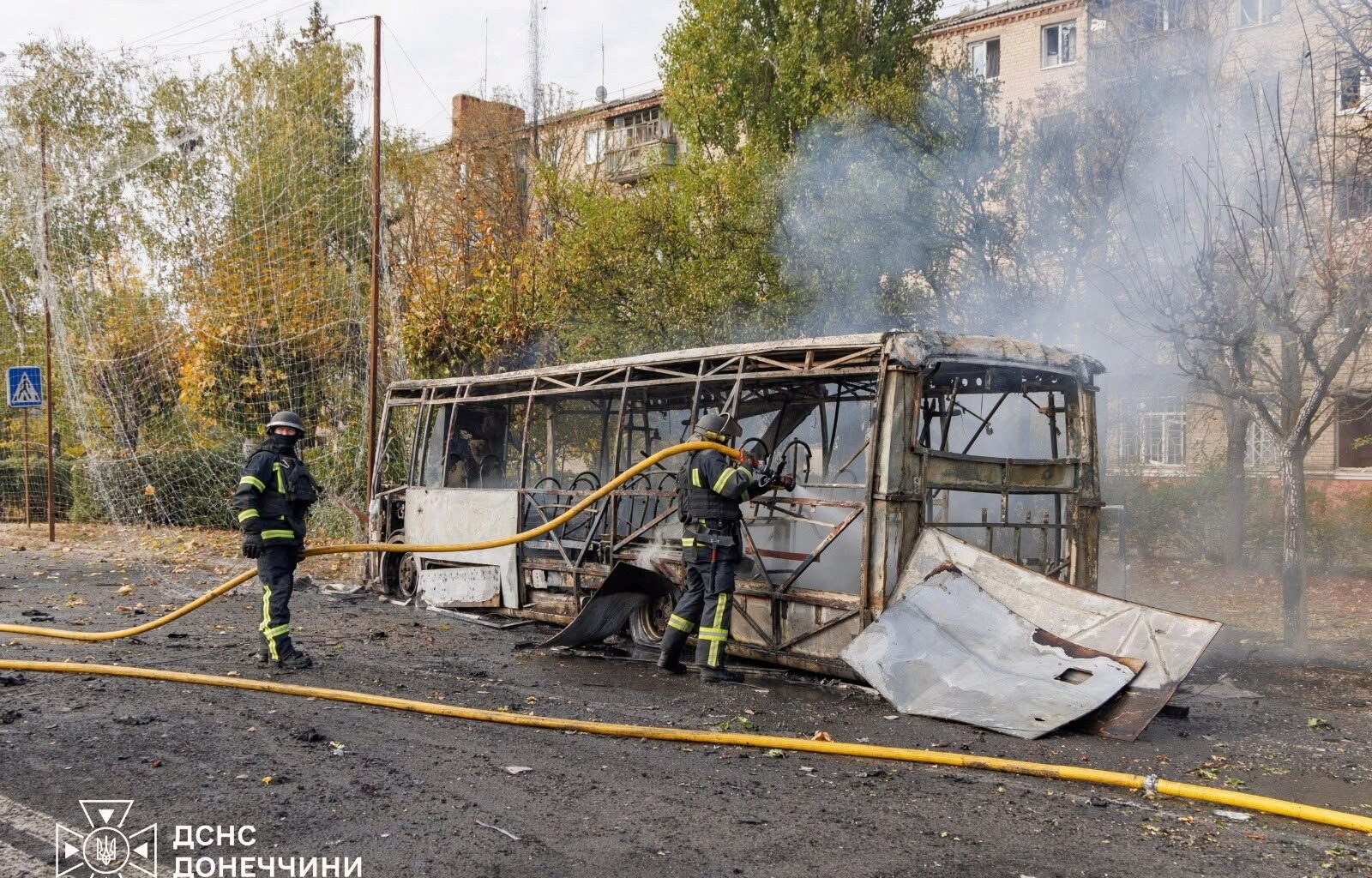
A Russian attack on two buses has killed at least 30 people and wounded 18 others in the eastern Ukrainian city of Kramatorsk, near the front line, authorities said.
The local prosecutor’s office on Thursday posted photos of bodies and debris strewn across a road in front of the burning metal shell of a bus.
Recommended Stories list of 3 itemsend of list
Police said the attack took place on a street where two city buses were operating at the time. President Volodymyr Zelenskyy described it as a bus stop and said there would be a response.
“This strike will not go unanswered. Russia is attempting to destroy all life in Donbas, and the world must respond … firmly,” he said on Telegram.
The Donetsk governor accused Russia of “deliberately targeting civilians”.
“For them [the Russians], a bus with passengers is an attractive target precisely because one strike can kill as many people as possible,” Vadym Filashkin wrote on Telegram.
Police said the buses were hit with a glide bomb. Al Jazeera’s Audrey MacAlpine said glide bombs “do not have the precision of a ballistic missile or the first-person view of something like a drone, so they don’t have the same accuracy as those weapons”.
Therefore, there is no way of knowing whether these buses were intentionally targeted or if they were “at the wrong place at the wrong time,” MacAlpine said.
The correspondent added this was one of the largest and deadliest aerial attacks in recent months, “in a sign of how the front line city of Kramatorsk is becoming more and more dangerous.”
There was no immediate comment from Moscow on the attack. Russia denies targeting civilians, though it has regularly pounded Ukrainian cities, towns and other targets during its full-scale invasion that began in February 2022.
Kramatorsk is one of the key cities that Russia has not yet captured in Ukraine’s eastern Donetsk region, which Moscow claims as part of Russia.
It has been a logistics and supply hub for the Ukrainian military for much of Moscow’s war and is part of the so-called “fortress belt” that troops are fighting to keep hold of.
Russian forces have edged close to the city’s eastern edge, which has prompted calls for civilians who remain to relocate to safer regions of Ukraine.
Kramatorsk City Council said it was “yet another horrific crime committed by the Russian army against the civilian population”.
“Once again, the Russians have struck a location where there are absolutely no military targets,” it added.
Elsewhere in Ukraine, the death toll from Wednesday’s Russian missile attack on a residential building in the city of Pryluky in the northern Chernihiv region rose to 22, including five children, Governor Vyacheslav Chaus said in a statement on Telegram.
President Zelenskyy said a cruise missile directly hit the building in Pryluky, about 150km (93 miles) east of the capital, Kyiv.
The city’s mayor, Vitali Klitschko, said two people were found dead on Thursday after a fire at a four-storey building that was hit by a drone in the densely populated Solomyansky district.
Klitschko has said the attacks, which have hit key transport bridges in the city, as well as the rail network and energy grid, were “tearing Kyiv apart”.
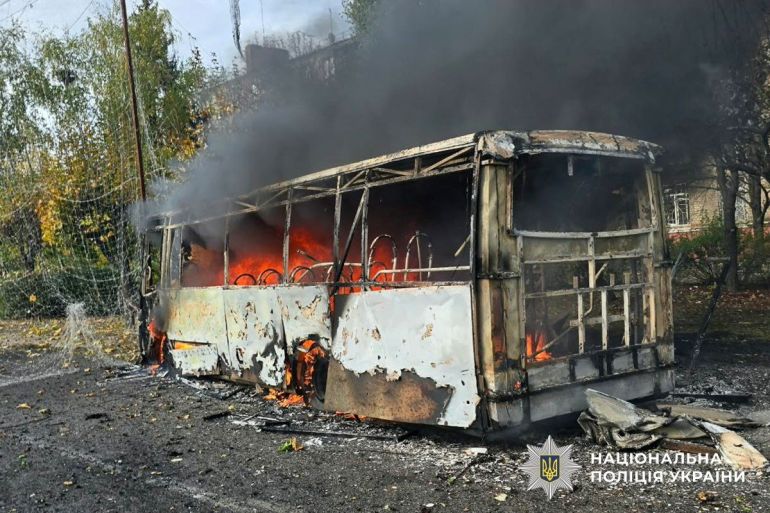 A bus burns following a Russian air strike, amid Russia’s attack on Ukraine, in the city of Kramatorsk, in Donetsk region, Ukraine October 8, 2026 [Press service of the National Police of Ukraine/Handout via Reuters]Attack on Russian data centre
Meanwhile, in Russia, a drone caused a fire at a data centre belonging to Russian technology company Yandex, the firm told the AFP news agency on Thursday.
Unverified images published on social media showed columns of thick, black smoke pouring from the roof of the building, which the company said was in the central Ryazan region, southeast of Moscow.
Russia and Ukraine have intensified long-range strikes on each other in recent months, with some of the latest Russian attacks targeting Ukrainian data centres and logistics warehouses.
The former head of Ukraine’s Centre for Countering Disinformation said Kyiv was responsible for the strike on the Yandex facility, writing on Telegram: “Two can play at this game”.
The firm is Russia’s largest technology company.
Often dubbed “Russia’s Google”, Yandex runs the country’s most popular search engine, as well as a food-ordering and ride-hailing application used by tens of millions of people across the Russian-speaking world.
Ukraine also claimed to have struck a large oil refinery complex in the city of Salavat, some 1,200 kilometres (about 750 miles) east of Moscow. Ukraine’s General Staff described the complex as one of Russia’s largest oil refining and petrochemical facilities.
Separately, a man was killed and a woman was injured in a drone attack on Moscow region, Andrei Vorobyov, the regional governor, said. A residential building and three cars were damaged in the attack.
In Russia’s Omsk region, Vitaly Khotsenko, the region’s governor, said Kyiv had hit an industrial zone. The Omsk region, which is in Siberia, hosts an oil refinery operated by Gazpromneft.
Ukraine has been waging its own campaign of long-distance drone strikes against military, energy and commercial targets in a bid to raise the cost to Moscow of continuing the war.
‘Dangerous stalemate’
US Secretary of State Marco Rubio on Thursday said Russia’s war in Ukraine was at a dangerous stalemate and that Washington would keep working toward a settlement to end the conflict.
“We’d love to see a negotiated settlement to this war that is permanent, enduring, and fair. And that’s what we’re committed to continuing to do,” Rubio told reporters during a visit to Portugal.
The US official said escalations could spark a wider conflict.
“That escalation could wind up being a sabotage campaign in neighbouring countries that are members of NATO,” he said, adding that other things “could quickly turn what is a war between two countries into a much broader and far more dangerous regional conflict.”
“This war needs to end in a negotiated settlement. The sooner, the better. The United States stands ready to facilitate that. We have tried. We will continue to try. But we’re also not going to invest in pointless processes if we can’t make progress,” Rubio added.