
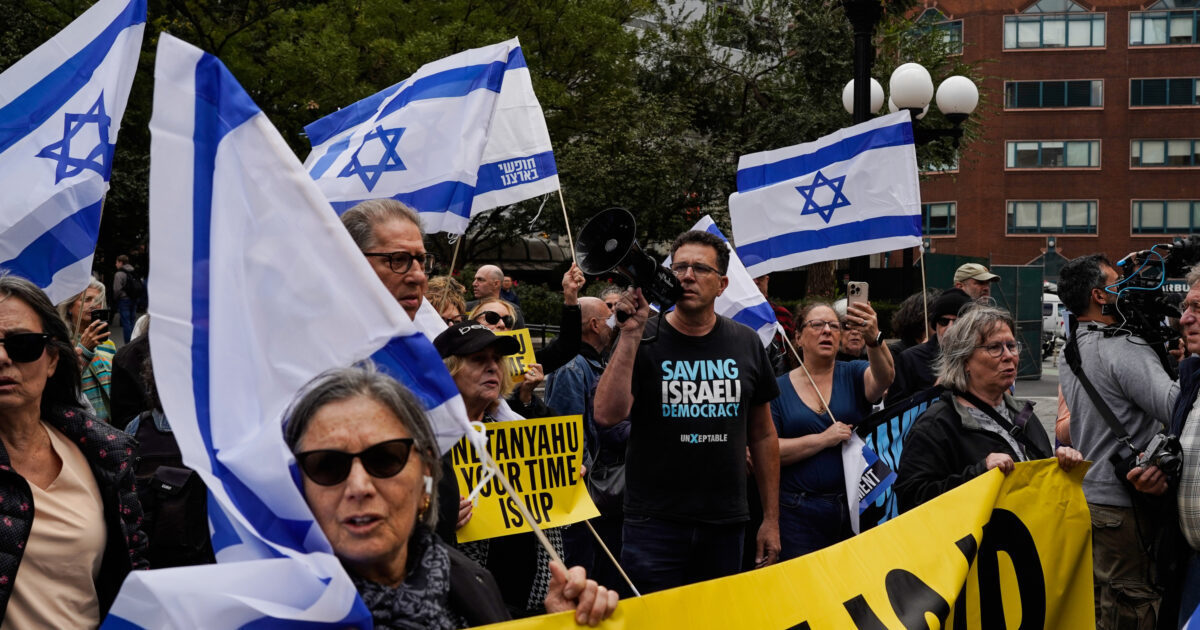
Last month, during their keynote High Holidays sermons, multiple liberal American rabbis shared their wishes that the upcoming Israeli elections might, this time, produce a transformation in the country. On Rosh Hashanah, prominent Los Angeles rabbi Sharon Brous expressed hope that “new faces and alliances” running in the Knesset elections might be able “to lead the state in the hard labor of teshuvah, of reckoning and repair”—a potential outcome she compared to the recent decisive loss of Hungary’s far-right trendsetter Viktor Orbán. “If it could happen there,” she recounted thinking to herself, “it’s not too late” for a change of government in Israel or the US. On Yom Kippur at TBZ Brookline, meanwhile, Claudia Kreiman described how she and other Israeli citizens would be traveling from the US to vote in the election because “the future of a democratic Israel is on the line. And so is the possibility of imagining a future in which Israelis and Palestinians can one day live side by side, with freedom, dignity, and security.”
As liberal Jews in the US grapple with the realities of Israeli rule that can no longer be avoided, such pleas have, in many quarters, overridden the old Zionist adage that diaspora Jews ought not meddle in Israeli politics. Yet the dramatic terms in which American Jews are framing the coming election—and the hopes they are placing in the parties challenging Israeli Prime Minister Benjamin Netanyahu—sidestep the fact that a substantive change in policy toward Palestinians is not on Israeli voters’ menus this October.
Many pundits argue that at stake in this election is not just another few years of power for the maligned Israeli leader, but Israel’s ability to endure as a nation at all. As the Tel-Aviv-based Israeli American journalist Dan Perry put it in a representative piece in The Forward last month, another victory for Netanyahu could cause irreversible “grievous damage” by deepening the right’s control over the country’s institutions and accelerating an exodus of liberal, secular Israelis, thereby limiting the center-left’s ability to ever return to power and causing Israel’s international standing to further plummet. In a July interview with Jewish Insider, former US ambassador to Israel Dan Shapiro declared bluntly: “I don’t see a path to repairing Israel’s deteriorating standing in the United States on both sides of the aisle without a change of leadership in Israel.”
If, for so many liberals, the question of Netanyahu’s reelection holds such high stakes, it’s because of the compromise formula many liberal Jewish leaders have long settled on in order to address the growing gap between most American Jews’ broad liberalism and the policies of the state of Israel: Pin the blame on Netanyahu, and his cartoonishly villainous coalition, while pledging continued support to Israel as a political project. Doing so allows them to address mounting anger over Israel’s genocide and the sea change in American opinion on Israel without jettisoning the foundations of their Zionist politics. It also plays well with their constituencies: Recent polls have found that six in ten American Jews view Netanyahu unfavorably—more than the 39% who view Zohran Mamdani unfavorably—and that more than half of American Jews would prefer that the opposition win the Israeli election, with only 14% supporting Netanyahu’s coalition.
Many Democrats have made similar calculations in order to keep up with the changing electorate without making themselves a target of Zionist opprobrium. In July, Rep. Jake Auchincloss of Massachusetts, a Jewish pro-Israel Democrat, justified his vote for the Massie Amendment to cut $3.3 billion in aid to Israel by insisting, “I represent a pro-Israel, anti-Netanyahu district and this is a pro-Israel, anti-Netanyahu vote.” Even Bernie Sanders, for years the lone Senate voice willing to put forth measures to cut or condition aid to Israel, continues to aim his vociferous criticisms squarely at “the Netanyahu government.”
It’s not surprising that so many hope toppling Netanyahu will bring about a reckoning in Israel/Palestine: He has been prime minister for 16 of the past 17 years, and has overseen an ever-accelerating lurch to the right that has culminated in genocide. Yet convenient as it may be to lay the blame for Israel’s unpopularity at the feet of Netanyahu’s ruling coalition, doing so reflects a misunderstanding of Israel’s history and of its forthcoming elections. From Israel’s very beginnings, state violence toward Palestinians has been a bipartisan project: Both the expulsion of 750,000 Palestinians in the Nakba and Israel’s initial post-1967 forays into settling the West Bank and Gaza took place under the auspices of Labor Zionist leadership. Israel’s military intelligence units—the ones responsible for so many of the decisions that cause mass Palestinian death and injury, including during the genocide—are frequently drawn not from Netanyahu’s base but from the country’s secular, supposedly liberal elite, as the film NAZA clearly depicts.
In that vein, Netanyahu’s centrist challengers in the upcoming election—though they may be less personally dedicated to prison torture and more critical of settler pogroms than someone like Itamar Ben Gvir—are not seeking to reverse Israel’s commitment to indefinite apartheid rule and military domination of Palestinians. The opposition frontrunner, former top general Gadi Eisenkot, is the originator of the Dahiya doctrine, a military strategy first piloted in 2006 in Lebanon that utilizes disproportionate force against civilian infrastructure in order to try and achieve long-term “deterrence”—in other words, collective punishment. On the campaign trail, Eisenkot has studiously avoided any criticism of Netanyahu’s prosecution of the genocide in Gaza, and he called a two-state solution “delusional” in the wake of October 7th. In truth, the fact that Palestinian freedom has been nearly irrelevant this election cycle is the rare point on which US pro-Palestine activists and Jewish Israeli voters seem to agree: On an August episode of his podcast, the hawkish American Israeli author Daniel Gordis argued that Israel’s borders, its relationship to Palestinians, and its military strategy have “zero” to do with this election. “Here’s a bitter pill for many diaspora Jews to swallow,” he announced. “No matter who gets elected, Israel’s policy on these fronts is not going to change.”
The pertinent question, then, is less whether an opposition victory on October 27th will transform Israel’s approach to the millions of Palestinians under its rule than whether it will slow the gathering tide of international pressure Israel faces. If Netanyahu’s open authoritarianism and fascist cabinet ministers have provided the impetus for those who support ending military aid to Israel and sanctioning its settlements, a change in leadership could risk such efforts being deprioritized. But given the depth and breadth of public skepticism of Israel, it’s more likely that the genie is already out of the bottle. J Street senior vice president Ilan Goldenberg, for example, recently recounted a dinner he attended with former US Biden and Obama administration officials, none of whom “believed the US-Israel relationship could simply return to what it was before”—even if someone like centrist opposition leader Yair Lapid were to triumph over Netanyahu in the elections. International examples are also instructive: Before announcing sweeping sanctions on Israeli settlements, UK Foreign Secretary Ed Miliband was reportedly urged by British Jewish leaders, intelligence sources, and Israeli diplomats to wait until after the elections, in order to give Israel a chance to change its government and to avoid handing Netanyahu a convenient enemy to boost his election prospects. Miliband refused to hold off, telling the Jewish News: “I’d say we as a British government can’t outsource our political moral responsibilities to the Israeli opposition or to the Israeli electorate.”
Indeed, those who have pinned their hopes on such an outsourcing will be disappointed. No matter what happens at the end of the month, liberals in the US and elsewhere will find themselves unable to return to compartmentalizing Israel’s belligerence. They may just have to get used to reckoning with the reality of the state beyond “Netanyahu’s government.”