

(Oct. 9, 2026 / JNS)
To get to Israel this week, former Australian Deputy Prime Minister John Anderson and his wife, Julia, flew first with Qantas to Thailand, where they boarded an El Al flight to Ben-Gurion Airport.
The two flights, Anderson told JNS in Jerusalem, illustrated a dramatic yet often overlooked difference between Israel and the rest of the Western world in a key element for the survival of any society: birthrates.
“The first flight was quiet. No kids. The second flight? Gosh, it was like being on a school bus,” Anderson recalled.
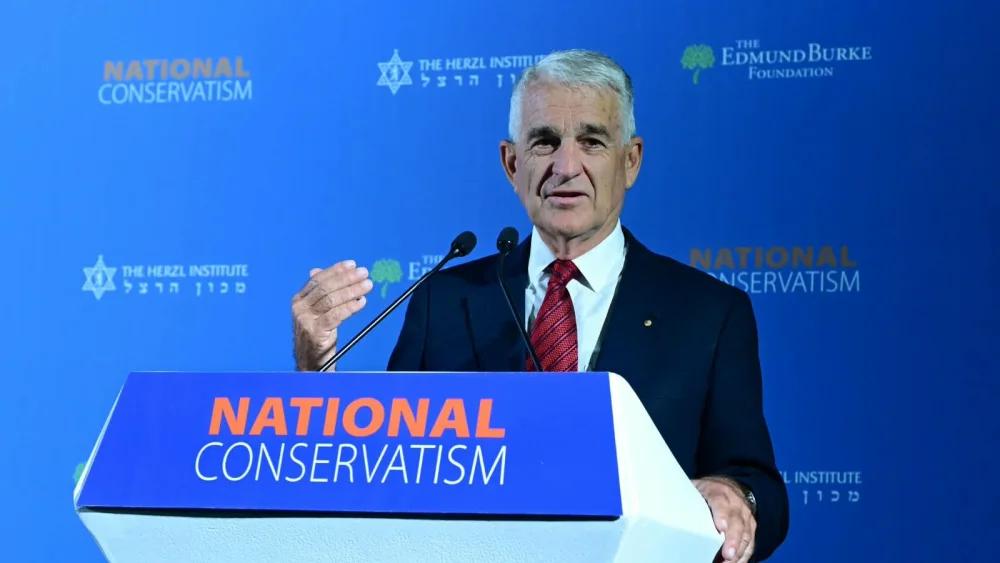
Australian former deputy prime minister John Anderson speaks at the NatCon conference in Jerusalem, Israel on Oct. 7, 2026. Photo courtesy of NatCon.
The flights underlined Israel’s unique status as the only OECD member with fertility above replacement level—an issue that featured prominently at the National Conservatism Conference, or NatCon, in Jerusalem, which Anderson attended along with dozens of other speakers.
The conference, whose founding gathering took place in 2019, ran from Oct. 6 to 8. Many speakers commemorated the third anniversary of the Oct. 7, 2023, massacres in Israel.
Sebastian Gorka, deputy assistant to U.S. President Donald Trump and senior White House director for counterterrorism, addressed the conference via a live video transmission, saying Oct. 7 showed “we are in a war between civilization and barbarity.”
Israel’s high fertility served as a source of inspiration and a case study for foreign conservatives, who described low birthrates elsewhere as a cause of social problems, including increased dependence on immigration, that often eclipse fertility in public discourse.
Anderson, who headed Australia’s right-wing National Party for six years until 2005, attributed Israel’s high birthrate partly to Jewish tradition. The conference had 900 attendees and took place at Jerusalem’s International Convention Center.
“Jewish people pass on understanding and give their young a sense of the journey, which I respect and admire. I think that’s partly why your birthrates are so interestingly higher than in so much of the West, where we’re dealing with nihilism in so many other countries,” Anderson said.
“A deep sense of a journey, of being part of a continuum, helps understand the importance of family,” added Anderson, who has four children.
Another speaker, British former MP and GB News presenter Miriam Cates, expressed a similar idea. To reverse the West’s fertility crisis, she said, “We need to remind every single generation of the truth, and that is, of course, what is established by Jewish patterns of remembering through Shabbat and festivals, which is something that British Christianity has almost entirely lost.”
The conference, which the Edmund Burke Foundation held for the first time in Israel, included sessions on geopolitics alongside discussions of family, faith and national identity.

Hundreds of people attend the NatCon conference in Jerusalem, Israel on Oct. 6, 2026. Photo courtesy of NatCon.
NatCon is part of an effort to put “family, nation and God at the center of a conservative discussion where they had been sidelined for decades,” Yoram Hazony, an Israeli conservative thinker and chairman of the Edmund Burke Foundation, told JNS.
Trump’s first election in 2016 signaled the return of these issues to “the heart of the debate,” he added.
Kevin Roberts, president of the Heritage Foundation, said in his address: “Faith, family and nation—these are the things the new left wants to destroy.”
Israel’s demographic exception
In 2024, Israel had a fertility rate of 2.87 children per woman, according to the Central Bureau of Statistics. The other 37 members of the Organisation for Economic Co-operation and Development—a grouping of mostly wealthy, developed countries—were below the replacement level of about 2.1 children per woman. South Korea’s rate was below one child per woman.
Preliminary figures for 2025 put fertility among Jewish women in Israel at 3.08 children per woman, compared with 2.76 among Muslim women.
Haredi women had a fertility rate of 6.5 children per woman in 2021-2023, according to the Israel Democracy Institute. Jewish women who are not haredi also had fertility above replacement level, at about 2.5 children per woman, according to OECD figures for 2020-2022.
Israel’s demographic exception was the focus of the first topical session at NatCon, a panel on Tuesday titled “Liberalism and the Crisis of the Family.”
Scott Yenor, a professor of political science at Boise State University, drew attention to “the amazing thing happening in Jerusalem,” as he phrased it.
In the United States, conventional wisdom holds that high-rise apartments are not conducive to having children, Yenor said.
“We need to have more suburban homes. But here, look at the cranes. In Israel people are having kids in apartments. Why? Because it’s not based on calculations of space and the convenience of children, but rather on a higher duty to have children,” he suggested.
Yenor proposed that the duty to procreate—a Jewish religious commandment as well as, for many secular Jews, a post-Holocaust imperative—is a key factor behind Israel’s high fertility.
“When the pros and cons of having children become the primary question, then you’re already really behind the eight ball,” Yenor said.
Yenor described reproduction as an existential matter for Western societies, which have turned to millions of immigrants to address labor needs, a development he said has precipitated cultural clashes and political unrest. Regardless of these complications, mass immigration will not solve the fertility crisis, he argued.
He noted that countries with relatively robust support systems for parents, including Norway, Sweden and Finland, have low birthrates despite this aid.
“The old language is the language of duty, and you actually kind of get results with duty,” Yenor said.
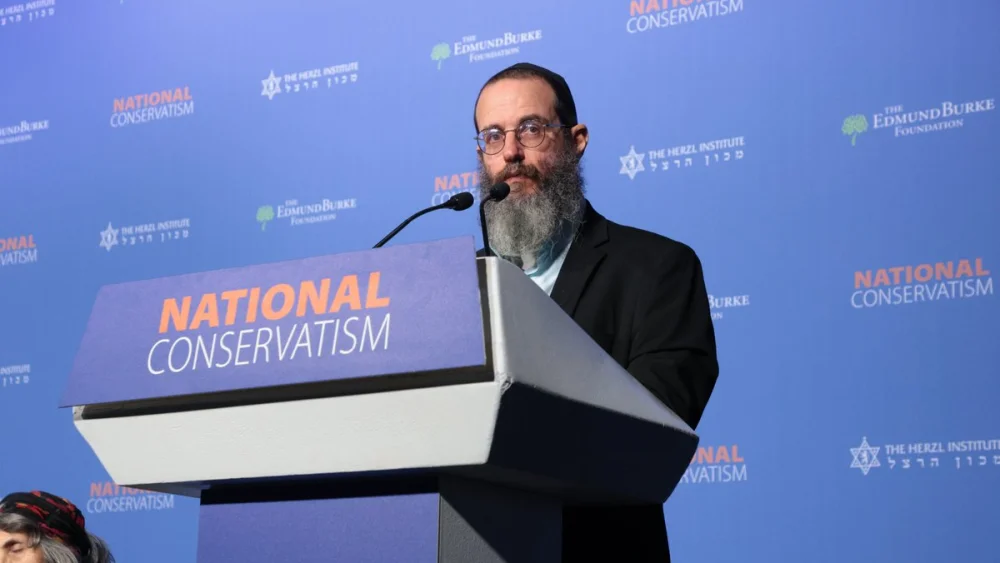
Rabbi Nir Menussi speaks at the NatCon conference in Jerusalem, Israel on Oct. 6, 2026. Photo courtesy of NatCon.
Duty or self-fulfillment?
Rabbi Nir Menussi, an Israeli writer and speaker, advocated presenting the individualistic case for having a family rather than appealing to duty.
“The classic conservative rhetoric about the institution of the family simply won’t cut it,” he said. “All those young Israelis getting married and serving as a demographic model for the rest of the developed world, they aren’t doing so to conserve the family or safeguard the nation or out of a sense of duty. They do it because they seek to live full, happy lives as individuals.”
Conservatives’ message, Menussi added, “should be that getting married and raising children is the highest form of self-fulfillment. We need to make the individualist’s case for the family to explain why the ultimate self-realization is found in the self-transcending act of building a home for one’s family.”
Other speakers included Israeli Finance Minister Bezalel Smotrich and Foreign Minister Gideon Sa’ar.
Some speakers, including Hazony, addressed expressions of antisemitism on the American right.
Jews, Hazony said, “find it harder and harder to consider themselves comfortably a part of the Democratic Party. But the big question is: Is that going to happen in the Republican Party, as well?”
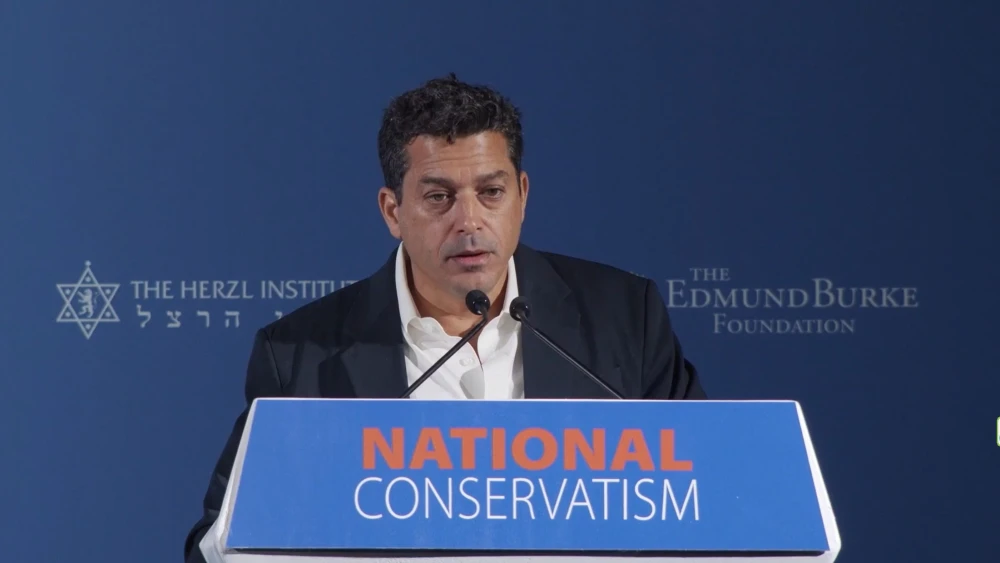
Israeli Diaspora Affairs and Combating Antisemitism Minister Amichai Chikli speaks at the NatCon conference in Jerusalem, Israel on Oct. 7, 2026. Photo courtesy of NatCon.
‘We must break the web of lies’
Israeli Diaspora Affairs and Combating Antisemitism Minister Amichai Chikli said at the conference: “We must break the web of lies that hides behind a broken language, smash political correctness, unite around our national movements, the only natural order in which our freedom has any meaning, and destroy once again the Tower of Babylon.”
Former Polish President Andrzej Duda also spoke, focusing on the geopolitics surrounding Russia’s war with Ukraine.
Post-communist societies, as well as Western ones, with the exception of Israel, have fertility rates below replacement level.
In the West, “we have lost our youthfulness, and of course, it is a nation’s youth that is her potency, her hope and her future,” Cates said.
“Let that be a warning to Israel,” she added. “Sometimes the old ways are the best ways, but those ways must be articulated, understood, defended and written on the hearts of every generation.”