
By David Albright, Sarah Burkhard, and Andrea Stricker[1]
August 20, 2025
During the 12-Day War, attacks by Israel and the United States destroyed Iranian facilities needed to make nuclear weapons — both facilities to enrich uranium and build the nuclear weapon itself. Most analysts have assessed that instead of months to field nuclear weapons, Iran will now need at least one to two years to build a deliverable nuclear weapon. Fielding a nuclear arsenal armed with nuclear-tipped ballistic missiles will likely take even longer. Moreover, the Iranian regime knows that any effort to enrich uranium or build a nuclear weapon risks detection and the triggering of fresh, potentially more destructive attacks by Israel and the U.S.
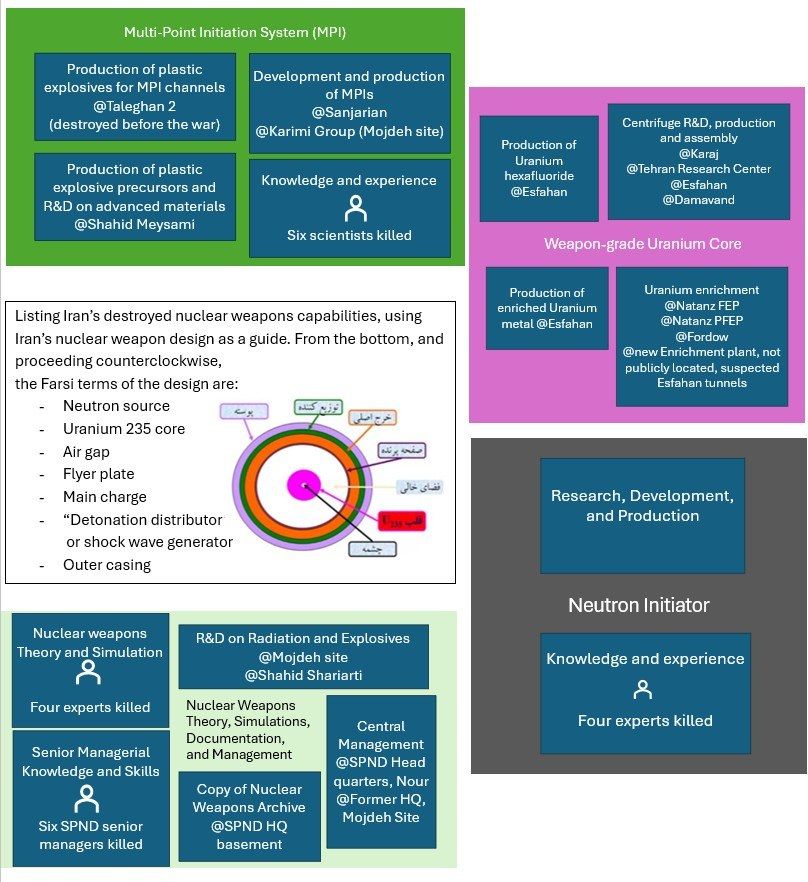
The diagram recognizes that Iran’s nuclear weapons program prior to the beginning of the 12-Day War was immense, dispersed across many sites, and involved many scientists and engineers. Iran’s program resulted from the regime’s decades-long effort to bolster readiness to build nuclear weapons, a process designed to eliminate technical bottlenecks and shorten timelines to building the bomb, while the regime held off on a final decision to actually build a nuclear weapon. This readiness program emerged from Iran’s late 1990s to 2003 crash nuclear weapons program, codenamed the Amad Plan, with a functional nuclear weapons design, relevant equipment and expertise, and various cover stories for work that would continue.
Iran’s post-Amad, decentralized effort complicated public understanding of the threat that the nuclear weapons program posed and created a challenge for Israel’s military planners. Although decentralized, the effort was coordinated. Many capabilities were co-located with other threatening capabilities, providing an incentive for Israel to broaden its attacks. Further, many of the most sensitive capabilities were tied to individuals with specific expertise, rather than specific locations. It quickly became clear after the 12-Day War that attacks on facilities and persons were so comprehensive that Iran’s capabilities—in terms of facilities, equipment, and expertise to make nuclear weapons—were destroyed. Iran’s ability to reconstitute a nuclear weapons program is severely constrained.
The visualization showcases key, known facilities and assets that were once part of Iran’s program to develop nuclear weapons but are now destroyed or severely damaged. Remnants of that program exist — most notably enriched uranium stocks and possibly undeployed centrifuges. There are also other, second-tier scientists who could resume the work of those that were killed. However, Iran’s challenges in producing nuclear weapons are far greater today. Iran possesses far less information and fewer experienced scientists, while facing a shortage of necessary equipment. Moreover, any personnel who choose to work on nuclear weapons will face increased personal risks, with success far from certain even in an effort to build a crude nuclear weapon.
Note: Plutonium production capabilities are not included in the visualization, as Iran’s known weapons design was based on weapon-grade uranium (WGU). Nonetheless, it should be noted that the plutonium pathway sustained damage through Israel’s attack on the Arak Heavy Water Reactor and Heavy Water Production Plant.
Sources
[1] Andrea Stricker is deputy director of the Nonproliferation and Biodefense Program at the Foundation for Defense of Democracies (FDD) and an FDD research fellow.