
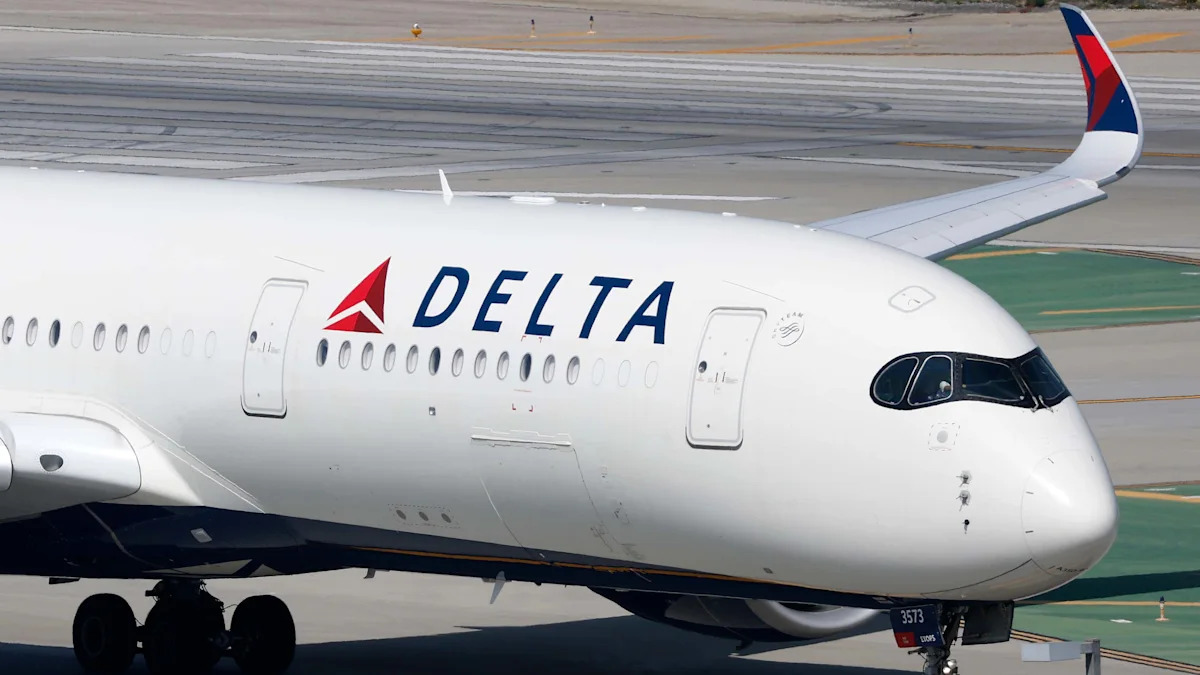
Delta Air Lines (DAL) reported third quarter results on Friday morning that missed the mark, as strength from Delta’s premium business could not blunt the effects of higher fuel prices. Delta subsequently cut its guidance, noting that its total fuel bill for the year would increase by a whopping $6 billion.
For the quarter, Delta reported Q3 adjusted revenue of $17.58 billion, slightly below analyst estimates of $17.76 billion per Bloomberg, up 15.7% from a year ago. Delta posted adjusted earnings per share (EPS) of $1.72 vs. $1.82 estimated, on adjusted net income of $1.134 vs. $1.23 billion expected.
Delta said its Q3 performance was hit by $500 million in higher fuel costs than the guidance it issued in July. Delta’s total fuel bill for the quarter hit $4.1 billion, up 62% from a year ago, as the US-Israeli war with Iran rocked the global oil market.
82.14 -0.83 (-1.00%)
At close: October 8 at 4:00:02 PM EDT
Delta stock was down over 4% in pre-market trading.
Speaking of guidance, Delta cut its adjusted EPS forecast to $5.10 – $5.60 from $6.50 – $7.50, with free cash flow coming down to $2.5 billion from a range of $3 billion to $4 billion.
“For the full year, we expect to generate a pre-tax profit of roughly $4.5 billion, absorbing a $6 billion increase in fuel costs,” CEO Ed Bastian said in a statement. “Looking ahead, our focus remains on profitable growth and delivering against our long-term financial framework, including mid-teens margins and returns, durable free cash flow, and gross leverage of approximately one times.”
“All of it’s fuel,” CFO Erik Snell added when asked where the impact of the guidance cut came from on a call with reporters. Snell added that he expects fuel costs to be higher next quarter as well, but Delta is planning to grow capacity by 2%, a reversal from earlier this year.
It was Delta’s highest-spending customers who helped blunt some of the blow this quarter.
Delta’s premium business grew 18% year over year in Q3, with loyalty and related revenue also up 18%. American Express (AXP) credit card remuneration grew 15% from a year ago, on track to “exceed $9 billion” for the year, Delta said.
 A lie flat seat in a Delta One cabin. · Delta
Part of the reason Delta’s premium segment is so strong is the perceived benefits of higher service and better loyalty treatment that Delta’s SkyMiles members expect. However, one area that’s been a thorn in the airline’s side is in-flight wifi.
Competitors like United (UAL) and American Airlines (AAL), which just announced an expanded Starlink deal, are looking to skim off Delta’s top customers, arguing that the Starlink internet service it offers is unparalleled. Both the airlines and others who offer Starlink are issuing “status challenges” to Delta customers, meaning they will match the customer’s status on those airlines immediately, assuming the customers continue to spend with them.
This comes after the war of words between Bastian and Musk, CEO of SpaceX, heats up.
The round started when an airline industry watcher posted remarks Bastian reportedly made at a Delta company event. Regarding SpaceX’s (SPCX) Starlink satellite service, Bastian allegedly said, “We do not want to be with Elon Musk. Trust me.”
Musk did not let this one go. “He will lose his job over this,” he wrote on Tuesday, replying to a View from the Wing post about the remarks by travel blogger Gary Leff.
Musk added, “Delta will lose a lot of customers,” in a reply to author John LeFevre, who posted that United (UAL) has more than 600 Starlink-equipped planes and Delta has zero.
Delta said it continued its rollout of free wifi for SkyMiles members across its planes, claiming recent “satellite upgrades” are expected to provide meaningful enhancements to connectivity.
Pras Subramanian is Lead Transportation Reporter for Yahoo Finance. You can follow him on X and on Instagram.
Click here for the latest technology news that will impact the stock market.
Read the latest financial and business news from Yahoo Finance