
This story originally appeared in the Forward. To get the Forward’s free email newsletters delivered to your inbox, go to forward.com/newsletters.
On the third anniversary of the Oct. 7, 2023, Hamas attack on Israel— his first commemoration as New York City’s mayor—Zohran Mamdani greeted the day with a message mourning the Israeli victims and the 251 people taken hostage then devoted the rest of the statement to condemning Israel’s war in Gaza as a “genocide” and accusing the U.S. government of complicity in Israeli war crimes.
“The suffering did not begin nor end that day,” Mamdani said in a 200-word statement, noting the Palestinian casualties of the war that was launched as a military campaign against Hamas. “Three years later, we must refuse to accept a world in which occupation and apartheid continue, where war crimes are met with impunity, and our federal government continues its complicity with every arms shipment.”
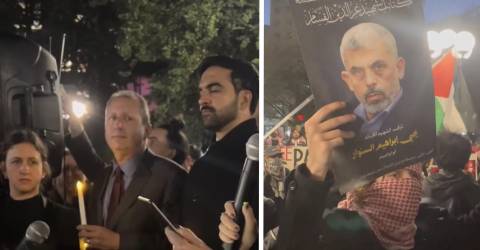
Still, Mamdani’s statement and 10 months in office have failed to satisfy some of his supporters, including young activists who interrupted a vigil on Wednesday night where the mayor was in attendance to honor the Israeli and Palestinian victims of Oct. 7 and the ensuing war.
Waving Hamas and Palestinian flags, chanting “Death to the IDF” and “Go back to Poland,” pro-Palestinian activists poured into Union Square shortly before the vigil was scheduled to start. New York Police set up barricades and a buffer zone around the event as the crowd chanted “Mamdani, you can’t hide. We charge you with genocide.”
The mayor’s words and chaotic demonstrations at the end of the day stood in stark contrast to how other elected officials, including New York Gov. Kathy Hochul, approached the anniversary, which Hochul noted was the deadliest day for the Jewish people since the Holocaust.
“The pain of that dark day has not faded,” she wrote. “But neither has the strength, resilience and enduring hope of the Jewish people.”
House Democratic leader Hakeem Jeffries noted the attack was carried out by “Hamas terrorists intent on destroying Israel,” but also acknowledged Palestinian deaths and Gaza destruction.
New York Attorney General Letitia James released a statement, to “honor the innocent people murdered and families forever changed by the Hamas terrorist attacks,” a term some noted Mamdani did not use.
”Not Once Do You Say ‘Jews’”
Jonathan Greenblatt, CEO of the Anti-Defamation League, noted another term Mamdani did not include.
“Not once do you say ‘Jews,’ Greenblatt wrote on X.
“You are weaponizing a day meant for mourning the worst massacre of Jews since the Holocaust to recycle your usual anti-zionist talking points,” he added. “The city with the largest Jewish population outside Israel deserves a mayor who can honor the dead without exploiting them.”
ADL was just one of many Jewish organizations that decried the mayor’s statement on Wednesday. Denouncements poured in from American Jewish Committee, the Simon Wiesenthal Center and Rabbi Rick Jacobs, president of the Union for Reform Judaism, who said he told the mayor directly that words matter.
“Turning this anniversary into an indictment of the Jewish state is not only hurtful, and deeply offensive, but it also makes Jewish New Yorkers less safe,” Jacobs said.
David Greenfield, a former Councilmember and head of the Met Council charity group, called Mamdani’s statement unhelpful, one that risks “further dividing” New Yorkers. “I really wish the Mayor of NYC would just focus on NYC,” he wrote on X.
Politicians too, both Democrats and Republicans, also criticized how the mayor marked the anniversary.
But Democratic congressional nominee Brad Lander, an outspoken Jewish ally of the mayor, did not criticize the mayor’s message. Instead, on his Substack, he shared his reflections on the anniversary, calling for Israelis, Palestinians, Jews and Muslims to mourn together as a first step toward peace.
“We can mourn for those lost on October 7th and still acknowledge the enormous imbalance of power between Israel and the Palestinians,” he wrote. “Over the past three years, so much more death, destruction, and displacement has fallen on Palestinians.”
A pro-Palestinian activist since his college years, Mamdani has been unapologetic about his anti-Zionist views that continue to shape his tenure. His harsh rhetoric on Israel and handling of antisemitism — including refusal to define that term — and defense of pro-Palestinian protests outside synagogues have strained relations with parts of the Jewish community.
Fierce Backlash
Mamdani drew fierce backlash earlier this year when he produced a Nakba Day video commemorating the displacement of Palestinians during Israel’s founding in 1948 around Israel’s independence day.
A new poll published Wednesday morning found that 64% of Jewish voters in the city prefer that Mamdani skip any event marking the Oct. 7 massacre. But on Wednesday evening, he did, and encountered more critics, including young activists from multiple chapters of the Young Democratic Socialists of America and Students for Justice in Palestine who accused him of capitulating “to Zionist pressure.”
Many of them had backed his bid for mayor and attended the pro-Palestinian protests on college campuses after the Oct. 7 attacks.
Maya Corda, a student at College of Staten Island, said Mamdani campaigned on supporting the Palestinian movement “because he needed it to win.”
“Then the second he gets into the power, he like switches and turns on us,” she told the Forward. “He doesn’t follow through with any of the promises he made. Not just for Palestine.”
Protester Jeremiah Cedeno, a member of the Bori Collective, a Puerto Rican community organization, expressed anger that Mamdani allowed Israeli Prime Minister Benjamin Netanyahu’s recent visit to the United Nations.
“Netanyahu came in and out like he owns the place,” Cedeno said. “It’s a betrayal to all the organizers who supported [the mayor.]”
Though Israelis for Peace NYC carried on with their vigil after much delay, protesters continued chanting and drumming outside the barricades, making it impossible to hear the speakers. Even when one speaker labeled Israel’s actions in Gaza a genocide and explained that testimonials would be shared from Israelis and “friends in Gaza,” the protesters drowned her out.
Motivated by Hatred and Excitement
Police sealed the barricades once Mamdani arrived.
Nicole Izsak came to the peace vigil to honor her cousin who was killed in the Oct. 7 attacks. She confronted a group of protesters when they arrived saying “This is a space for mutual recognition.”
They taunted her, asking “Do you want to colonize this space?”
“They have no no empathy, no understanding, no historical context,” Izsak told the Forward. “They are motivated by hatred and excitement.”
Abby Tochinsky also attended the vigil to remember the victims and expressed dismay that the protesters disrupted what was supposed to be a peaceful and solemn occasion.
”If you show up and behave this way when people are remembering a massacre and mourning—it’s just pure hate,” she said.
Joe Sherinsky showed up to the vigil with a shofar, intending to blow it while Mamdani was speaking, but he feared that by blowing it at the wrong time it might look like he was with the protesters.
“Sometimes you need to make a sound to drown out the hate,” he said.
Police outside the barrier frequently stepped between pro-Israel supporters and pro-Palestinian protesters. But in the midst of the screaming, name calling and threats, moments of common ground shone through. At one point, a man in a kippah and a man in a keffiyeh shook hands. They had found common ground over a shared grievance: Mamdani.