
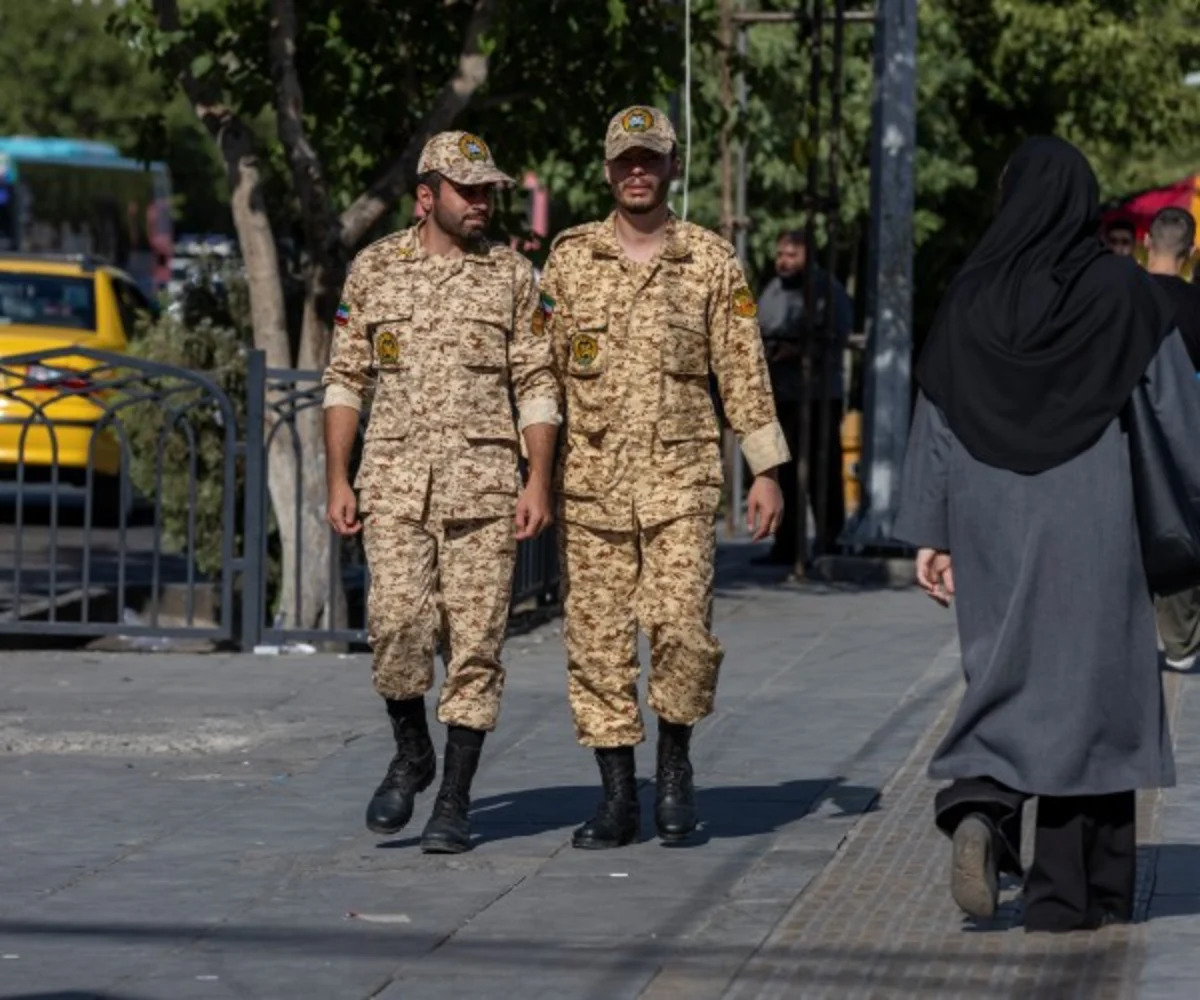

Military soldiers are seen walking on a street in Tehran, Iran. (Majid Saeedi/Getty Images)
Thousands of motorcyclists affiliated with government institutions on Tehran’s streets, military training in a public square, and commanders warning that a “spark” could become a blaze raise an important question: What confrontation is Iran’s regime preparing for?
The official narrative emphasizes defense against foreign threats. But security officials’ statements reveal another concern: renewed domestic protests connecting with opponents capable of organizing them.
For observers who view Iran primarily through negotiations, its nuclear program, and its military capabilities, these preparations carry an important message.
The regime may withstand external pressure while still fearing that protests over living conditions could challenge its political control.
In a Sept. 25 report, the Spanish news agency EFE described thousands of motorcyclists attending an event billed as a “parade of 40,000 motorcyclists.”
Participants included members of the Islamic Revolutionary Guard Corps (*IRGC), the Basij militia, police, and other government institutions.
The same report described Tehran’s Imam Hussein Square being converted into a military training ground, complete with walls and barbed wire.
The advertised figure differs from the number of participants observed.
Still, the large presence of government forces in public spaces was a clear display of readiness and power.
Commanders’ statements explain the domestic purpose of this display.
Former police chief Esmail Ahmadi-Moghaddam warned the intelligence ministry, the Revolutionary Guards, the Basij, and the police that opponents wanted to turn every “spark” into a blaze.
Current police chief Ahmad-Reza Radan likewise identified living costs, gasoline, the economy, and unemployment as issues that, in his words, the enemy sought to exploit to foment unrest.
These warnings show that the security apparatus sees a connection between economic hardship and political protest.
The regime cannot know which price increase, strike, or confrontation with a citizen might bring scattered protests together.
It therefore seeks to remind people of the consequences of taking to the streets before a gathering even begins.
But why does a regime with a record of firing directly on protesters and carrying out mass arrests remain worried?
Because dispersing a crowd does not remove the conditions that brought it together. Repression can empty the streets temporarily.
High prices, corruption, and the absence of prospects for improvement remain. If activists also preserve their connections, the next wave of protests will not necessarily have to start from scratch.
This is where organized opposition becomes important.
The statement marking the 45th anniversary of the National Council of Resistance of Iran, an opposition coalition whose principal members include the People’s Mojahedin
Organization of Iran, or MEK, reports that Resistance Units were active in all 31 provinces during the Iranian year 1404, from March 2025 to March 2026.
These units are MEK-affiliated networks operating inside the country.
The council reports 4,092 operations and 240 campaigns during that year, as well as 630 operations between Dec. 28, 2025, and Jan. 11, 2026, during the uprising.
The political significance of these figures lies less in the number of actions than in their continuity and geographic reach: Activity preceded the mass protests and intensified as they spread.
A network that maintains its connections can carry experience from one period of protest into the next. Activity across multiple regions also forces the security apparatus to divide its attention and resources among more locations.
This is the difference between a crowd that takes to the streets for a day and an organization that maintains its presence between uprisings.
Discontent has broad social roots.
The question is whether, alongside it, a force exists that can preserve connections, experience, and the capacity for collective action.
The regime’s judicial conduct shows that this issue occupies an important place in its security calculations.
Six MEK prisoners, arrested before the uprising, were executed between March 30 and April 4, 2026.
In presenting their cases, the judiciary emphasized organizational membership, the formation and leadership of groups, and organized activity aimed at overthrowing the regime.
In addition to these six prisoners, 40 other protesters were executed.
Carrying out these sentences amid a war with foreign powers shows that pursuing organized opponents remained a priority.
Executions alone do not establish a network’s strength or determine Iran’s political future.
But alongside commanders’ warnings and the deployment of forces in the capital, they clarify the danger the regime takes seriously: widespread discontent becoming a protest movement capable of sustaining itself and mobilizing again.
For Washington, this distinction matters.
Weakening Iran’s military capabilities does not necessarily produce political change inside the country.
Nor does the regime’s ability to suppress one wave of protests demonstrate lasting stability. Any assessment of Iran’s future must also consider conditions within society and the opposition’s capacity to organize.
Tehran’s security preparations show that the regime’s survival will not be determined solely at the negotiating table or on the battlefield against foreign adversaries, but equally back home.
Hamid Enayat (@h_enayat) is an expert on Iran, and a writer based in Paris. He has written frequently on Iranian and regional issues in the past 30 years. Read more of Hamid Enayat Insider articles — Click Here Now.
© 2026 Newsmax. All rights reserved.