
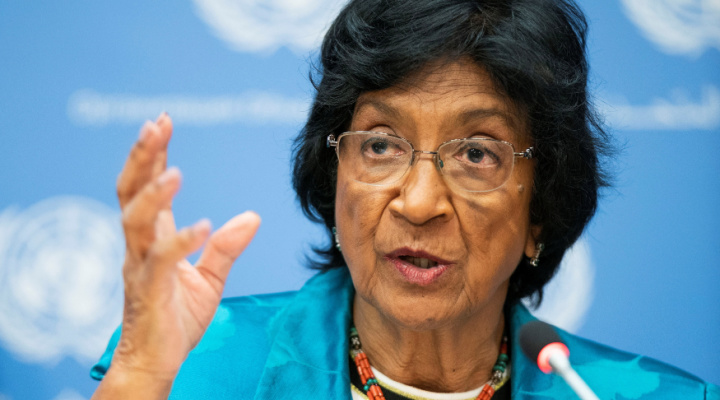
Member of the United Nations Independent International Commission of Inquiry on the Occupied Palestinian Territory, including East Jerusalem, and in Israel, Navanethem Pillay speaks during a press briefing at the United Nations headquarters in New York, US, Oct. 27, 2022. Photo: REUTERS/Eduardo Munoz
Navi Pillay, the former United Nations human rights chief who led an investigation accusing Israel of genocide in Gaza, was awarded the 2026 Nobel Peace Prize on Friday for her contributions to international law and justice.
The Norwegian Nobel Committee awarded the prize to the 85-year-old South African jurist “for her efforts to promote peace and international law,” praising her decades of work prosecuting war crimes, crimes against humanity, and genocide.
“The system of international law is under tremendous pressure, and its institutions are under attack,” the Nobel Committee said in announcing its decision. It described Pillay as having “exceptional courage and integrity.”
Pillay’s selection comes a year after a UN Commission of Inquiry (COI) she chaired concluded that Israel had committed genocide in Gaza.
Israel’s Foreign Ministry condemned the award on Friday, accusing the Nobel Committee of legitimizing anti-Israel hatred and prejudice by honoring a figure who had promoted what it called the “genocide lie.”
The ministry described the decision as a “grotesque weaponization of an award” and said that Nazi propaganda minister Joseph Goebbels “is certainly applauding from hell.”
“If there were an award for lies, hatred, and blood libels, Navi Pillay wouldn’t just be a contender. She’d be a frontrunner,” the ministry said in a statement posted on X.
Anne Herzberg, legal adviser and UN representative for the Jerusalem-based watchdog NGO Monitor, accused Pillay of enabling antisemitism throughout her career at the United Nations.
“At a time when antisemitism is spiraling out of control, it is hardly surprising that the Nobel Peace Prize Committee chose to give this year’s award to Navi Pillay, who in her various UN roles has allowed Jew hatred and demonization of Israel to flourish,” Herzberg told The Algemeiner, describing the Nobel Committee’s choice as part of a history of inappropriate selections.
She accused Pillay of “egregious antisemitic remarks and repeatedly violat[ing] international fact-finding standards” while chairing the commission.
“She has whitewashed Hamas terrorism and spread the genocide blood libel,” Herzberg said.
The COI concluded in a 72-page report released in September last year that Israeli authorities had committed four of the five acts constituting genocide under the 1948 Genocide Convention in a bid to “destroy the Palestinians.”
“It is that there is an intent to destroy the Palestinians in Gaza through acts that meet the criteria set forth in the Genocide Convention,” Pillay said.
The commission accused Israel of wantonly killing Palestinians, causing “serious bodily or mental harm,” imposing conditions intended to bring about their destruction, and “imposing measures intended to prevent births.” It also accused Prime Minister Benjamin Netanyahu, President Isaac Herzog, and former Defense Minister Yoav Gallant of inciting genocide.
Israel rejected the findings as politically motivated and unfounded, maintaining that its military operations were directed against Hamas following the terrorist group’s Oct. 7, 2023, massacre, rather than against Palestinians as a people.
The genocide report followed a March 2025 investigation in which the same commission accused Israel of committing genocidal acts and employing sexual violence against Palestinians, allegations rejected by Israeli officials.
Israel’s mission to the UN in Geneva challenged the commission’s methodology, arguing that investigators had accepted secondhand and uncorroborated allegations against Israeli soldiers while applying more demanding evidentiary standards when examining Hamas’s conduct.
Pillay’s appointment to lead the commission had drawn objections years before the genocide findings.
In February 2022, Geneva-based watchdog UN Watch submitted a 30-page complaint calling for her recusal, arguing that she had publicly prejudged issues she was subsequently appointed to investigate.
The complaint cited a 2020 petition Pillay signed demanding sanctions against what its organizers called apartheid Israel, as well as a 2017 interview in which she asserted that racial segregation amounting to apartheid was taking place in Israel.
The commission itself, established following the May 2021 war between Israel and Hamas, drew criticism for its unprecedented open-ended mandate.
In June 2023, the United States and 26 other countries condemned the inquiry at the UN Human Rights Council, criticizing its unlimited duration and what they described as disproportionate scrutiny of Israel.
The controversy also extended to Pillay’s fellow commissioners.
In 2022, Indian human rights expert Miloon Kothari suggested that a “Jewish lobby” exercised control over social media and questioned why Israel was permitted to remain a UN member state. Kothari subsequently apologized following international criticism.
Another commissioner, Australian human rights expert Chris Sidoti, drew criticism for saying accusations of antisemitism were “thrown around like rice at a wedding.”
Pillay defended her colleagues against allegations of antisemitism and, when questioned again about Kothari’s remarks in 2023, said the matter had already been addressed.
Herzberg also pointed to Pillay’s tenure as UN High Commissioner for Human Rights during the 2009 Durban Review Conference, at which then-Iranian President Mahmoud Ahmadinejad delivered an anti-Israel speech that prompted European diplomats to walk out. Pillay publicly condemned his remarks afterward but criticized governments that boycotted the conference.
In 2014, more than 100 US lawmakers signed a letter addressed to Pillay accusing the Human Rights Council of investigating Israel rather than Hamas during the Gaza war and declaring that the body “simply cannot be taken seriously as a human rights organization.”
In September 2023, more than 30 Jewish and civil rights groups called on three major US law firms to withdraw their sponsorship of an international law conference that planned to present Pillay with an Outstanding Achievement Award despite her “bigotry” and harboring a “bias that fundamentally undermines the fight against antisemitism, Israeli-Palestinian peace prospects.”
Born in Durban in 1941 to a family of Indian descent, Pillay served as a judge at the International Criminal Court and as UN High Commissioner for Human Rights from 2008 to 2014.
NGO Monitor founder and president Gerald Steinberg also issued a blistering condemnation of the Nobel Committee’s decision.
“Honoring notorious antisemite Navi Pillay with the Nobel Peace Prize is one more obscene step in the madness. If the committee would have been around in 1492, they would have given the award to Grand Inquisitor Tomás de Torquemada. Who is next – Francesca Albanese?” Steinberg told The Algemeiner, referring to the Spanish Inquisition’s first grand inquisitor and the UN special rapporteur on the Palestinian territories, who has accused IDF forces of raping, abducting, and executing Palestinian women, among other charges.