
More than 860,000 without power
Isaias has left more than 860,000 people without electricity as it moves inland across the south-east.
Here’s the latest breakdown of the worst affected states, according to poweroutage.us:
Florida: 436,745
Alabama: 316,366
Georgia: 87,334
Washington: 6,550
California: 4,467
Texas: 4,404
Ohio: 3,827
Idaho: 1,549
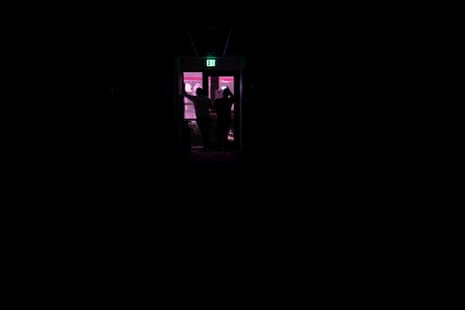 People look at wind, rain, and flying debris from a hotel lobby in Pensacola, Florida, during a power outage ahead of the arrival of hurricane Isaias. Photograph: Marco Bello/ReutersShare
Key events
How storm surges are formed
As a hurricane approaches a coast, the churning winds force ocean water up on to land; atmospheric pressure from the storm also helps squeeze the water ashore. The shallower the continental shelf, the higher the threat of a dangerous surge. The water may take a couple of days to fully subside.
Water is heavy – about 1,700lb, or 770kg, to a cubic yard (0.76 cubic meters) – and it can move fast in a surge, sweeping people to their deaths, throwing about boats and vehicles, and pulverizing structures. Six inches of fast-moving water is enough to knock over an adult, the National Hurricane Center (NHC) says. Surges become even more dangerous as they coincide with high tide.
Hurricane Katrina in 2005 caused storm surges of over 25ft on the Mississippi coastline. The NHC says many of the 1,500 people killed lost their lives, directly or indirectly, due to the storm surges.
Our data visuals team has been keeping tabs on the path of hurricane Isaias. Here’s where we expect it to hit:
ShareIsaias weakens as it moves across Alabama and Tennessee Valley – NHC
The storm is expected to move across Alabama and into the Tennessee Valley later today and Sunday, the National Hurricane Center (NHC) said in its latest advisory.
“Maximum sustained winds have decreased to near 35 mph (55 km/h) with higher gusts. Slow weakening is forecast today, and Isaias is forecast to dissipate on Sunday,” the center said.
The NHC warned heavy rainfall across the south-east increases the risk of flash flooding, with southern Alabama, the Florida Panhandle and south-western Georgia expected to be among the hardest-hit areas, while landslides are also possible in the Southern Appalachians.
ShareMore than 860,000 without power
Isaias has left more than 860,000 people without electricity as it moves inland across the south-east.
Here’s the latest breakdown of the worst affected states, according to poweroutage.us:
Florida: 436,745
Alabama: 316,366
Georgia: 87,334
Washington: 6,550
California: 4,467
Texas: 4,404
Ohio: 3,827
Idaho: 1,549
People look at wind, rain, and flying debris from a hotel lobby in Pensacola, Florida, during a power outage ahead of the arrival of hurricane Isaias. Photograph: Marco Bello/ReutersShareIsaias, first Atlantic hurricane of 2026 season, batters US Gulf coast
More than half a million people were without power after hurricane Isaias wreaked havoc on the US Gulf Coast, with Alabama and the Florida Panhandle being hit the hardest by the storm.
The category 2 hurricane made landfall near Destin, Florida, late Friday, with maximum sustained winds of 105 miles per hour. It weakened to a post-tropical cyclone by early morning, with winds of 65 mph, the National Weather Service said.
Debris is seen in an intersection in Pensacola, Florida as wind and rain from Hurricane Isaias pass through the area. Photograph: Joe Raedle/Getty Images
More than 750,000 people in Florida and Alabama have been left without power, according to poweroutage.us, with outages also reported in Georgia for tens of thousands of customers.
“Things are flying really fast, and I’ve never seen wind this fast before, so it’s intense, it’s scary,” Jonathan Ramos, a 40-year-old government employee, said from his hotel in Pensacola, Florida, where the power went out.
“I don’t recommend people coming down here for fun to do this.”
You can read our overnight report here:
Isaias intensified into a hurricane on Wednesday night, then becoming the first Atlantic hurricane of the 2026 season.
In the days prior to landfall, storm surge warnings were in effect from the mouth of the Mississippi River to the Suwannee River in Florida. Residents in the affected areas were urged to follow advice from local officials and evacuate if instructed to do so.
Stick with us as we bring you the latest news and updates from hurricane Isaias.