
Amna Nawaz:
Candidates for U.S. Senate in three battleground states faced off in fiery debates last night that frequently veered into personal attacks.
In Michigan, Republican Mike Rogers tried to tie Democrat Abdul El-Sayed’s family to terrorism, despite there being no evidence.
Abdul El-Sayed (D), Michigan Senatorial Candidate: You go after my mom?
Mike Rogers (R), Michigan Senatorial Candidate: I’m not going after your mom.
Abdul El-Sayed:
That’s exactly what you’re doing.
Mike Rogers:
What your mom was working at, I was going after that organization that was indicted for funneling money to al-Qaida.
Amna Nawaz:
In Georgia, Democratic Senator Jon Ossoff accused Republican Congressman Mike Collins of bigotry and racism.
Sen. Jon Ossoff (D-GA):
It’s not just that you have hired half the Third Reich to staff your congressional office and you have promoted neo-Nazi content online. It’s that you’re robbing your constituents to subsidize your donors. If John Lewis were marching today from Selma to Montgomery, Mike Collins would be grabbing a billy club.
Rep. Mike Collins (R-GA), Senatorial Candidate: I have condemned racism, antisemitism, hate. I don’t care where the source is. And I tell him that too. It’s wrong. We have no place in this world for that.
Amna Nawaz:
And, in Maine, Republican Senator Susan Collins demanded that Democrat Troy Jackson apologize after he accused her of corruption.
Troy Jackson (D), Maine Senatorial Candidate: She could use her leverage to stop this war, but instead they’re making money. I mean, Senator Collins and her husband are making money more off of this war, and so is a whole bunch of other people, and that’s why this doesn’t stop.
Sen. Susan Collins (R-ME):
That is absolutely outrageous, and you owe me an apology.
Troy Jackson:
No, you owe me an apology.
Amna Nawaz:
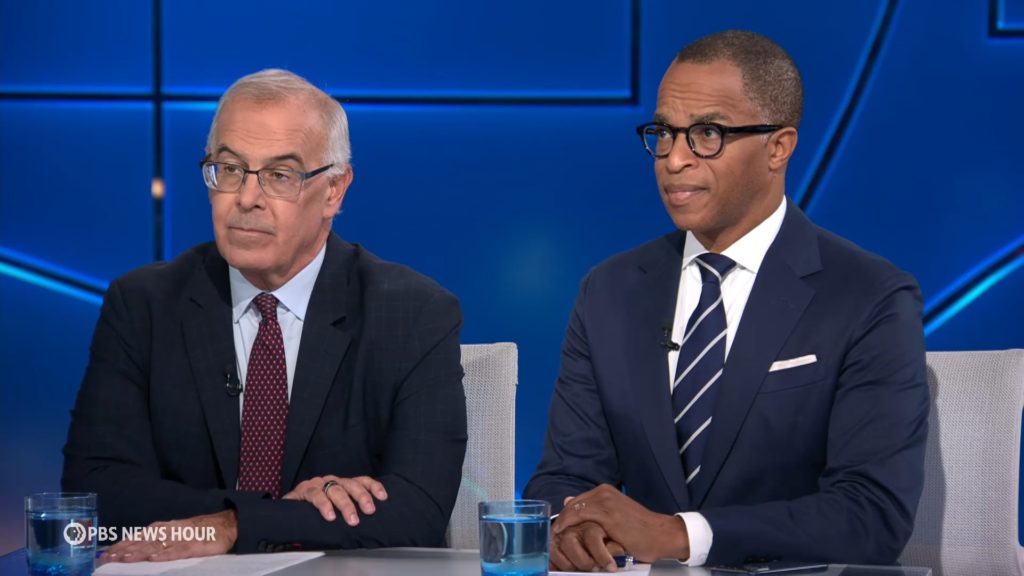
For more on the battle for control of Congress, we turn now to the analysis of Brooks and Capehart. That is “The Atlantic”‘s David Brooks and Jonathan Capehart of MS NOW.
Good to see you both.
Jonathan Capehart:
Hey, Amna.
Amna Nawaz:
Speaking with those debates last night, some policy discussions, but very heavy on the personal attacks. And in the context of this, we should say The Cook Political Report just this week shifted eight house races and three Senate races in Kansas, North Carolina, and New Hampshire toward Democrats.
Jonathan, Senate control is on the line here. Is that why these are getting so heated?
Jonathan Capehart:
Yes.
I mean, I have said many times — excuse me — I have said many times here that this election cycle, midterm election cycle, reminds me of 2006, exactly 20 years ago. These same conversations were happening, particularly with the Senate. The Senate map then and now was supposed to be extremely difficult, if not impossible for Democrats to retake the majority.
And here we are in just Georgia, Michigan, Maine. I mean, Maine would be the only pickup of the three. But the fact that these debates are so nasty and personal shows that Democrats feel they are within striking distance. Republicans feel perhaps that they are on their on their back foot — on their back feet.
And, I mean, given who the president is, same — president of their party, they should feel that they’re on their back feet.
Amna Nawaz:
David, you agree?
David Brooks:
Some — I agree with Jonathan, but I think something has changed since 2006, which is we have had 10 years of political, moral decay, and sound a lot — the candidates used to be inhibited a bit by the sense that, if I lie, if I’m a total sleazebag, it might hurt me.
And now they realize it won’t hurt me at all. And, in fact, my partisans may actually like it. And so you had — I think, in those three cases, all three of those things were sleazy behavior, Troy Jackson. Susan Collins has some Boeing stock in her portfolio. And he calls her a war profiteer because of that? That’s ridiculous.
The insinuations that El-Sayed is involved in terrorism because he’s Muslim, ridiculous. Jon Ossoff, my advice to him is, if you start calling your political opponents Nazis, maybe it’s time to shut up. That’s just not what we do here in this country.
And the Bull Connor stuff — and a lot of these candidates have real weaknesses. Like, Mike Collins, who’s the Georgia Republican, I think what’s accurate to say about him is, he has a disturbing number of young men on his — around him who have ties to the alt-right and some of the vile antisemitic stuff online.
El-Sayed can…
Amna Nawaz:
Who have shared, we should say, white nationalist content online, right.
David Brooks:
Right.
Amna Nawaz:
That’s the accusation.
David Brooks:
El-Sayed, he can’t tell the difference between Iran and Israel. When asked whether — which was a greater threat, he couldn’t tell the difference. Iran has killed thousands of Americans. Iran is the leading cause of — or leading sponsor of terrorism around the world.
If you can’t tell the difference, then something’s wrong here. And so they could have gone after legitimate weaknesses. But in each case, they took it to 11 and it was dishonest.
Amna Nawaz:
Meanwhile, we know the cost of living, price of gas, these are the things at the top of all voters’ minds.
And I want to ask you about what we heard from the president himself late today, which was a deal with Vladimir Putin to get diesel from Russia. That reverses years of pressure on Moscow for their war in Ukraine. It also flies in the face of new legislation that Congress just passed that would allow the president broad powers to punish countries that buy Russian oil.
It also follows Trump pledging that there would be no more strikes on Iran, David, until after the midterm elections. These are all foreign policy flip-flops really geared towards getting oil prices down?
David Brooks:
Yes. Yes. Maybe after the races are called, then Trump starts bombing.
It’s ridiculous. The important — the most important thing that Trump is dealing with on these issues is that Russia cannot be allowed to win this war. If Russia’s allowed to win this war, then America becomes and the world becomes more dangerous for a generation.
And to skip over that on some futile attempt to lower diesel prices strikes me as ridiculous, especially since it won’t work. In part, even if Russia could produce all the diesel it used to be capable of, it’s a tiny percentage of the global supply. Second, their capacity to refine and export diesel has been severely weakened by Ukraine.
And so this is not going to bring prices down. It’s just sort of a flamboyant gesture which has a corrosive effect by legitimizing Vladimir Putin and what he’s doing in Ukraine.
Jonathan Capehart:
And also, at the same time, helping Russia to finance its war machine against Ukraine. And Russia can — you were saying Russia cannot be allowed to win this war.
You are absolutely right, and yet the president is doing nothing, it seems, to help bring that — bring that goal to fruition.
Amna Nawaz:
Meanwhile, you heard my interview earlier with Eric Deters. He’s a former Trump donor. He alleges that the U.S. ambassador to Greece, Kimberly Guilfoyle, asked him for 100,000 dollars to pay off her American Express credit card bill in exchange for White House access.
He’s looking to get to people to try to extradite an Ohio doctor who fled to Pakistan. What did you make of that interview, of what his allegations are? Do you believe what he has to say? And do you believe those allegations should be investigated?
Jonathan Capehart:
Yes, yes, and yes.
The original story in The Washington — in — I’m sorry — in The Wall Street Journal was just — even for this administration, had me slack-jawed at just the brazenness here. Yes, I believe him because past is prologue. We have seen this kind of behavior throughout particularly this second Trump administration, where the grifting is out in the open, it is brazen.
And he’s been all over television. He was at MS NOW. He was at another place that I can’t remember right now. He was just…
Amna Nawaz:
He’s given a number of interviews.
Jonathan Capehart:
Was just with you. He’s going to be on later tonight on another program on MS NOW following through on what he said to you, that this is revenge, and I’m going to keep speaking out until they do what I want.
Well, why would a man think that he could go toe-to-toe with the chief of staff and all of these high-ranking people in the Trump administration? Because that’s been the pattern. You ask for things, you pay for things, you get things. And he tried — he paid for or tried to pay for this from Kimberly Guilfoyle, and didn’t receive the services back.
And so now he’s going out into the open. And so, in this case, it’s sort of like they reap — they’re sowing what they reaped, or whatever the saying is. You know what I mean.
Amna Nawaz:
David, you have seen — you may have seen some of the text messages he’s alleging are real. We know Guilfoyle’s lawyer says they’re not all real, but there’s essentially like a 300-page document he is circulating with all of these messages and all of these documents, and you see what’s alleged to be Guilfoyle saying, please just pay this. I need this done right away.
It would have been right before her confirmation hearing to be ambassador to Greece.
David Brooks:
Yes, one of my favorite writers is Tom Wolfe, the author of “The Me Decade” and “The Man in Full” and “Bonfire of the Vanities.”
I have been basing my career on the idea that his spirit and ghost will some time — somehow infuse me, and I will write a novel about the current moments. And when I do write that novel, Kimberly Guilfoyle is going to be one of my main characters, because, if you start with the Gavin Newsom marriage, then the Don Jr. engagement, and then this…
Amna Nawaz:
There’s a lot of twists and turns.
David Brooks:
There’s a lot of — she’s the epitome of American culture in 2026.
And those text messages, it’s like — she’s like — I used the word — I learned from her that papering is a verb.
(Laughter)
David Brooks:
She’s saying, stop papering this, and apparently it means leaving a paper trail to the corrupt thing we’re all involved in right here. And so she’s like quite out in the open.
And so, if you’re going to be a grifter, you have got to deliver on the influence. And so I think it’s appalling that they accept this bogus money and didn’t deliver for the guy. And so there’s no honor among thieves.
Jonathan Capehart:
Well, I will say this.
In the text messages, we do see that she did try. She did try and told him…
Amna Nawaz:
To get him the access that she promised.
Jonathan Capehart:
To get him the access, and followed up and made sure he knew all the steps she was taking.
But I left — I didn’t answer one of the questions you asked me initially, and that was, should Congress investigate?
Amna Nawaz:
Yes.
Jonathan Capehart:
In a normal administration with a normal Congress that is a co — acting as a co-equal branch of government, you better believe there would be hearings. She would be brought back from Greece and before the Senate Foreign Relations Committee and all the other committees of jurisdiction and asked to explain herself.
And that’s just the minimum. A properly functioning Department of Justice would also be looking into what she did or didn’t do, Mr. Deters, and whether his allegations are true or false, and then take the appropriate action.
But with this DOJ, that is not going to happen. The president does the — well, yes, the president does not go after his friends.
Amna Nawaz:
David, separate from your novel, you think Congress should look into this?
(Laughter)
David Brooks:
Yes.
I don’t know. I think Trump may crack down. I think grifting is a family business. And when people outside the family get in — horn in on the family business, Trump tends to get upset. So we might see something.
Amna Nawaz:
Finally, I want to end on something I know we have all been paying attention to this week, and that is the Pentagon’s announcement that it’s going to publicly livestream the early December firing squad execution of the convicted Fort Hood mass shooter Nidal Malik Hasan. He killed 13 people. He injured over 30 more in that brutal 2009 attack.
I want to play for you what the defense secretary, Pete Hegseth, had to say on why he thinks it should be broadcast live. Take a listen.
Pete Hegseth, U.S. Defense Secretary:
It was a radical Islamist attack in uniform inside the ranks. And so he’s going to get a firing squad of soldiers, as it should be. And we will make sure that people are able to watch it, that it’s public, because people need to understand that this is — there’s serious consequences for these types of things.
Amna Nawaz:
Jonathan, this would be the first state-sanctioned public execution in the United States since 1936. What do you make of this?
Jonathan Capehart:
It is a grim new chapter in our nation’s history.
It used to be that just being sentenced to death was supposed to be the deterrent. And now, according to this administration, no, people need to see it, and maybe that will be a part of the deterrent.
But there’s another thing here. This administration has cultivated an atmosphere of menace and violence. We see it all around us, and this will just be yet another manifestation of that. And I would hope that more members of Congress — and I’m happy to see that there’s been a bipartisan outcry over this — that more people will step forward and say, yes, there needs to be accountability, but this isn’t the way to do it.
This does not need to be livestreamed.
David Brooks:
Saint Augustine was a fifth century, I guess, scholar, theologian, bishop of Hippo.
And he had a friend who went to the Roman Colosseum and could not resist watching the blood of human suffering. And the point of this story, which Augustine tells in I think “The Confessions,” is that it is seductive and dehumanizing and degrading to have to watch this.
And so, over the course of Western history, of course, over centuries, people watched people getting drawn and quartered. People watched getting people getting burned to the stake. People watched people getting hung. And they finally discovered that we can make some moral progress by not turning the death of a human being into a something that’s degrading for the spectators.
It has a perverse, dehumanizing effect on how they see people ever since. Seeing someone die is a vicious thing. I don’t care what the cause is. And you do not walk away from that without having been affected in some really brutal way.
And so the reason we stopped having public executions was this effect, and then it created this perverse circus atmosphere where you got all the flotsam and jetsam of humanity watching this stuff. And so what Hegseth is doing is just — is amoral beyond — beyond reckoning.
We make moral progress in this world, and we no longer torture people in public. Yet we seem to be going back to something. So we make moral regression, as well as moral progress.
Amna Nawaz:
We heard the vice president say he’s not sure it will even happen. We will continue to follow that story, of course.
David Brooks, Jonathan Capehart, great to see you both. Thank you.
Jonathan Capehart:
Thanks, Amna.