
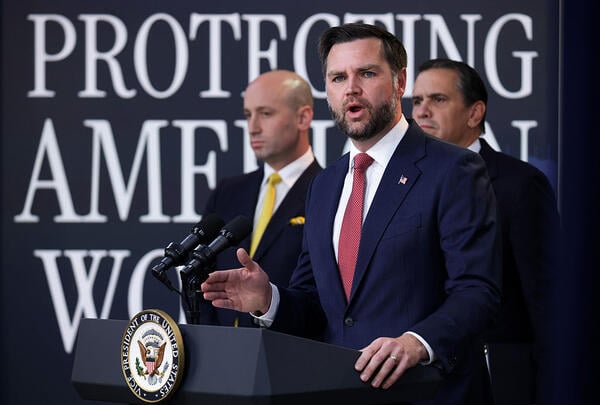
Vance, citing J-1 visa usage data, said, “Something weird is going on at these universities.”
Vice President JD Vance said Thursday that nine universities are under investigation for allegedly abusing the J-1 visa program, which allows noncitizens to temporarily teach, lecture, conduct research or receive graduate medical education, among other options.
The Labor Department is leading the investigation, and at a press conference on visa fraud Thursday, an official said that subpoenas “have been served” to higher ed institutions. The department’s inspector general, Anthony D’Esposito, pledged to “follow the money and uncover the schemes.”
At the press conference, Vance, who chairs the administration’s fraud task force, accused some universities of using the program to “bring in foreigners to undercut the wages of American residents.” He singled out Arizona State, Brown, Harvard, Yale and Stanford Universities, as well as the California Institute of Technology; the Massachusetts Institute of Technology; the University of California, Davis; and the University of Pittsburgh.
“These universities are employing J-1 visas for federally funded grants at a rate of about 61 percent. The national average is 38 percent,” he said. “So something weird is going on at these universities. They’re using these visas way too much. They’re using them to undercut the wages of American grad students and American researchers.”
Vance said that American graduate students or researchers earn $20,000 more than someone on a J-1 visa.
Several universities told Insider Higher Ed on Thursday that they comply with all applicable laws and defended international scholars.
“Brown’s international scholars, students and employees make essential contributions on our campus, including to teaching and research that advances American innovation, competitiveness and economic vitality,” a Brown spokesperson wrote in an email. “We have received a subpoena from the government for various records pertaining to foreign labor programs administered by the U.S. government, and we will respond promptly and directly to the government.”
An Arizona State spokesperson said the university educates more STEM majors than any other university and employs one of the largest technical and scientific workforces in the country.
“This benefits both the Arizona and the United States economies and in doing so, ASU has hired the talent needed to perform these functions and done so in complete compliance with existing United States policy and law,” the spokesperson said.
A Stanford spokesperson said the university complies with all applicable visa laws and will cooperate with the investigation.
Kimberly Allen, executive director of media relations at MIT, said the university is reviewing the Labor Department’s “very broad” subpoena, adding that the U.S. government vets each J-1 visa holder.
“We value international students and scholars on our campus. America’s ability to attract top talent from around the world while protecting U.S. economic and security interests is a national strength, and that competitive advantage should be supported,” she said.
At the press conference, D’Esposito characterized his agency’s inquiry as a “historic investigation into J-1 visa fraud.” He said American taxpayers deserve to know where federal money for research and innovation is going. He added that the investigation will explore “whether foreign influence, improper financial relationships, or visa abuse are compromising federally funded research,” pointing to concerns about China.
D’Esposito noted his background as a New York Police Department detective and said he wouldn’t back down.
“I don’t care how prestigious a university thinks it is,” he said. “Break the law and screw the American people, and I will personally cuff you in the university square. I don’t care how large your endowment is, how powerful your alumni are or how many politicians you have on speed dial.”