
A Presidential Executive Order brings more access to a fuel normally reserved for off-road uses, potential relief and, for many, confusion.
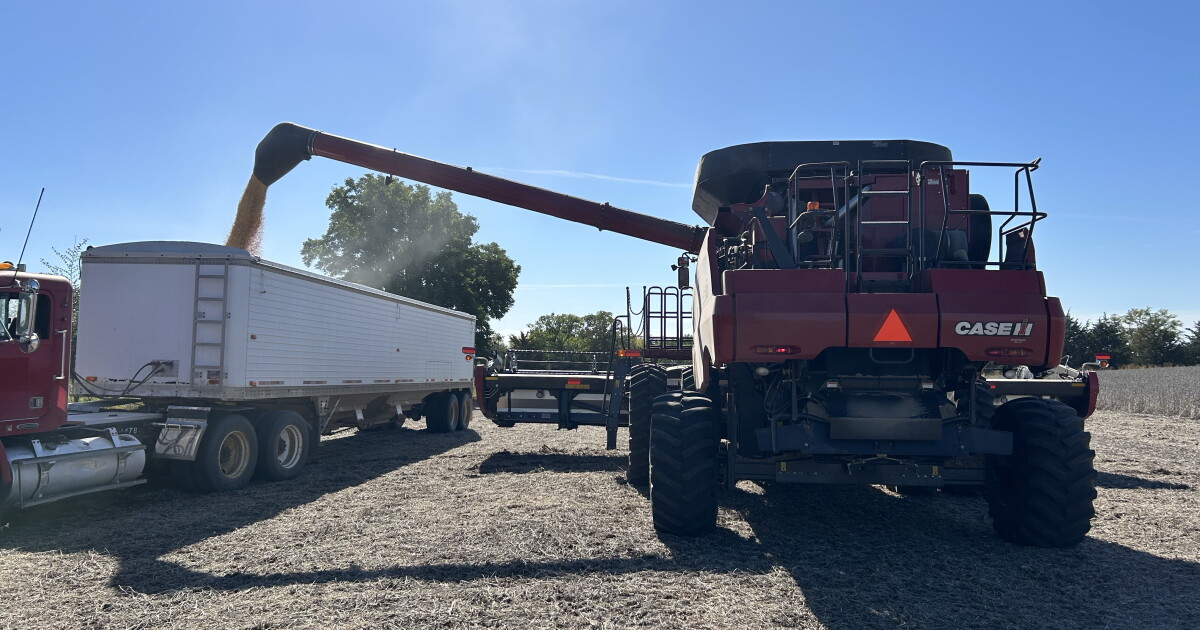
Sixty-five-year-old Larry Birgen loaded soybeans into a cargo truck. His combine operates on a fuel that’s exempt from federal taxes. It’s called red-dyed diesel and it’s only legally allowed in machinery that’s off-road. That is until a recent President Donald Trump announcement changed that. Now, Birgen’s truck that gets filled with soybeans can also fill up with the red-dyed diesel. That means he won’t have to pay the 24-cents-per-gallon federal tax to fill up.
“We’ve got a long ways to go as far as how many times I’m going to fill. So, it’d make a lot of difference,” Birgen said.
Dyed diesel is the exact same as normal diesel. It’s dyed to make it easier to tell the difference for tax purposes.
Diesel prices have spiked, in large part due to conflicts in Iran and Ukraine. President Trump announced relief to help ease some of that pain. The White House said it’ll save producers $60 on a 250-gallon tank.
For producers, any little bit helps during the busiest time of year: harvest. But it’s not going to get them back to diesel prices a year ago.
“It’s not going to make up for that. That’s more the Iran War or whatever is causing those high prices,” Birgen said. “So, it’s double of last year I think–or close to it.”
Diesel prices are nearly two times the cost they were the same time a year ago, according to AAA.
Scott VanderWal is the state’s Farm Bureau President.
“I guess what our attitude is that every little bit helps,” he said in an interview with SDPB.
But it’s short-term.
“It’s a little bit of a Band-Aid. It certainly doesn’t make up the difference because fuel prices right now are about 60-70% higher than they were last spring when we planted the crop that we’re harvesting now, So that’s a tremendous difference,” VanderWal said. “The only cure for that is to calm down the world stress and conflict, and try to get our refining capacity up where it should be. And get back to some semblance of normalcy.”
Another producer is critical of the system in its entirety.
“For years I’ve said this is silly to have road diesel and dyed diesel. It should all just be dyed. Run it, because most of your diesel is either truckers or farm,” said Audie Larson, who farms near Hamill. “And a lot of the truckers it goes back to agriculture one or another. I think it’s silly to have this road diesel. Let’s run just dyed diesel in everything.”
Another ag leader in the state said relief could be greater. Doug Sombke is the South Dakota Farmer’s Union President. He drew attention to the state tax on diesel.
“There’s nothing that the governor has done, or is able to do, to remove that tax. Now, if you remove that, it’d be substantial,” Sombke said. “I mean, it’d be closer to 52 cents, 50-52 cents total that you would take off of a gallon of diesel fuel in there.”
South Dakota’s undyed diesel tax sits at 28 cents a gallon.
Gov. Larry Rhoden said it would take the Legislative action to suspend the diesel tax.
“I don’t have as much authority in my emergency powers, as far as suspending statute. I can suspend administrative rules, and the laws regulating the fuel tax is not an administrative rule,” Rhoden said. “It’s a statute. So, I didn’t have the authority.”
Rhoden has signed executive orders in attempt to ease the burden on farmers. That includes suspending an overweight trip permit and allowing producers to haul their products at 10% above weight restrictions.
Following Trump’s announcement, Rhoden announced he was directing the Department of Public Safety not to enforce rules against dyed diesel being driven on highways.
The Department of Revenue followed it up with a guidance to address some of the questions on Thursday. It said that only ag producers with a valid agricultural exemption certificate should fuel with red dyed diesel for on road use.
DOR warned that — depending on federal guidance — consumers using red dyed diesel and paying sales tax “may actually pay more than the regular diesel tax in certain circumstances.”
The guidance also encourages anyone using dyed diesel on the road to maintain accurate fuel-use records and keep an eye on state guidelines.
Sombke noted the timing of the announcement, right before midterm elections.
“It’s funny as we get closer to an election how all of a sudden politicians come up with, I’ll just call it silly solutions,” Sombke said.
Farmers helped Trump get into office. South Dakota, an agriculture-heavy state, supported Trump with at least 60% of the vote the last three elections.
Back on Larry Birgen’s farm, he said the relationship between farmers and the government have gotten too complicated, in general.
“When if you would’ve just left things alone, we’d been better off and you wouldn’t have to do all this stuff,” Birgen said. “So sometimes it feels like you’re getting, farmers are getting bought off.”
Farmers also stressed concern that the red dye would stay in tanks and cause potential fines beyond the next few months.
A spokesperson for Rhoden’s office said that for long-term enforcement, “DPS will validate a failed test by pulling a fuel sample. While residue can be detected for longer, a simple color check can determine if the violation was recent or residual.”
SDPB also asked Rhoden’s office if they intended to pursue relief at the pump beyond farmers.
“The governor is a Constitutional conservative who operates within his authority — and he doesn’t have any authority to unilaterally waive any tax,” the spokesperson said in a statement.