
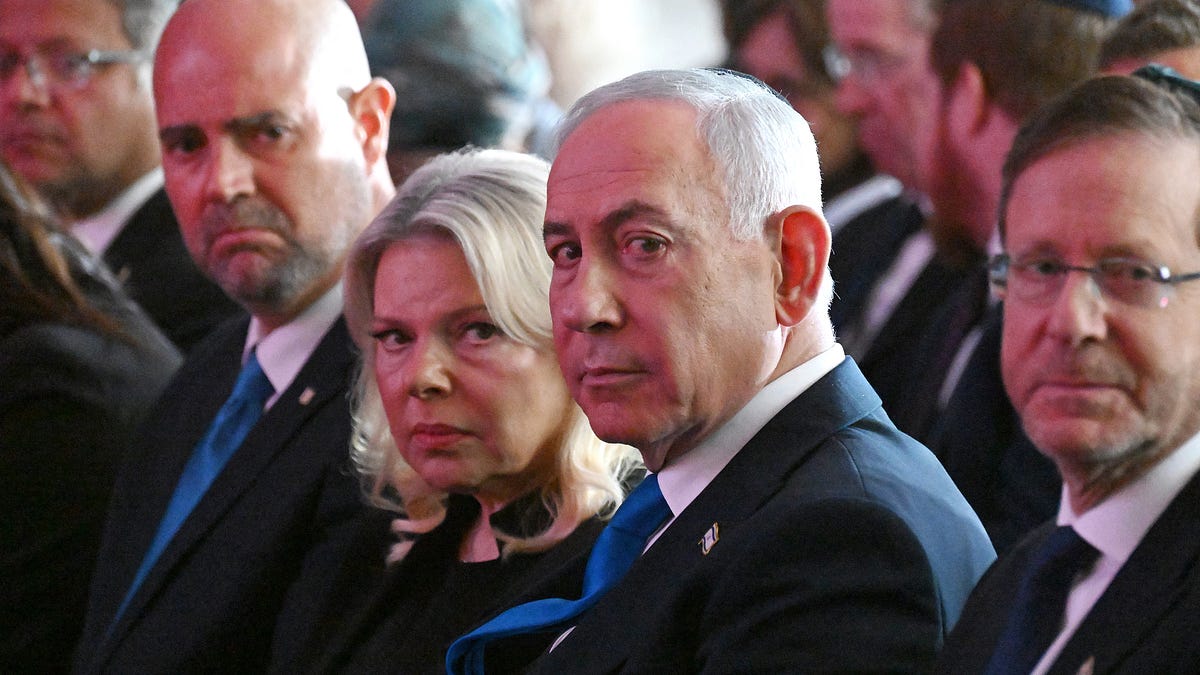
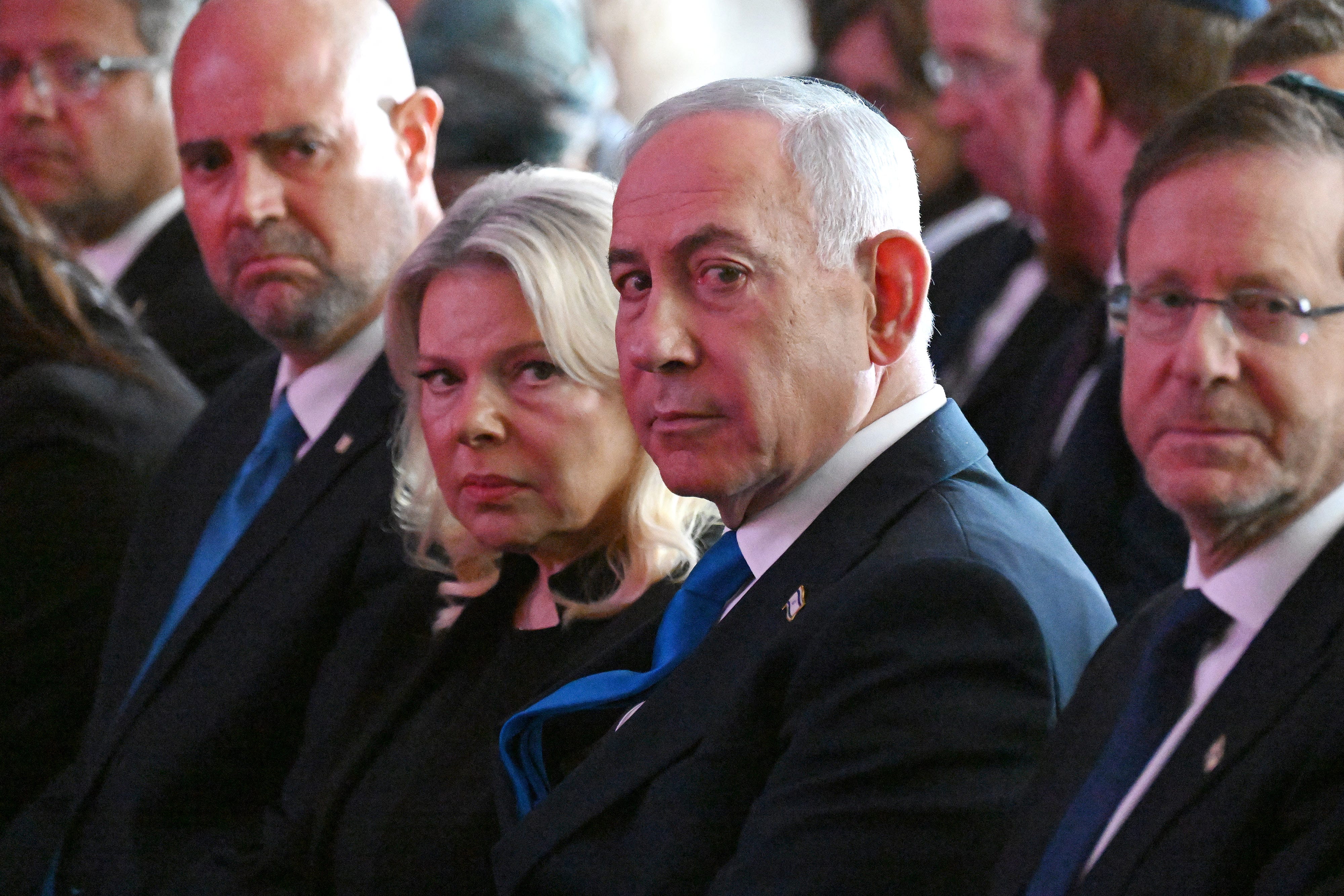
 (Photo by Debbie Hill / POOL / AFP via Getty Images.)
This article is brought to you by American Purpose, the magazine and community founded by Francis Fukuyama in 2020, which is proudly part of the Persuasion family.
In less than three weeks’ time Israelis are scheduled to vote in national elections they widely view as the most consequential of their lives. The most common term used in the country these days to describe the salience of the upcoming election is “B’hirot Goraliot”—literally, fate-defining elections. According to a September survey by the Jewish People Policy Institute, 81% of Israelis regard the October 27 election as either “the most important in the country’s history” (40%) or “especially important” (41%).
Popular awareness that the stakes are high, however, has not translated into clear political choices. On the contrary. In its fragmentation, mercuriality, conspiracism, and cast of fantastical characters, contemporary Israeli politics makes Game of Thrones look like The Golden Girls. The political waters in which Israelis are swimming—domestically, in the Palestinian arena, in the region and the wider world—are all swirling.
This translates into chaotic electoral politics. In a country of ten million people, no fewer than thirty-eight parties—including The Pirates Party and a list dedicated to achieving national unity through marijuana consumption—are running for seats in Israel’s 120-member parliament, the Knesset. Even the most dedicated students of Israeli politics have abandoned all hope of remembering the names of its political parties; as they sprout in the morning, then merge, splinter, and defect in the afternoon, or evaporate by nightfall. In this electoral season there is even a character called “Winter,” and Winter is coming, but only if he passes the electoral threshold.
Of the thirty-eight parties in the race, somewhere between eleven and fourteen are expected to achieve the magic 3.25% threshold of valid ballots cast and make it into the Knesset—a minimum of four seats, which means roughly 172,000 votes. The outcome of the elections may well hinge on one or two small parties failing to clear the threshold by a few hundred votes.
But who will sit with whom in what kind of coalition government, under what conditions, and under whose leadership? The range of possible permutations is near infinite, yet some measure of order can be imposed on this shape-shifting mess using scenarios. Five such scenarios are structurally possible. Each needs to be taken seriously, none are inevitable, though some are more likely than others.
Before proceeding to outline each scenario specific to October 27, a word about what the existence of this degree of uncertainty means. Sometimes, to paraphrase George Orwell, the first duty of a sober observer is the restatement of the obvious. Functional democracies do not normally face five alternative outcomes less than three weeks before a crucial election. With rare exceptions, two-party systems produce binary results—either one party wins, or the other. In multi-party systems, like Israel, the range of the possible should extend to no more than a third scenario—the establishment of some form of coalition government. The fact that electoral politics in Israel now deviates from this bounded set of options indicates a degree of democratic volatility and fragility both novel and concerning. Only one scenario points to a path towards national recovery and repair after the terrible traumas of the past few years.
The first scenario is one in which the election is postponed, interrupted, or contested so severely that its legitimacy is seriously questioned. This has never happened in seventy-eight years of modern Israeli statehood and would have been unthinkable even five years ago. After three years of a multifront war that is essentially ongoing—Iran, Lebanon, Gaza, the Houthis in Yemen, none of which are resolved—and amidst a combustible internal atmosphere, however, disruption is not a hypothetical and could come from multiple sources. Israelis certainly fear the prospect. An Israel Democracy Institute survey in July found that 72% of Jewish and 58.5% of Arab Israelis believe the integrity of elections is in danger, and that was before repeated warnings in recent days by security chiefs that Israel’s enemies are seeking to subvert the election or exploit it as an opportunity for an armed attack.
We should distinguish between two categories of disruption. The first, and less likely, is formal postponement or the prevention of viable elections due to internal or external violence. Israeli law does not contemplate the possibility of elections being cancelled and a military coup in Israel is outside the realm of credible scenarios. The law does, however, provide for the possible temporary postponement of elections in the event of an extraordinary national emergency that makes voting impossible. There is no exhaustive list for such circumstances, but it would certainly include a large-scale missile attack by Iran and/or its remaining proxies—Shi’a militias in Iraq, Hezbollah in Lebanon, or the Houthis in Yemen. It would also certainly include a surprise attack from a less predictable source, such as Syria, Sinai, or Turkey.
It is unclear whether the outbreak of a Third Intifada in the West Bank, rocket-fire from Gaza, the kidnapping of Israeli soldiers or civilians, large-scale rioting by protestors, or a high-level political assassination taking place shortly before or on elections day, would constitute grounds for postponement. The disruption would have to be widespread and debilitating enough to stymie the process in large parts of this small country. In any case, Israeli law sets strict limits on postponement. Delaying elections cannot be decreed. It requires the passage of Knesset legislation by a supermajority of two-thirds (80 members of Knesset) and the delay caused must be as brief as practicable—a condition that will be closely supervised by the courts.
Disruption may also come in the form of a breakdown of trust in the electoral process or the announced outcome, either as the result of active subversion or, more corrosively, a large proportion of the Israeli public coming to believe that the election was “stolen” by the opposing camp and is therefore illegitimate. The latter is more likely to come from the pro-Netanyahu right, which is less concerned about the risk of voter suppression among Arab Israelis than it is about preventing initiatives helping Israeli expats fly home to vote in the upcoming election.
Prime Minister Netanyahu’s Likud party has already petitioned Israel’s Central Elections Committee—the non-partisan national body responsible for conducting elections—to demand it blocks such initiatives, alleging that they constitute voter bribery. If the anti-Netanyahu camp wins by one or two Knesset seats, it is likely that at least some of his supporters will point to the expats and cry foul.
The Central Elections Committee is far better prepared to manage the threat of attempted subversion on the part of external actors than the more nebulous risk of internal conspiratorial mistrust. David Zini, head of the Shin Bet (Israel’s internal security agency), recently told legislators in closed session that Iran is the leading foreign actor seeking to interfere in the Israeli vote—with Russia, China, and Turkey also involved—and that candidates themselves may be targeted.
The raw material for an Israeli version of the January 6, 2021 assault on the U.S. Capitol is in place and may or may not be kindled on October 27. If it does, and trust in the essential integrity of elections is destroyed, Israel will find itself in a constitutional crisis that it has no agreed rules to resolve.
The second scenario—inconceivable a year ago, improbable two months ago, but now perhaps the most likely—is stalemate: an outcome where neither bloc obtains the sixty-one seats needed to form the barest majority; no combination of parties manages to negotiate a coalition; or the anti-Netanyahu camp decides it is better off going to another round of elections than attempting to form a minority government.
Israelis are intimately familiar with this situation, having lived through it repeatedly in recent history, and many now believe it is about to happen again. A survey published by Haaretz on October 1, for example, saw 49% of respondents express the view that the elections will not be determinative and that the country will likely go to another round.
Israel held five rounds of national elections between April 2019 and November 2022. Of these, two ended up in stalemate, but for different reasons. The elections of April 2019 saw Netanyahu’s right-wing bloc nominally achieve a majority, but Avigdor Lieberman’s Yisrael Beiteinu party refused to join over the Haredi miliary draft issue, leading to another round of elections five months later. Those produced another stalemate, with neither Netanyahu’s nor Benny Gantz’s Blue and White bloc able to reach sixty-one. The Knesset promptly dissolved, forcing a third election in March 2020, just as the world plunged into the Covid pandemic.
Current opinion polls suggest a stalemate, with neither the perennial Netanyahu nor his maiden chief opponent, and Gantz’s erstwhile party member, Gadi Eizenkot, likely to secure more than 52-55 seats for their respective blocs. If the polls are correct, Eizenkot can rely on 54 seats—23 for his own Yashar party, 12 from Naftali Bennett and Yair Lapid’s combined Beyahad party, 10 from Yair Golan’s The Democrats—remnants of the old, once hegemonic, Israeli Labor Party, plus left-secular-cosmopolitan Meretz—and 9 seats provided by the seasoned Avigdor Lieberman, still at the helm of Yisrael Beiteinu (more about him in scenario four).
Facing Eizenkot’s 54, under this scenario, will be Netanyahu’s 52-54: a diminished Likud with 20-21 seats, the Ashkenazi Haredi party United Torah Judaism (UTJ) with 8, the Sephardic Haredi party, Shas, with 7, and the three ultra-nationalist parties, Itamar Ben-Gvir’s Otzma Yehudit, 7-8, Bezalel Smotrich’s Religious Zionist party, 6, and Ofer Winter’s Amcha Yisrael party, 4. Neither bloc would be able to reach sixty-one, even if they include the only Arab party that would agree to sit in a Zionist coalition government, Ra’am, or in the unlikely event that every single one of the right-wing satellite parties currently hovering just above or below the electoral threshold make it through.
For Netanyahu, stalemate would represent a “win on points”; for Eizenkot, it would spell disaster. Under Israeli law, Netanyahu continues to serve as prime minister unless and until a new government, headed by an alternative PM, is sworn in by the Knesset. If he can force a stalemate, Netanyahu remains interim PM after October 27 and can then use all his skill to set the agenda, divide and rule, and take the country into another electoral round in April 2027 (then another and another still if he needs to) until he does to Eizenkot what he did to the now politically defunct Benny Gantz—grind him down to irrelevance.
Gadi Eizenkot has one shot to slay the dragon; if he does not win this round, he will be weaker in the next, as the anti-Bibi camp searches desperately for the next Benny, the next Gadi, to lead the charge against Bibi. Eizenkot, more politically savvy than Gantz, knows this full well, and will do everything in his power to avoid the stalemate trap. But there is another trap waiting for him in scenario five.
Under a third scenario, Netanyahu’s camp would win a majority to form a narrow but viable government. This could happen through a combination of several factors. First, voting rates in favor of the pro-Netanyahu camp will need to be substantially higher than for the anti-Netanyahu bloc. A low Arab-Israeli voting rate would reward the pro-Bibi camp by increasing the likelihood that small far-right parties manage to cross the electoral threshold.
Second, Netanyahu could eke out a victory if the existing members of his coalition, especially Likud, do dramatically better at the ballot box than most polls predict. Channel 14—roughly speaking, Israel’s version of Fox News—wishcasts exactly this, with Likud winning 31-32 seats, rather than the 20-22 recorded by other pollsters.
Third, the Netanyahu bloc could win if its existing members do substantially better than most polls predict and the two new right-wing satellite parties cross the electoral threshold and join a Netanyahu-led coalition. The most significant of these is Ofer Winter’s new far-right party, Amcha Yisrael, which could give Netanyahu the crucial 4-5 seats he requires to retain power. Similarly, Netanyahu could end up on top if, during coalition negotiations, yet another small satellite party, The Reservists, crosses the electoral threshold and breaks its promise not to sit in government with the ultraorthodox. Lastly, in the cauldron of post-elections coalition negotiations, Netanyahu might poach a party from the opposing camp, for example Lieberman’s Yisrael Beiteinu, or Naftali Bennett’s Beyahad. An outright Netanyahu victory remains a tall order, but it is far from inconceivable, and the momentum of the past few weeks is drifting exactly in this direction.
A Netanyahu bloc win, even if by a bare majority, would amount to a vote of confidence in the same government that orchestrated the attempted dismantlement of the rule of law in Israel and then presided over the country’s worst security disaster—a multilayered failure it has consistently refused to impartially investigate—which was followed by three years of unresolved war.
To the Israeli soft right this would be explicable in terms of Netanyahu’s grit and experience: After being punched in the face by Yahya Sinwar in the brutal terrorist invasion of October 7, 2023, the logic would be, Bibi got himself off the floor and, despite intense international pressure, proceeded to fight a determined multifront war against Israel’s mortal enemies, all of whom are now either gone (the Assad regime in Syria), broken (Hamas in Gaza and Hezbollah in Lebanon), or diminished (Iran). The vote for Netanyahu, for this sizeable portion of Israeli society, would be justified because the war is not over and because they believe that none of the alternatives to Netanyahu—not Eizenkot, Bennett, or Lieberman, let alone Yair Lapid—would have withstood the pressures of the past three years.
Under this scenario, Netanyahu remains the default choice for the Israeli electorate—an electorate that has moved strongly to the right after October 7—not because they believe he is blameless for October 7, but because, when push comes to shove, they conclude that in the face of continued existential dangers no one is better qualified to navigate the ship. Netanyahu’s main campaign message is directed precisely at this narrative. Strewn across Israel are giant posters with his image next to a two-word caption: “Doesn’t Surrender.”
To the nationalist-religious camp, a Netanyahu victory would mean vindication and license wrapped in messianic cellophane. Like the son of the widow of Zarephath, whom the prophet Elijah brought back from the dead, Netanyahu is resurrected in an astonishing feat of political revival. The true sons of Israel are with him and have been handed a popular mandate to complete the judicial overhaul, sweep away the last remaining bastions of the liberal “deep state,” extend efforts to drive Palestinians out of Gaza, and annex Judea and Samaria.
 Why I Worry About Israeli Democracy
For liberal Israelis, this outcome would signal that the Israel they were born and grew up in is no more; that the country’s DNA has irrevocably mutated to illiberalism and that—given the steady demographic tilt in favor of the nationalist-religious—they are unlikely to win another election ever again. If not now, when?
In retrospect, under this scenario, we would look back at the November 2022 election as the crucial tipping-point at which a certain Israel perished, and another was born. Viewed through this lens, October 2026 would be seen as the mere consolidation of the historic triumph of Israel’s religious right. Judaism has beaten secular Zionism; conservative Judea has vanquished liberal Israel.
For secular-liberal Israelis the loss would also mean diminished faith in the capacity of the state—a state they fight for and disproportionately fund through their taxes—to provide long-term physical and ontological security to their children. It would be read as a clear signal that the essential link between government performance and democratic accountability has been severed, and that, going forward, tribal identity politics would be so dominant that the fundamental corrective mechanisms of democracy no longer work in Israel.
Some liberal Israelis—the most cosmopolitan and mobile—will give up and leave, emigrating reluctantly into an increasingly antisemitic world. Some will take inspiration from Hungary and continue to struggle for a liberal-democratic Israel. Others will stay to defend their gradually shrinking enclaves; others still will try to moderate the transition to a religious-nationalist Israel or will join the successor regime.
A fourth scenario would see a narrow victory for the opposing bloc, which is united by one goal and one goal only—the removal of Netanyahu from power. The anti-Bibi camp, referred to as Gush Ha’Shinui (“the Change Bloc”) is composed of four core parties—Yashar, Beyahad, Yisrael Beiteinu, and The Democrats—the leaders of which, with the exception of Yair Golan of The Democrats, all see themselves as the most qualified to replace Netanyahu as PM.
Until a month ago polls suggested the combined strength of the four might just achieve the 61 seats required to form a narrow but viable majority or at least reach the 57-60 seats needed for a minority government propped up from outside with the backing of the Arab-Israeli parties, who are desperate to dispatch Netanyahu, Ben-Gvir, and Smotrich.
That is no longer the case, as the momentum has drifted away from the Change Bloc over the past weeks. The polls may be off, and we can envisage a reality in which the Change Bloc wins a bare majority through a combination of a dramatically high anti-Netanyahu voting rate (here again the Arab-Israeli voting rate may prove decisive) coupled with a low pro-Netanyahu one, as disappointed Likud voters stay at home on elections day. But if the latest polls are to be believed, even if the four core members of the Change Bloc bring in Ra’am—and all except The Democrats have vowed not to do so—they are unlikely to rise above 60 seats.
To comfortably clear 61, therefore, the Change Bloc would have to first hope that Ofer Winter’s Amcha Yisrael and The Reservists cross the electoral threshold and then manage to persuade both that—in order to avoid a stalemate, and for the sake of establishing “a Zionist government” that would exclude the “anti-Zionist” Arab and Ultraorthodox parties—they have no choice but to join the Change Bloc. Israeli journalist Raviv Drucker has recently argued that Eizenkot may be able to bring Winter into his coalition by first trying to form a national unity government with Likud, and failing, so that Winter can justify his switching camps as being both reluctant and necessary to prevent Ra’am from being in government. Under such a scenario, Drucker observes, Amcha Yisrael and The Reservists would be able to demand senior cabinet positions, with Winter likely becoming Israel’s next minister of defense.
A less likely, but not entirely inconceivable, variation would have the Change Bloc poach a party currently solidly in the Netanyahu camp, possibly Shas, by bestowing lavish budgets and ministerial appointments upon it while violating their own campaign promises on key policy issues, such as a major compromise on the Haredi military draft.
The question of Haredi military service is worth lingering on for a moment as it stands at the core of the identity-based fissure between the contending camps and is by far the anti-Netanyahu bloc’s most salient argument for his replacement. The Haredi draft dispute pertains to the question of whether ultraorthodox men, long exempted from compulsory military service so they can study Torah full-time, must serve in the Israel Defense Forces (IDF) like all other Jewish Israelis. The rapid demographic growth of the ultraorthodox—a population that grows by about 4% per year, the fastest rate among any population in the developed world—means that what in 1948 appeared to be a token concession by David Ben-Gurion to four hundred yeshiva students, now extends to tens of thousands of draft-age men. After two decades of failed attempts to legislate a consensual formula, in June 2024 the Israeli Supreme Court ruled unanimously that Haredi draft exemption has no legal basis and cannot continue. At the same time, the heavy burden imposed by the post-October 7 wars on the rest of Israeli society, particularly the reservists and their families, turned a simmering chronic grievance into an acute demand to sanction those who do not serve.
The IDF has since issued roughly 24,000 call-up orders, to which only about 1,200 Haredi recruits responded, while polling shows 85% of non-Haredi Jewish Israelis favor sanctioning those who refuse to share in the national defense burden. The pro-Netanyahu coalition depends on the ultraorthodox parties (United Torah Judaism and Shas) and has therefore tried to legislate the exemption back into law. Yet the pro-Netanyahu bloc itself is deeply divided on this issue, since Likud and religious-Zionist voters (Otzma Yehudit and the Religious Zionism party) serve in large numbers. In fact, the religious-Zionist community, which makes up roughly 10% of Israel’s population, has sacrificed disproportionally in the post-October 7 wars, with roughly one-third of all fallen soldiers coming from this community.
If anything can make right-leaning Israelis switch camps and side with the Change Bloc, it is the absolute knowledge that every single one of its leaders—particularly Eizenkot, who lost his son, Gal, in the December 2023 battle of Jabaliya in Gaza—is determined to increase Haredi service rates as part of a broader drive to integrate the ultraorthodox into modern Israeliness.
An outright victory for the anti-Netanyahu bloc remains a tall order, but not an impossibility, especially if it is Avigdor Lieberman who will emerge as PM under this scenario. It is Gadi Eizenkot’s Yashar party that is certain to be the largest opposition party. But this does not automatically mean Eizenkot will stand at the head of a Change Government. Israeli law provides that it is not the head of the largest political party, but the head of the party most likely to be able to form a stable government, that is invited by Israel’s president to attempt forming a coalition. In 2021, Naftali Bennett became prime minister at the head of a party with only six Knesset seats.
Something similar could happen with Lieberman this time. With his hawkish reputation, close personal ties to Ofer Winter (who reputedly despises Eizenkot), distance from the October 7 debacle, and decades of experience in senior roles—including minister of finance (2021-22), minister of defense (2016-2018), and deputy prime minister and minister of foreign affairs (2009-2012 and again in 2013-2015)—it is Lieberman, not Eizenkot or Bennett, who may prove to be the only enzyme capable of the alchemical feat of ousting Netanyahu.
Whether headed by Lieberman, Eizenkot, or Bennett, a narrow Change Bloc government that will see Netanyahu deposed and his current coalition partners sent into opposition will be greeted with relief by Israeli moderates as well as most international audiences. Yet unless it can be quickly enlarged—by poaching a few members of the opposition or bringing in another party—a narrow Change Government will be immediately vulnerable to internal fissures and the risk of defections. Unlike the pro-Netanyahu camp, there is no ideological glue holding an anti-Netanyahu coalition together, and the fate of a 2026 Change Government could easily replicate that of the 2021 Change Government, which disintegrated after a year.
In the longer term, the most demoralizing and dangerous outcome for the liberal camp in Israel may not be a stalemate that drags the country into another round of elections, but a fragile anti-Bibi victory that then produces a dysfunctional coalition paralyzed by endless bickering and is liable to crumble in the face of its first serious internal or security challenge.
Which brings us to the final scenario: the dissolution, or at least temporary suspension or blurring, of the pro-Bibi/anti-Bibi firewall that defines all other scenarios, and the emergence of some form of broad centrist coalition.
At its broadest, such a coalition would extend from Ra’am—an Arab party whose number two is now Yoav Segalovich, a Jewish, proudly Zionist former police commissioner—and The Democrats, on the left, through Yashar, Beyahad, and The Reservists in the center, to Likud and Yisrael Beiteinu on the right. Based on current polling, such a coalition would command 82 Knesset seats, more than two-thirds of members—an enormous majority capable of passing any legislation it can agree on.
 Netanyahu’s Wars of Dismantlement
Even a somewhat more limited, but more ideologically aligned, center-right coalition composed of Yashar, Likud, Beyahad, Yisrael Beiteinu, Amcha Yisrael, and The Reservists—which would exclude the more divisive Democrats, Arab parties, and Jewish ultranationalists and ultraorthodox parties—would command some 70 seats. It would be a broad coalition capable of far-reaching reforms, including in politically sensitive areas such as military conscription, constitutional changes, and law enforcement vis-à-vis settler violence and organized crime in the Arab-Israeli community.
The temporary suspension of rivalry between antagonistic political camps is familiar to Israelis. In 1967, four days before the outbreak of the Six-Day War, Prime Minister Levi Eshkol (of the Mapai party, the predecessor of Labor) brought the Menachem Begin-led opposition Gahal bloc (precursor of Likud) into the government, uniting 111 members of Knesset in the face of an imminent existential threat. National unity governments built on Labor-Likud cooperation were also formed to save Israel from hyperinflation (1984-88) and manage the crisis presented by the collapse of the Oslo Process and outbreak of the Second Intifada (2000-2002).
What are the prospects of something similar taking shape in late 2026? The answer depends, first and foremost, on whether Israel faces either an extraordinary national emergency or an exceptional geopolitical opportunity sometime between October 28 and mid-December. War with Iran-Houthis or Turkey would constitute an example of the former, but so could the outbreak of a Third Intifada in the West Bank. The world of 2026 is, sadly, defined by the proliferation of known unknowns and unknown unknowns that could force even Netanyahu and Eizenkot together. Conversely, the imminent and credible prospect of a regional “deal of the century”—involving normalization with Saudi Arabia that is conditional on progress towards Palestinian self-determination—is an example of a positive game changer that could drive the Israeli center left and center right to temporarily unite.
Barring such a deus ex machina, the prospect of a broad centrist coalition increases dramatically if Netanyahu exits the political scene. This could happen for health reasons, by Netanyahu agreeing to a plea bargain in which he receives a preemptive presidential pardon for his criminal indictments, or through some force majeure. All three heads of the Change Bloc who are credible candidates for PM—Eizenkot, Bennett, and Lieberman—would be willing to make far-reaching concessions to a post-Netanyahu Likud, including offering his successor the prospect of a rotating premiership—a power-sharing arrangement in which two coalition leaders agree to split a government’s term, each serving as PM for part of it.
None of them, however, would be so naïve as to enter a rotation agreement with Netanyahu, who has repeatedly destroyed his opponents by making, and then breaking, rotation deals. Eizenkot in particular has had a front row seat to the undoing of his colleague, Benny Gantz, who broke his promise to his electorate and signed a rotation agreement with Netanyahu in the early months of the Covid crisis. The Netanyahu-Gantz “emergency government” was sworn in on 17 May 2020, with Netanyahu as PM and Gantz as “alternate prime minister” and defense minister, due to rotate into the premiership in November 2021. It never happened. Netanyahu let a budget vote fail and dissolved the Knesset in late December 2020, taking Israel to another round of elections in March 2021. Benny Gantz never recovered. The man who, in April 2019, stood at the helm of the mighty Blue and White party with 35 Knesset seats is now being urged by the Change Bloc to announce his withdrawal from the race; Blue and White is now utterly defunct, scoring 0% of the projected vote.
After seven years of political instability, toxic polarization, and war, Israel desperately needs a government broad enough to possess the legitimacy and stability necessary for the country to heal, reform, and rebuild. Assuming the elections scheduled for October 27 are not disrupted, a stalemate on October 28 may, just may, compel a torn and exhausted Israel to negotiate the formation of some kind of unity government.
As one wag put it after three Israeli passengers rescued Fly Dubai flight 1073 from being hijacked and crashed last month, it is Netflix that should take out a subscription on Israel.
Amichai Magen is the founding director of the Jan Koum Israel Studies Program at Stanford University’s Center on Democracy, Development, and the Rule of Law.
Follow Persuasion on X, Instagram, LinkedIn, and YouTube to keep up with our latest articles, podcasts, and events, as well as updates from excellent writers across our network.
And, to receive pieces like this in your inbox and support our work, subscribe below: