
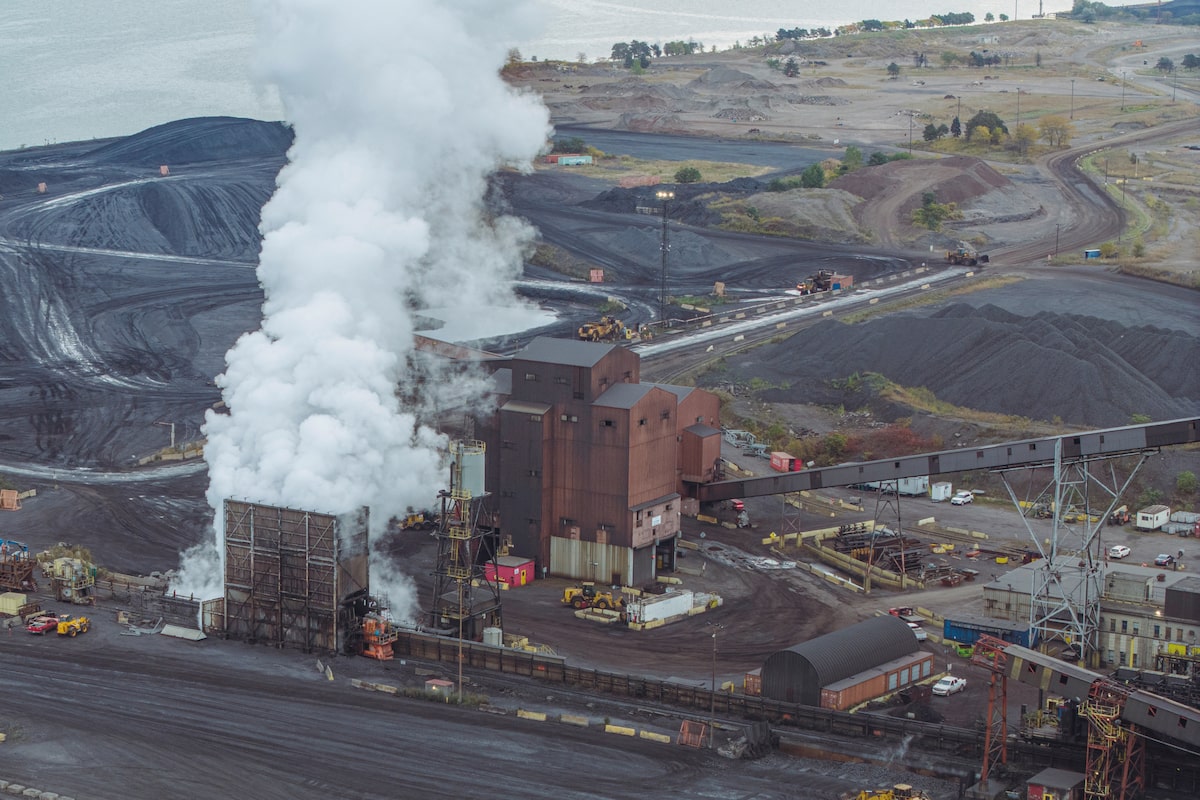
The Stelco Hamilton Works steel mill, owned by Cleveland-Cliffs, on Sept. 29.Carlos Osorio/Reuters
Stelco Inc. has informed Ottawa it is not in violation of its Investment Canada Act job commitments, and it is proceeding as planned with hundreds of layoffs in Canada.
Stelco, which is owned by U.S. steelmaker Cleveland-Cliffs Inc., said on Sept. 28 that it was laying off up to 500 workers in Hamilton and Nanticoke, Ont., saying it couldn’t compete in galvanized steel as a result of the trade war.
When the federal government approved Cliffs’ $3.4-billion acquisition of Stelco in 2024, it imposed legally binding conditions, including maintaining at least the same number of unionized employees in Canada for five years, as well as the vast majority of non-unionized workers.
On Monday Industry Minister Mélanie Joly issued the Cleveland-based steelmaker an ultimatum to map out a plan within five business days for complying with its employment guarantees under the Investment Canada Act or possibly face legal action.
In the company’s response letter obtained by The Globe and Mail, Stelco president and general counsel Paul Simon on Friday told Ms. Joly the steelmaker is in fact not in violation of its commitments, citing a legal provision around the promises, and the government’s own ICA guidelines.
“Your representation that Stelco’s planned layoffs cause it to breach its undertakings is false,” Mr. Simon wrote. “As the undertakings do not stipulate a commitment to avoid layoffs, nor do they include a requirement that employment levels be above a certain amount on each day of the five years of the undertakings.”
He added that the spirit of ICA gives the government plenty of flexibility to allow layoffs in unforeseen circumstances.
“Throughout the history of the Investment Canada Act and its predecessor foreign investment acts, it has consistently been understood that changes in circumstances may necessitate the non-enforcement or renegotiation of undertakings,” he wrote. “This decades-old principle is set out in the Government of Canada’s Investment Canada Act Guidelines – Administrative Procedures: Monitoring of Investments.”
Ms. Joly’s office did not immediately respond to a request for comment.
Stelco’s exit from galvanized steel leaves big Canadian buyer baffled and in the lurch
Cliffs argues that the imposition last year of a 50-per-cent tariff on Canadian steel exports to the U.S. was an event that was out of its control.
Responding to the plan that Ms. Joly asked Cliffs to map out, Mr. Simon said that owing to its inability to profitably make galvanized steel anymore, it is proceeding with the idling of its Hamilton Works operation. Laid off workers will have the opportunity to apply for job openings at Lake Erie Works, he said. The local union has said that only 46 positions were available at Lake Erie Works.
Ron Wells, president of United Steelworkers Local 1005, said he is severely disappointed that Cliffs is proceeding with the layoffs, but it wasn’t unexpected.
“It’s not shocking that they are trying to weasel out of the agreement,” he said.
Mr. Wells says he now wants Ottawa to follow through on its threats and sue Cliffs.
“I’m sure if it went to court, and hopefully it does, the federal government would prevail,” he said.
There is precedent for the government to sue and it revolves around the same Canadian steel maker. After U.S. Steel acquired Stelco in 2007, it made commitments under the Investment Canada Act around jobs and production levels. After the financial crisis hit in 2008, U.S. Steel laid off workers in Canada. The federal government later sued the company for allegedly reneging on its legally-binding commitments. A settlement was reached in 2011 with U.S. Steel agreeing to a new set of commitments, including around production levels and investment in Canada.
Cliffs has said it is prepared to immediately call back laid off workers in Canada if Ottawa can reach a “Fortress North America,” trade pact with the U.S. but it has also been clear it believes the government has not done enough to reduce foreign dumping of galvanized steel in the country, which is hurting Cliffs’ ability to compete in the domestic market.
Cleveland-Cliffs boss dismisses idea of nationalizing Stelco as Ottawa pushes to preserve jobs
Ottawa has already aggressively cracked down on the dumping of foreign steel into Canada through the imposition of tariff-rate quotas and mandated that publicly funded projects use Canadian steel wherever possible.
“The most important step the government could take,” Mr. Simon wrote, “would be to impose further restrictions on imports of cold-rolled and coated steel products into Canada, limit import substitution, and eliminate remissions for steel products that Canadian producers, including Stelco, can supply.”
He also took issue with the government’s contention that it was blindsided by Cliffs’ announcements to lay off workers in Canada.
Cliffs, he said, had been clear, both in its direct communications with Ottawa dating back to July, and in its public comments to investors, that its galvanized business was in trouble and that layoffs in Canada were imminent.
Opinion: The steel jobs may never come back. Ottawa should consider nationalizing Stelco
Furthermore, he said that Ottawa had suggested a meeting to discuss “proposed revisions to the undertakings” owing to the expected idling of the affected Stelco operations.
“Your suggestion that you only recently learned of Stelco’s intentions to indefinitely idle its Hamilton Works finishing lines is therefore inaccurate and misleading to the Canadian public,” Mr. Simon wrote.
“By failing to mention or acknowledge these regular communications, your letter created the false impression that we have not been cooperative and transparent. This is profoundly regrettable at a time when we hope to lower public tensions and engage in a dialogue with you.”