
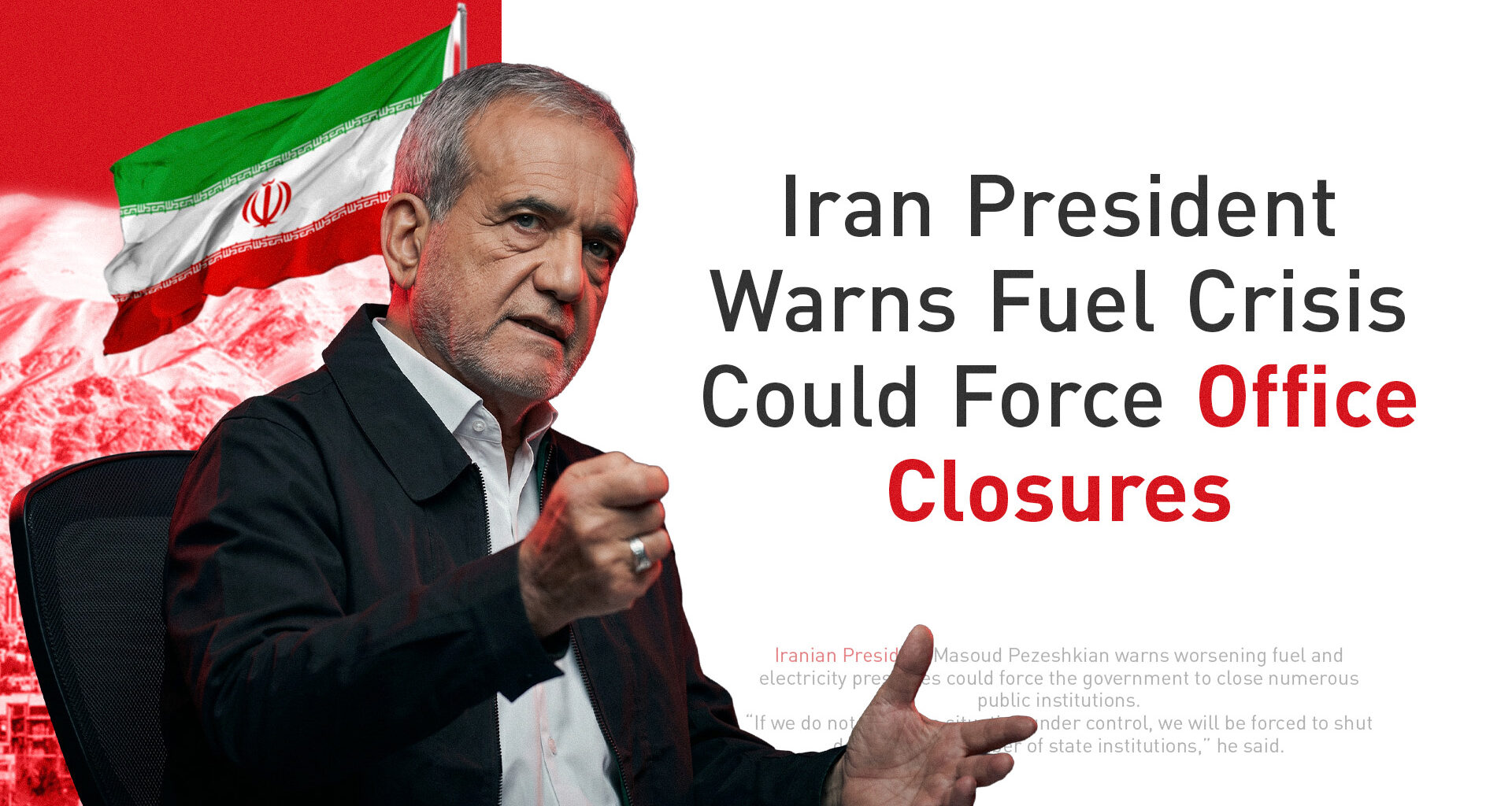
Iranian President Masoud Pezeshkian warned that fuel and electricity shortages could force state office closures and said internal divisions could weaken Iran more than external pressure.
ERBIL (Kurdistan24) – Iranian President Masoud Pezeshkian warned Sunday that deepening fuel, electricity and environmental pressures could force the government to close a number of state institutions, while arguing that internal division and the marginalization of talented people pose a serious threat to Iran’s ability to withstand external pressure.
Speaking in Tehran on Oct. 11 during a meeting with government officials, authorities and prominent figures, Pezeshkian addressed both the domestic situation and what he described as pressure from Iran’s enemies.
He argued that external pressure alone could not defeat the country if Iranians avoided internal conflict and exclusion.
“If we do not sanction ourselves and do not marginalize our talented and capable people, the enemy cannot destroy us or bring us to our knees,” Pezeshkian said.
He called for greater opportunities for young Iranians to demonstrate their abilities and contribute to the country.
Pezeshkian also said political and institutional unity was necessary if Iran was to overcome the pressures it faces.
“If we join hands, no force can bring us down,” he said.
He claimed that Iran’s adversaries had expected the country to collapse under attack but had failed to achieve that objective.
“The enemy thought that if it attacked us, our country would fall apart,” Pezeshkian said. “But not only did that not happen, today we are all standing strong, and we will continue strongly.”
He further argued that what he described as efforts to kill senior leaders, commanders, scientists and political and military figures had also failed to break Iran.
His remarks represented the Iranian president’s political assessment of the country’s confrontation with its adversaries.
Pezeshkian said Iran’s ability to resist depended heavily on avoiding policies that sideline or undermine people within the country.
“If we work on the basis of unity and move away from policies of eliminating and undermining one another, the enemy will fail to achieve its objectives,” he said.
Alongside those political remarks, Pezeshkian gave a stark assessment of Iran’s domestic energy pressures.
He called on citizens to cooperate in dealing with shortages of electricity, gas and other fuels, warning that the government could be forced to suspend the work of some public institutions if the situation cannot be brought under control.
“If we do not bring the situation under control, we will be forced to shut down a large number of state institutions,” he said.
The president did not provide figures in the supplied remarks on the scale of the shortages or specify which institutions could face closure.
He also addressed environmental and infrastructure pressures in Tehran, including problems connected to water, land and the growing burden on the capital and surrounding province.
Pezeshkian warned that continued congestion and pressure on Tehran could make existing problems increasingly difficult to resolve.
“If we continue on the current path, Tehran’s problems will grow day by day and become increasingly impossible to solve,” he said.
He added that the government had a responsibility to make difficult decisions now rather than leave greater problems for future generations.
“It is our duty to make the right decisions and act properly; otherwise, we will be indebted to future generations,” he said.
Pezeshkian’s remarks tied together two themes: the need for social and political unity and the need for practical cooperation over domestic shortages.
While much of his speech focused on Iran’s ability to resist external pressure, he repeatedly suggested that internal choices could determine whether the country is able to manage its current challenges.
His message to officials and prominent figures in Tehran was to remain united, support capable people and contribute to rebuilding and strengthening the country.
For Pezeshkian, the central warning was that Iran risks weakening itself if internal exclusion, political rivalry and poor management continue at a time when the country is also confronting energy shortages and wider external pressure.