
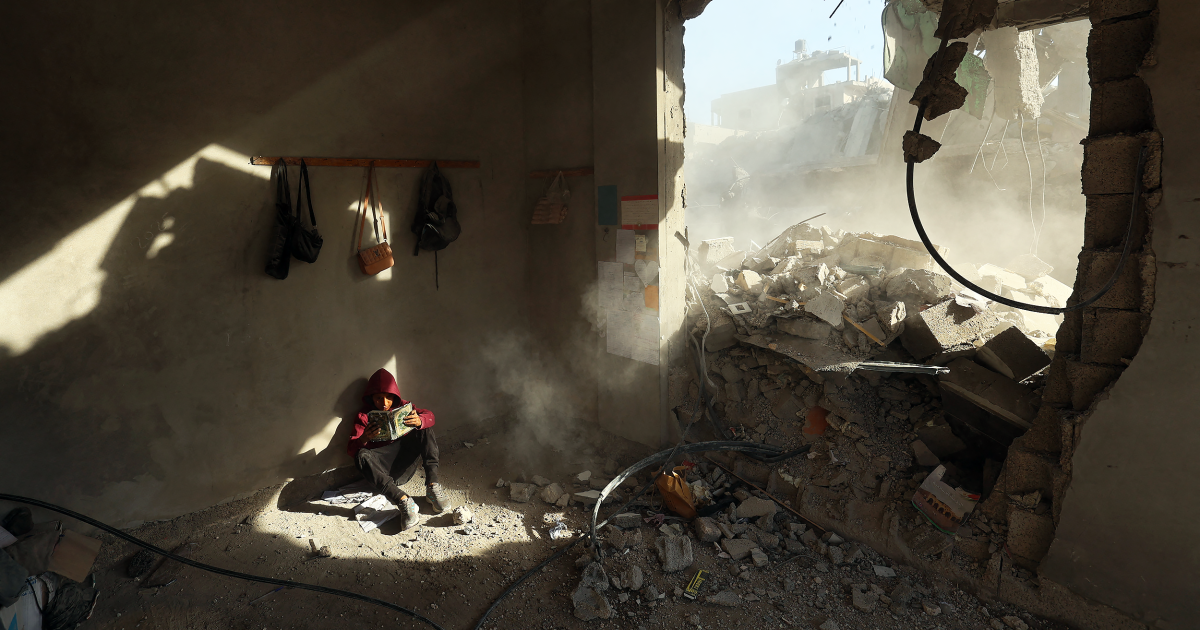
Nearly three years ago, when Israel split the Gaza Strip in half, north and south, my 28-year-old cousin refused to leave our neighborhood in Al-Daraj. The rest of us kept moving from one temporary shelter to the next, while he stayed on the broken ground where we grew up.
I reached him recently, the phone line so weak that every few words dissolved into nothing.
“You ask how the neighborhood looks three years later? There is no neighborhood. It’s just landmarks made out of memories,” he told me on the crackly line. “You know where the corner bakery used to be? It’s all a mountain of crushed brick with an iron beam sticking out like a broken arm.”
We thought the killing would stop and that the pain might finally have somewhere to go.
When the ceasefire in Gaza was announced one year ago, I celebrated from afar along with thousands of Palestinians who were in Gaza. It had been over a year since I had left.
Over phone calls, I shared in the joy and relief that the sounds of terror and bombardment were about to end. We thought the killing would stop and that the pain might finally have somewhere to go.
Within hours, people began walking north along Al Rashid, the coastal road, toward a Gaza City most of them hadn’t seen in two years. They pushed carts and carried children on their shoulders. Many were returning to homes that no longer existed.
In the months that followed, I have spoken with people across the enclave. Many of them spoke to me from tents pitched in the mud, sometimes on phone lines that kept cutting out mid-sentence, like in my conversation with my cousin, or over glitchy video calls. For safety, I’ve withheld their names in this essay.
Play
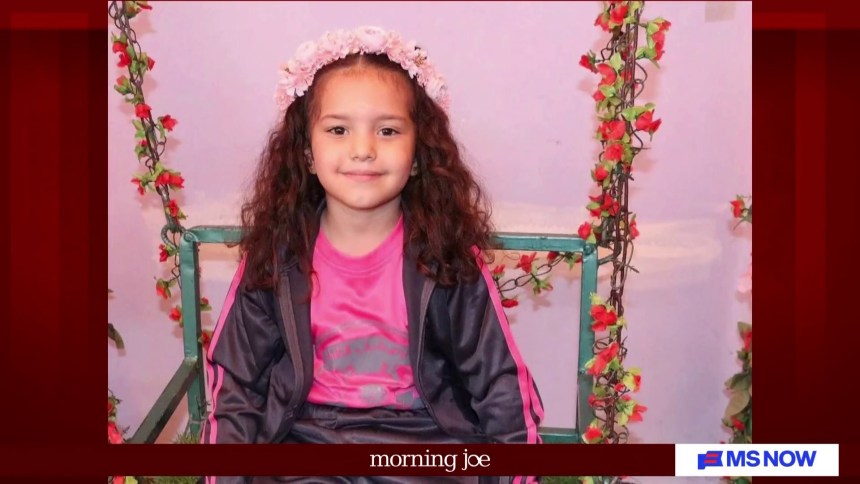
Three years into this genocide, people in Gaza no longer count days or years. Instead, they measure time in burials; how many children were killed, how many parents, and how many of the old ones they have put in the ground.
More than 1,000 Palestinians have been reported killed by Israeli fire since the truce was announced. Some were shelled while waiting for food. Others were crushed under ruins that finally gave way. Most of these attacks have been called isolated strikes by the Israeli government. I suppose they are, in the sense that a strike can take out a family at a time and rarely makes the front page. The quietest phase of the extermination is also the easiest one for the world to forget.
The ceasefire also drew a new line. Israeli troops pulled back behind the “yellow line,” a row of yellow concrete blocks, keeping more than half the strip on their side of it. Since then, the blocks have crept west. Israeli Prime Minister Benjamin Netanyahu said Israel controls about 60% of Gaza, and people who have come too close to the line have been shot. Two million people are now packed into what is left.
“God knows we lived on ground animal feed for months,” my cousin told me. “I miss sitting on our doorstep with your uncle every evening after sunset, drinking black tea with sage. We lost our home and my father, your uncle, is buried in a mass grave behind the clinic because we couldn’t reach the cemetery. A year of ceasefire on the news, but every few days another house is struck and another family is wiped out quietly. I walk through these streets and I feel like a ghost visiting a city that used to belong to living people. Everyone who stayed here aged 20 years in three years. My friend Hassan, he’s 26, his hair is entirely white now. All we talk about is whether we could find clean water for the day.”
“Last week, a girl in the second row looked up at me and said, ‘Teacher, my brother’s shoes are still under the house. Can we go get them?’ What do you say to that?”
A teacher in Gaza, whose youngest daughter was killed in 2023
I spoke to a man from the Sheikh Radwan neighborhood who now teaches under a tarp in Deir al-Balah, in central Gaza. We spoke on video briefly before switching over to a voice call due to the poor connection. Three splintered wooden posts driven into wet sand and a faded blue tarp pulled tight across the top is now called a school, where 50 children sit cross-legged on a carpet that he told me never quite dries out.
Before October 2023, our classrooms used to hold around 45 kids, two to a bench, and we thought that was crowded. Almost every school and university in the Strip has since been flattened into concrete, and some have become mass graves. But the teachers keep showing up anyway.
“People outside hear ‘ceasefire’ and ‘schools are back’ and think things returned to normal a year ago,” he tells me. “They see a photograph of a kid holding a notebook and think, ah, good, they’re learning again. But come stand inside this tarp for an hour. Half of them haven’t held a pencil in a year and a half.”
He is 44, and he taught Arabic for 16 years before his school was destroyed. Over video I can see his palms are stained with dark blue ink, the same ink I remember on my own teachers’ hands when I was 12.
“A 9-year-old sits down to draw a straight line and his hand trembles like an old man’s. Last week, a girl in the second row looked up at me and said, ‘Teacher, my brother’s shoes are still under the house. Can we go get them?’ What do you say to that?” he implored, his voice descending into exhaustion.
I asked him why he comes back every day. If a child has nothing to hold in their hands at 9 a.m. in the morning, he said, the noise in their head takes over.
Play
“My school of 16 years is just a pile of grey dust. I write letters on cardboard boxes from aid packages with a marker I buy with my own money. We stand here trying to teach grammar while their bellies are completely empty. These young kids are watching the sky every time a drone passes overhead, waiting to see if the tarp is going to shake.”
The man lost his youngest daughter in November 2023, in the second month of the war. Every morning since the tarp went up, he has come back to teach the alphabet to other people’s surviving children.
More articles
North of Deir Al Balah, back in Gaza City, Al Shifa was once the largest hospital in the Gaza Strip. Israeli forces have besieged it twice during the war. After the ceasefire last October, I spoke to a paramedic who had been sleeping in an ambulance for three months in Gaza City, where Al Shifa hospital once stood. After the second siege, in the spring of 2024, the Al Shifa complex was burned out by the Israeli military, and mass graves were dug up in its courtyard. When I was there in early April of 2024, I remember the air around what’s left of it still smelled of turned earth and burnt wire.
The vehicle’s rear windows had been blown out and replaced with plastic sheeting held in place with tape. The man, 31, is from Jabalia. He picked gravel out of the treads of his boots with a rusted nail while we talked by phone.
“Every night when I try to close my eyes, I hear that tiny whimper dying out in the dark under three tons of cement.”
A 31-year-old paramedic in Gaza
“People always ask me what the hardest rescue was over these three years. They expect me to talk about the blood or the crushed limbs. But the blood is just work; your hands move automatically before your head can process it. The hardest part is the silence right after you pull someone out, or the choices you were forced to make five minutes earlier,” the paramedic told me.
“In Jabalia, under a collapsed house, we heard two voices. One was a man screaming for help near the front, loud and clear. The other was an infant, barely a whimper, deep under the concrete slabs in the back. The frame was settling fast. We knew if we spent two hours digging out the back wall to reach the baby, the front slab would collapse and crush the man. If we dug out the man, the baby would suffocate before we could turn around. We dug for the man. We saved him. But every night when I try to close my eyes, I hear that tiny whimper dying out in the dark under three tons of cement.”
I’ve spoken to a lot of paramedics in Gaza, and they rarely look you in the eyes when you talk to them.
“They signed a ceasefire paper last year, but the bodies are still coming in,” he said. “Who treats us for what we had to calculate while everyone else was running?”
Play
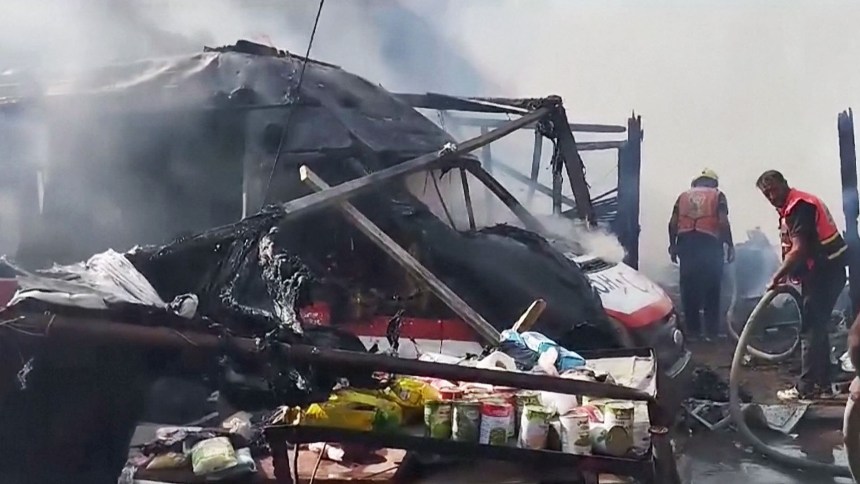
The man paused. The scratch of metal on rubber was the only sound between us. The familiarity of his pain hangs over my own family’s conversations now. We talk easily enough about who survived, who made it across town, who found a tent in the sand, but we almost never talk about the math it took to pull the living out from under the dead.
In March of last year, Israeli troops killed 15 paramedics and rescue workers in Rafah and buried them in the sand along with their ambulances and vehicles, the UN reported. Their colleagues found them about a week later. One of the men had filmed the last minutes on his phone.
Farther south, in Al Mawasi near Khan Younis, life is no less disjointed. Nearly two months ago, outside a canvas tent there, I spoke over video to a 39-year-old widow as she blew softly on a pile of damp olive twigs, trying to keep a weak fire alive under a dented aluminum pot. She has four children, and every hour of daylight goes to keeping them fed and warm enough to feel like themselves.
“My kitchen was the center of our home. I had spices in glass jars lined up on tile shelves and an oven that smelled like baked bread every Thursday, real ceramic plates,” she reminisced.
“My husband was killed while searching for flour. Since then, I am the father, the mother, the cook, the guard.”
A widow and mother of four in Gaza
“My husband was killed while searching for flour. Since then, I am the father, the mother, the cook, the guard. My twelve-year-old daughter came to me last week crying because her clothes smelled like smoke and wet earth. She said, ‘Mama, I don’t feel clean anymore.’ I had to wash her hair using half a cup of salty well water and a piece of harsh laundry soap. She stood there shivering in the cold wind, holding her breath so the salt soap wouldn’t burn her eyes.”
Her husband was one of hundreds of people who have been killed while trying to bring food home. Last December, when the storm flooded Al Mawasi, an eight-month-old girl named Rahaf Abu Jazar died of the cold in a tent not far from hers.
The second winter of the so-called ceasefire is almost here.
“I don’t care about what the media says,” the widow told me. “I just want to sit my children at a real table with clean plates and wash their faces with warm, sweet water without feeling like I am wasting something precious. I want my husband back.”

Mohammed R. Mhawish
Mohammed R. Mhawish is a Palestinian award-winning journalist and writer from Gaza City.