
Archaeologists in Scotland recently uncovered an Anglo-Saxon coin dating back 1,000 years that was minted under a king known as “the Unready.”
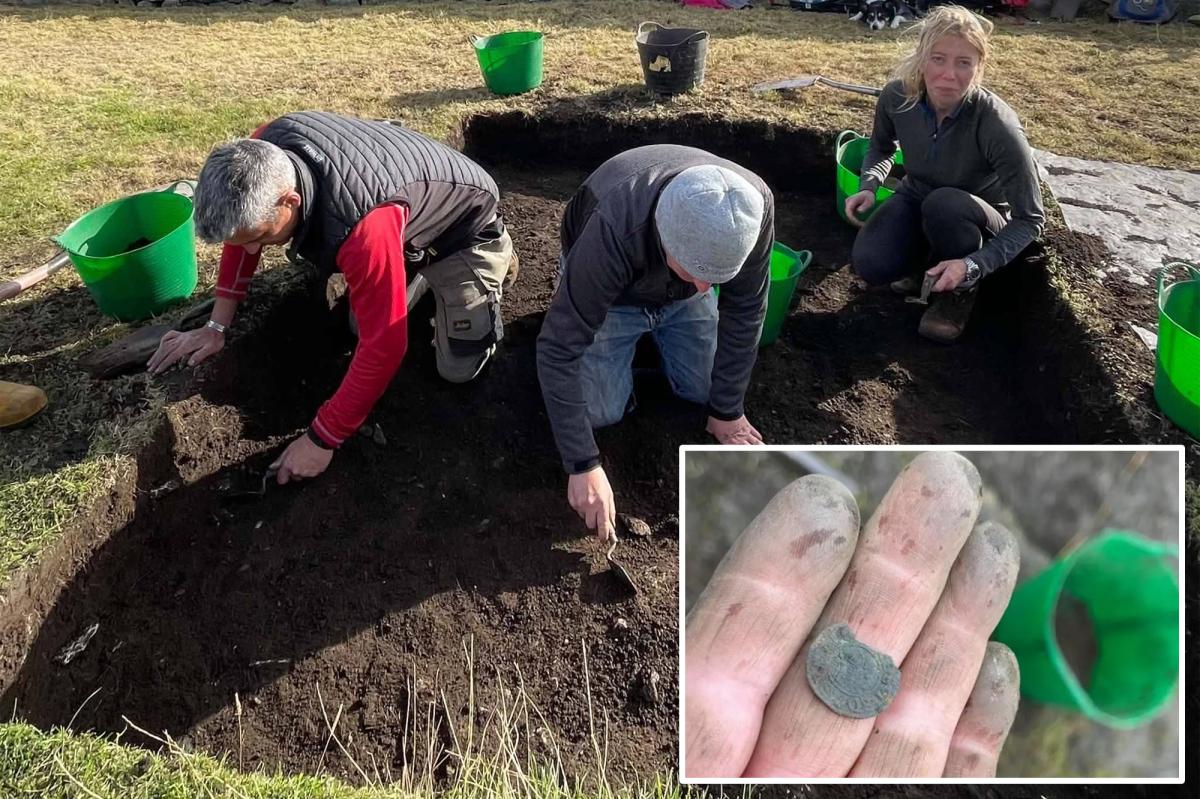
The coin was unearthed during an excavation in Nesting, a coastal community in Scotland’s eastern Shetland Islands, according to Jam Press.
Pictures show a thick, greenish-brown patina covering its surface, though some of the original markings remain visible.
The excavation was originally conducted to investigate prehistoric structures threatened by coastal erosion, according to Archaeology Shetland.
The archaeological investigation included an examination of nearby Iron Age structures.
The artifact was minted between 991 and 997 A.D., Jam Press noted.
The coin’s face depicts King Ethelred the Unready, who ruled England from 978 to 1013 A.D.
Archaeologists in Scotland unearthed a 1,000-year-old Anglo-Saxon coin minted during the reign of King Ethelred the Unready. Jam Press/Archaeology Shetland/Valerie Ward/Dr Elinor Graham
Ethelred, best known for his failed attempts to fend off Viking invasions, was eventually driven from the throne by Danish King Swein Forkbeard.
He regained power in 1014 and ruled until his death in 1016, making him the longest-reigning Anglo-Saxon monarch.
Elinor Graham, an archaeologist from the University of Aberdeen, was on vacation in Shetland when she participated in the excavation, according to Jam Press.
The coin is coated in a thick, greenish-brown patina, but some of its original markings remain visible. Jam Press/Archaeology Shetland/Valerie Ward/Dr Elinor Graham
“This is exactly how I wanted to spend my holiday,” Graham said.
“The writing on the coin is still so sharp, and we knew immediately that it was extremely rare, actually unique, in this context.”
The discovery could offer clues about ancient trade routes between Viking-controlled Shetland and Anglo-Saxon England, though researchers have not ruled out the possibility that the coin was taken during a Norse raid.
The Anglo-Saxon coin marks the northernmost discovery of its kind. Jam Press/Archaeology Shetland/Valerie Ward/Dr Elinor Graham
Graham said another Anglo-Saxon coin had previously been discovered at Old Scatness, an archaeological site in southern Shetland; the latest find, though, marks the northernmost discovery of its kind.
Scotland’s Treasure Trove Unit will determine whether the artifact should be offered to a museum.
Graham said she hopes the coin will eventually be added to the collections at the Shetland Museum and Archives, Jam Press reported.
She said the discovery suggests the area may once have been home to a “well-connected cosmopolitan community” with trading links to Anglo-Saxon England.
“It’s an area with a huge amount of history through the Bronze Age, the Iron Age, the early medieval period and into the Viking Norse period,” Graham said.
The ancient coin is one of many that have surfaced across the United Kingdom.
Earlier this year, archaeologists uncovered a nearly 1,750-year-old Roman coin during a railway construction project in England.
In Scotland, a metal detectorist discovered a 900-year-old coin believed to be the oldest ever minted in the country.