
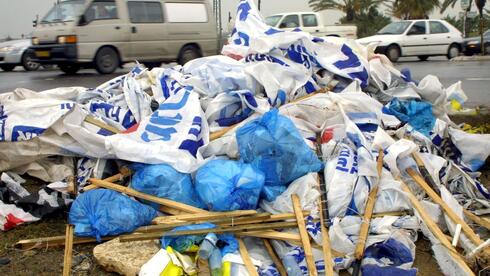
Israeli citizens will head to the polls later this month to vote in the Knesset elections, exercising one of the most fundamental and important democratic rights. But behind Election Day lies an environmental cost that rarely enters public debate.
Although an election campaign is a short, intensive event, generally held once every four years, it generates enormous amounts of waste in a relatively brief period, from ballot papers and billboards to campaign materials, packaging and equipment that end up in the trash immediately after the election.
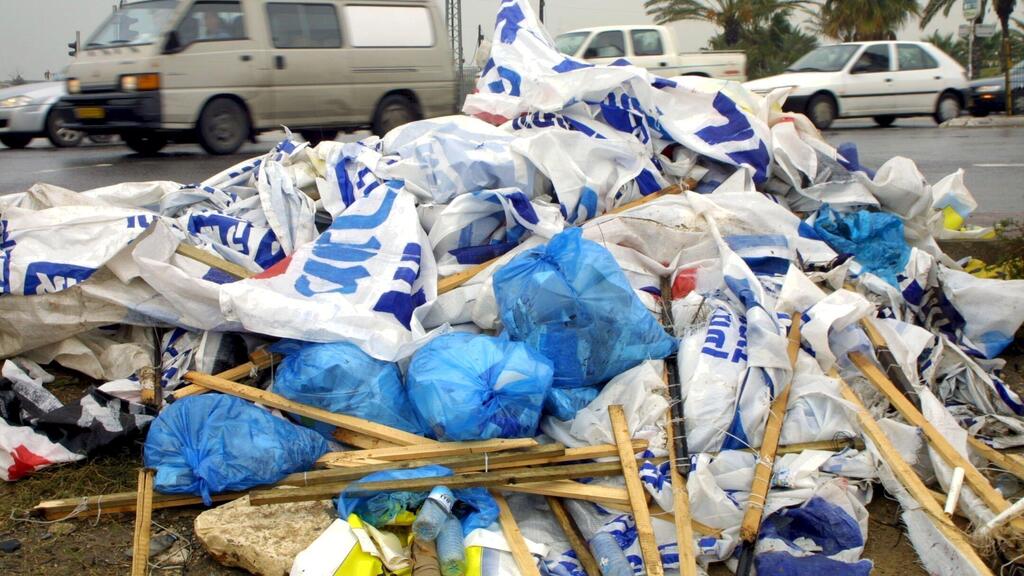
Election waste the day after a past Election Day
(Photo: Zvika Tishler)
Elections leave a significant environmental footprint. It is not just the physical waste they generate, but also the digital pollution associated with creating and publishing online content. So just how “green” can our elections really be? And can we imagine a future in which elections protect not only democracy but also the environment?
To understand the scale of the problem, one need only look around during an election campaign. Within a short period, public spaces fill with signs, posters, stickers, flyers and other campaign materials. Some are displayed along streets and at intersections, while others are handed out to passersby. At best, most of these materials are used for anywhere from a few minutes to several weeks. Either way, by the day after the election, they have become waste.
In Israel, no organization systematically measures the environmental damage caused by election campaigns, and assessing the impact of the entire campaign period, which can last several months, is itself a complex task. Although comprehensive data is not collected, estimates suggest that Israeli elections generate thousands of tons of waste associated with campaigning and Election Day itself.
The problem, then, is not limited to the amount of waste generated, but also raises the question of who is responsible for dealing with it.
Attorney Meirav Abadi, director of regulation at Adam Teva V’Din – the Israel Union for Environmental Defense, notes that, because campaign materials are produced in large quantities but used for only a very short time, the day after an election leaves behind a substantial amount of waste.
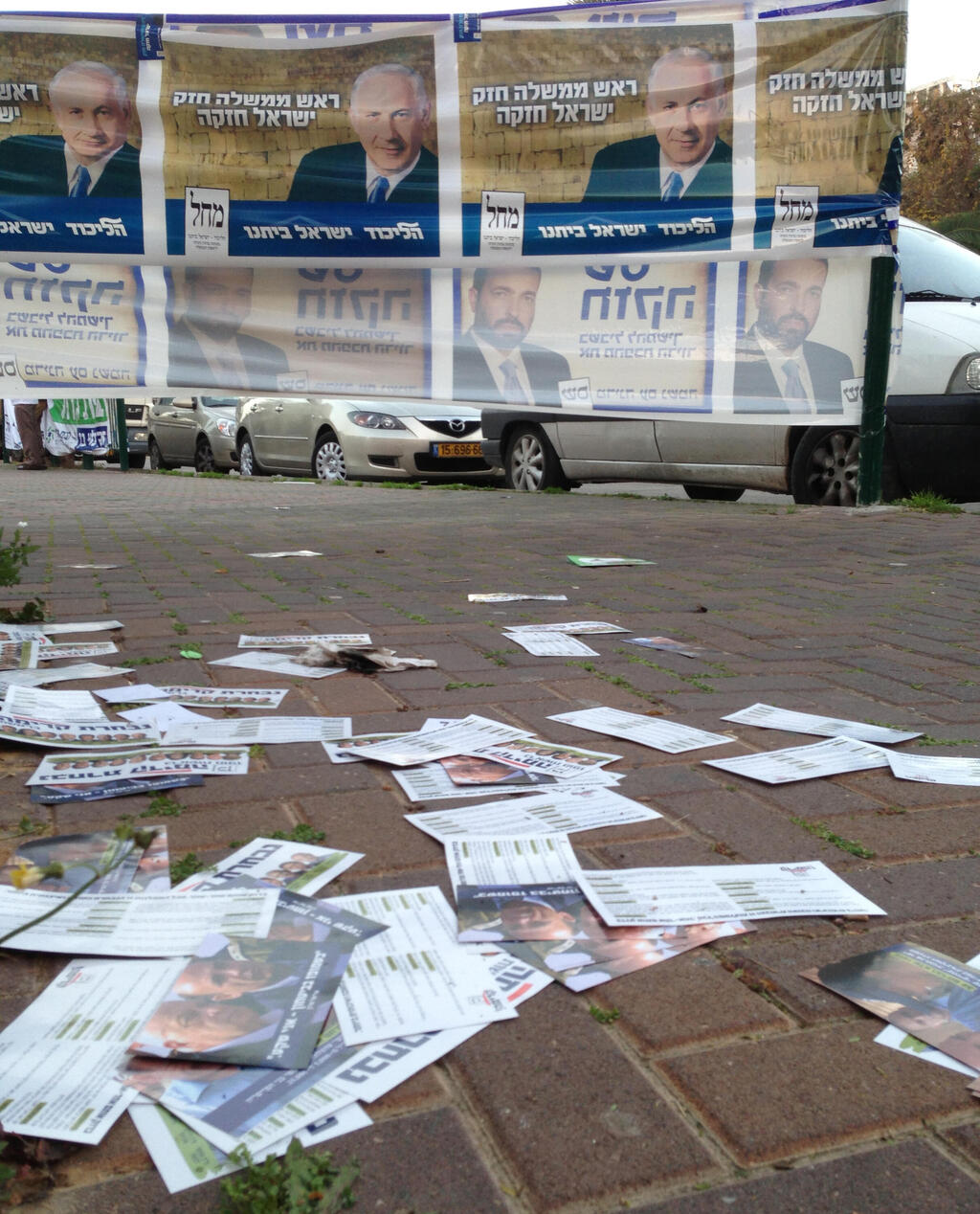
Election materials litter the ground near a polling place on Election Day
(Photo: Eran Granot)
According to Abadi, most of the burden falls on local authorities, which are responsible for collecting and disposing of the waste, with the cost ultimately passed on to the public.
“There is no ‘polluter pays’ mechanism in Israel, meaning that those who generated this waste are not required to deal with it or remove it. It’s time to introduce comprehensive regulation of this issue.”
In recent years, election campaigns have increasingly shifted to the digital arena. Videos, posts and social media campaigns allow political parties to reach millions of voters without printing and distributing large quantities of campaign materials. This shift offers a clear environmental advantage by reducing the use of paper and other physical materials.
Nevertheless, digitalization has not eliminated campaign advertising from public spaces. Billboards still fill the streets, banners are hung on bridges and fences, and flyers and other promotional materials continue to be distributed in public areas.
Creating, storing and uploading digital content also consumes electricity and water, particularly in the age of artificial intelligence. Using AI to generate images or videos requires extensive computing power in data centers, consuming substantial amounts of energy and water.
“Digitalization is a good thing, but it also has a carbon footprint, mainly because of the large amounts of energy it consumes,” Abadi says.
“It’s something we don’t see as clearly, unlike the waste from flyers, for example. In politics, the interests involved are so powerful and emotionally charged that, in the end, everyone goes all in. That means using both digital and physical campaigning.”
Even if campaign materials are an unavoidable part of an effective election campaign, it is still worth asking how their environmental impact can be reduced.
“In my opinion, the environmental discussion should always take place, even when there is a legitimate interest on the other side that deserves protection,” Abadi says.
“Just as it’s clear that medical staff need to use disposable gloves when treating patients, we should still ask whether their use can be reduced and whether there is a better way to handle the waste afterward. The same applies to elections: We need to ask who is subsidizing and dealing with this waste.”

Ballots litter the floor at the end of the day
(Photo: Tomariko)
According to Abadi, the solution is to make political parties directly responsible for the waste they generate.
“I’m not saying there should be no waste at all during an election campaign. I’m saying that, first and foremost, we need to try to manage it, examine whether the amount of waste can be reduced, and establish clear standards and procedures for dealing with it.”
Ultimately, responsibility does not rest solely with political parties and local authorities. It also lies with the voters.
Environmental considerations are rarely at the top of our priorities when we enter the voting booth, but Abadi believes they deserve a place in our political decisions as well.
“I would very much like to encourage everyone who goes to the polls to also think about the environment and specifically about waste, because this is the kind of problem that we, as a society, don’t really see, but it has a major impact on our lives.”
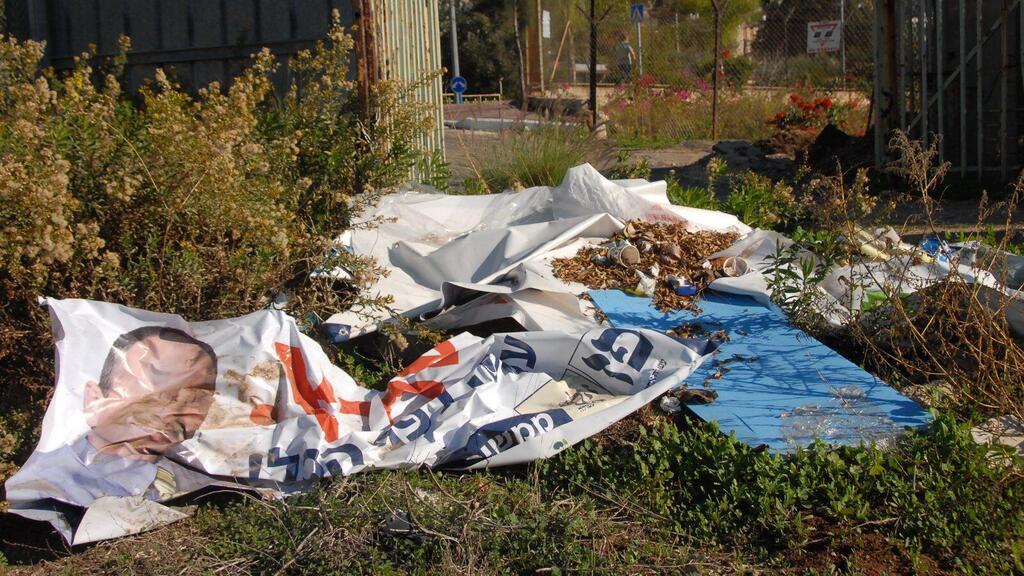
According to Abadi, about 80% of Israel’s waste currently goes to landfills, which are steadily filling up, while only a small percentage is recycled.
She believes elections should reflect every aspect of our lives, including the environment.
“We need to understand that waste is not something we should only deal with after it is created. We also need to think about how to reduce and prevent it in the first place.”
So when we cast our ballots, the environmental impact is also worth keeping in mind.
Prepared by Zavit, the news agency of the Israeli Society of Ecology and Environmental Sciences