
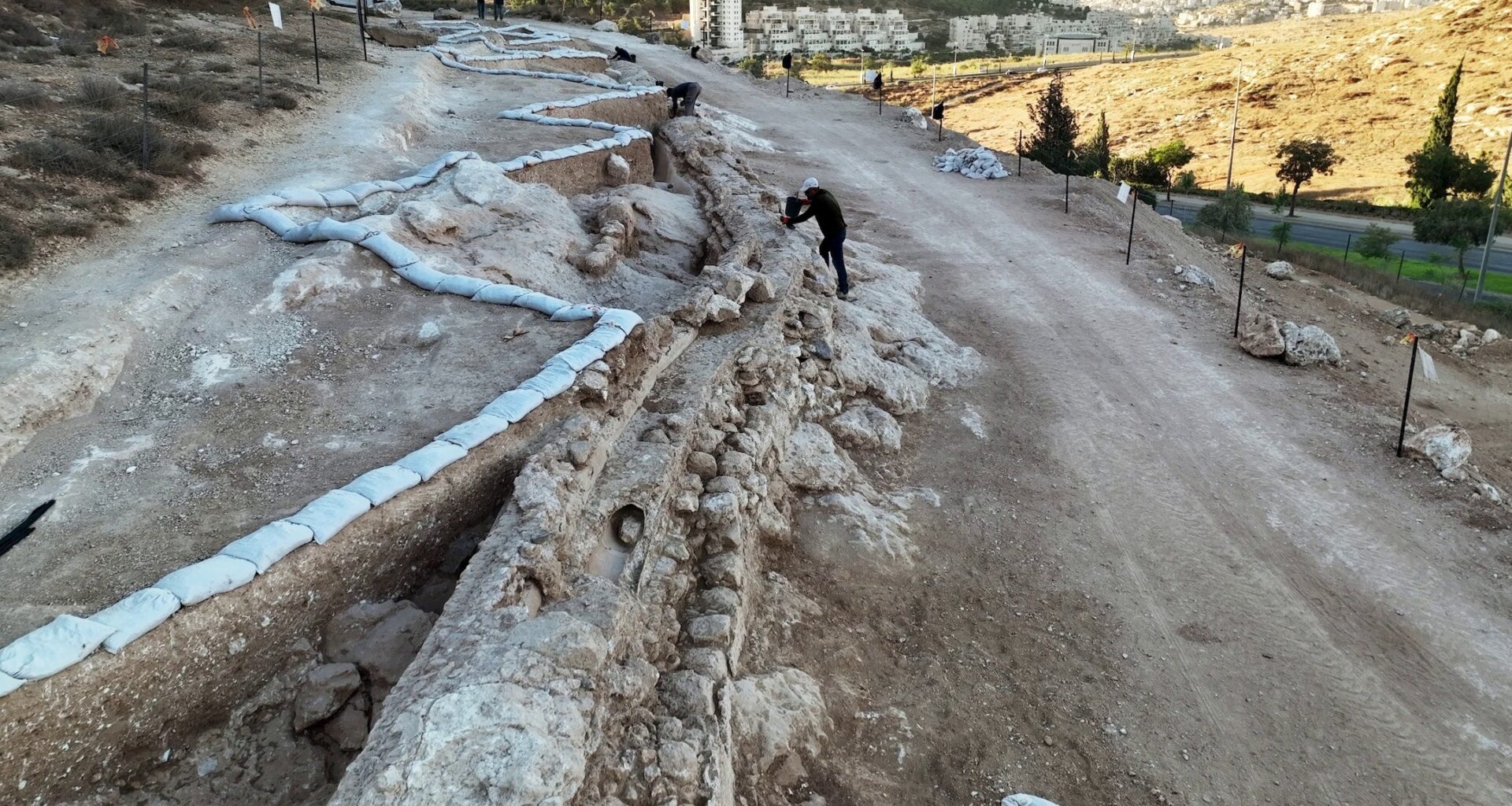
JERUSALEM — Israeli archaeologists have uncovered a 300-meter (984-foot) section of Jerusalem’s ancient Lower Aqueduct, providing another window into how engineers about 2,000 years ago ensured that the city would have an adequate supply of water for residents and pilgrims.
The Israel Antiquities Authority (IAA) began the dig three months ago in advance of the planned construction of a new neighborhood in East Jerusalem, at the city’s edge. Such “salvage excavations” are often carried out prior to major construction projects in Israel to ensure that any ruins discovered at the site can be mapped and protected even if they aren’t excavated at the time.
Believed to have been built in the Hasmonean period in the second and first centuries B.C.E., this engineering system carried spring water from the Gush Etzion region of the West Bank, through Solomon’s Pools south of Bethlehem, to Jerusalem and the Temple Mount. It remained in intermittent use until the early 20th century.
Although parts of the aqueduct have been uncovered in previous excavations, this is the first time such a large section will be made permanently accessible to the public, Benyamin Storchan, an IAA archaeologist and the excavation’s co-director, told the Jewish Telegraphic Authority.
Based on earlier discoveries and a wide range of research, archaeologists had strongly suspected where the newly uncovered section was located.
“We were able to work with municipal urban planners to ensure that the shape of the new neighborhood will be determined not only by its natural topography, but based on the antiquities found there,” Storchan said.
The aqueduct, the discovery of which was made public on Sunday, will be preserved as a promenade/archaeological park at the entrance to the future neighborhood by the IAA and Israel Land Authority.
Bringing Water to Jerusalem
Before the aqueduct was built, the landlocked city of Jerusalem relied on the Gihon Spring and rainfall runoff for its entire water supply, Storchan said. Under Hasmonean rule, Jerusalem’s population grew and the need for water increased. That was especially true during Jewish festival times, when pilgrims doubled or even tripled the population.
The solution involved transporting water from springs in the Gush Etzion region, a hilly area more than 800 meters above sea level. Spring water had to be channeled to collection areas, and then toward Solomon’s Pools, an extensive water-storage complex built south of Bethlehem. From there, two major aqueducts, the Lower Aqueduct and the Upper Aqueduct, carried water toward Jerusalem – a distance of more than 20 kilometers (12 miles).
The Lower Aqueduct, which appears to predate the Upper Aqueduct, “is an engineering marvel,” Amit Re’em, the IAA’s Jerusalem district archaeologist, said in a press statement. “Even today, with all our modern technology, building such a system would require extensive planning and effort. The thought that, about 2,000 years ago, they managed to bring water to Jerusalem this way is astonishing.”
Its route had to follow the contours of the rugged topography while maintaining a gentle gradient for the water to flow by gravity alone, without mechanical pumps. Along most of its route, the water dropped just one meter in elevation per kilometer.
“The newly exposed section reveals the various stages in the history of the water system,” the IAA said. “Initially, the water flowed in a built, plastered channel. Then, about 500 years ago, during the Ottoman period, ceramic pipes were installed within the original channel, the outer face of the aqueduct wall was plastered and small stones were pressed into the plaster while still wet.”
Used for about 2,000 Years
One of the aqueduct’s most remarkable characteristics was its longevity. Believed to be constructed during the Hasmonean period, it was repaired and reused through successive eras, including the Roman, Byzantine, Umayyad, Crusader, Mamluk and Ottoman periods.
The fact that various kingdoms and rulers decided to repair and not replace the water system “is one of the most fascinating parts,” Storchan said of the waterway. Rather than repurposing an older structure for a different use, successive rulers retained the aqueduct’s original purpose.”, “here we see a single installation being reused again and again for its original function.”
The aqueduct was used until about a century ago, when modern water infrastructure, including electric pumping stations, proved more efficient. Its long history of repairs, however, complicates archaeological dating, Storchan said. Those who repaired it over the millennia added plaster, repaired collapsed sections and modified the channel, sometimes obscuring evidence of the original construction.
Utilizing modern technology
Still, the latest excavation gives researchers an opportunity to reexamine longstanding questions with advances in scientific dating methods.
“Today, technology is more advanced than it was then. We’re working with all kinds of specialists to pinpoint the dating of the original construction,” Storchan said.
One such method is optically stimulated luminescence (OSL), which can estimate when mineral grains in sediment were last exposed to sunlight. Combined with the analysis of mortar, plaster and archaeological layers, the technique may help narrow the dates associated with different stages of the system’s development.
For Storchan and his colleagues, every new insight is a cause for celebration.
“Our job as archaeologists,” he said, “is to fill in another piece of the puzzle.”
As the Year Turns, Support the Journalism You Trust. JTA covers the stories shaping Jewish life around the world — with the depth this moment calls for. As you reflect on the year ahead, consider a gift that keeps independent Jewish journalism strong.
One-time
Monthly
Choose an amount to donate
$72$180$360$500
Support Us