
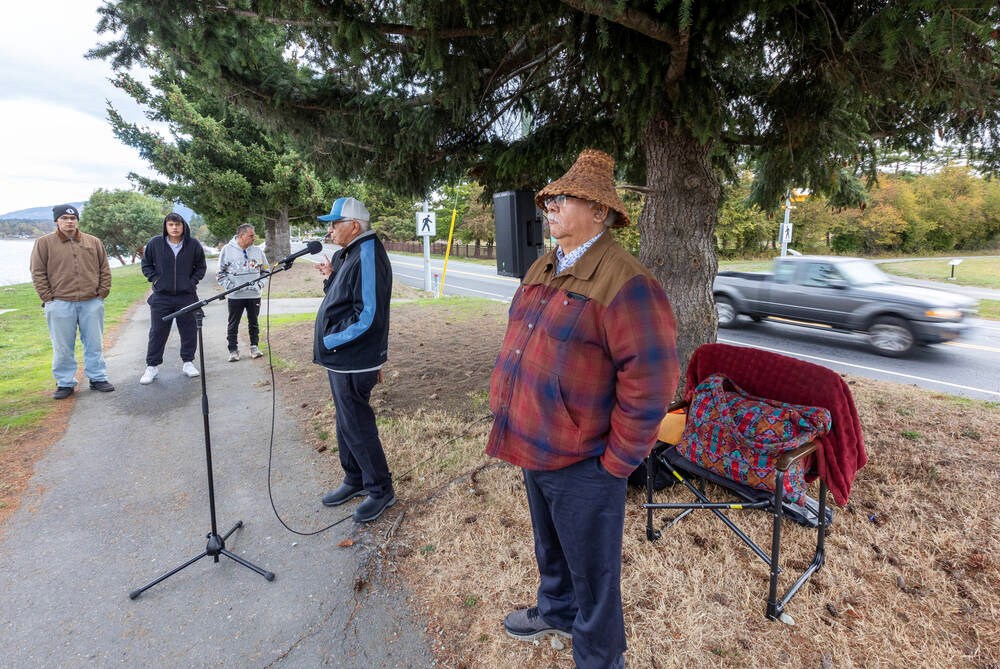
Vern Jack said he’s always known that thousand-year-old bones lie beneath West Saanich Road, along the coastline of the W̱SIḴEM (Tseycum) reserve.
W̱SÁNEĆ Hereditary Chief Vern Jack, known as XÁLÁȾE, has spent decades driving down a road he knows was paved over his ancestors’ graves.
Now in his 80s, Jack said he’s always known that thousand-year-old bones lie beneath West Saanich Road, along the coastline of the W̱SIḴEM (Tseycum) reserve near Victoria International Airport.
“It’s about time we do something about it,” said Jacks, who has been trying to draw attention to the unmarked graves for as long as he can remember.
He spoke to the Times Colonist in 2017 when a 500-metre section of the road was widened and resurfaced.
At the time, Tseycum Chief Councillor Tanya Jimmy said the work, which added a crosswalk and shoulder to improve pedestrian safety, was done after years of consultation with the community and province.
Jack held a protest and gathering at Patricia Bay Park on Saturday, across from the Holy Trinity Church, to draw attention to what he sees as disrespect from all levels of government.
“We want this park to be closed,” Jack said, referring to the waterfront park with picnic tables, a sloped beach and kayak launch in North Saanich.
The district website says the park area was “originally settled by the Tseycum First Nation” and is “valued for its ties to transportation and the waterfront, and their pivotal role in the development of North Saanich.”
While the cemetery at the nearby church is protected by fencing, Jack said the same courtesy isn’t applied to the graves of his ancestors.
“Our people respect all grave sites,” he said. “But it’s a one-way street.”
At the gathering, Jack called for a meeting with municipal, provincial and federal governments to discuss his role as a hereditary chief and what he says is the failure to honour the North Saanich Treaty, one of the Douglas Treaties negotiated in 1852 by James Douglas, then governor of the Colony of Vancouver Island.
Jack wants a memorial at the site to recognize the village that once stretched across Patricia Bay, long before Douglas arrived in what is now Victoria.
SȾÁUTW̱ (Tsawout) Hereditary Chief Eric Pelkey spoke to the crowd about the importance of the wording of the treaty document that is still constitutionally recognized.
“Under that treaty, all of these grave sites should have been protected,” Pelkey said, pointing to the treaty promise that “village sites and enclosed fields” would be spared from harm.
Archaeologists found proof of bones dating over 1,000 years old in 2006 when North Saanich put in a new sewer line.
Jack said he invited local politicians to the event and was disappointed that no one came.
“They have to sit down with us and ask us what we want.”
Chief Jimmy said in a statement Saturday that she’s not in direct communication with the protest organizers.
“I uphold our ancestors’ sacredness; in death, there must always be dignity,” she said. “W̱SIḴEM has a responsibility to ensure our ancestors’ dignity remains intact.
Jimmy said the nation “will engage with the mayor and council-elect, seek counsel from our elders, and conduct the necessary ceremony if any.”
Jacqueline Ahenakew is from Tseycum and said the timing of the event during a provincial and municipal election is fitting.
“I do love this park, but I have a very different feeling now.”
She pointed to the cemetery behind her and asked the non-Indigenous members of the crowd to consider their own family’s resting places.
“What would you want that to look like?”