
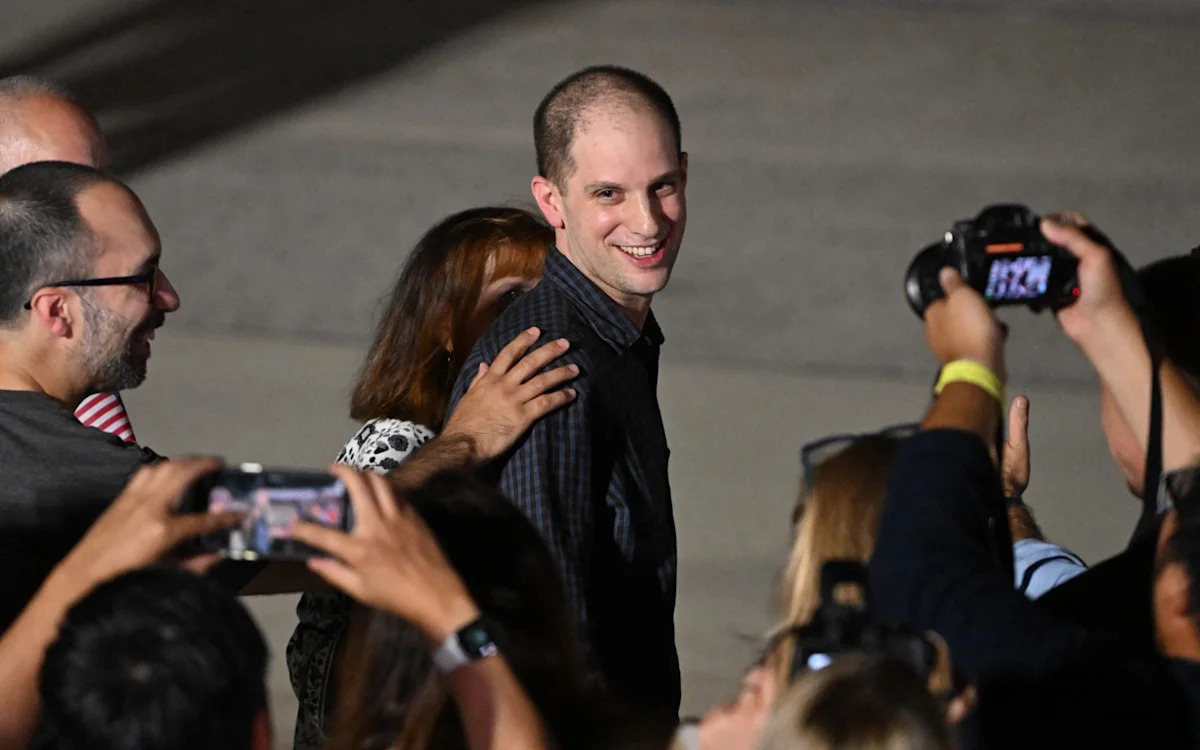
What does the CIA think a man needs after more than a year in captivity? A tablet of Viagra.
Evan Gershkovich, the US journalist who spent 16 months in a Russian prison accused of espionage, has revealed the unusual contents of the “recovery kit” he was issued on being freed in a prisoner swap in 2024.
On the flight home to the Andrews military base in Maryland, US, he was handed a small package.
“Typically, it’s the state department who put together the recovery kits, but it was the CIA who put together these recovery kits and, in mine, they put Viagra.
“Maybe it’s a smart thing – a traumatised person comes home and sees his wife for the first time in years or whatever. Or is this what the CIA brings along for its missions abroad? We couldn’t figure it out,” he said.
Mr Gershkovich said he had saved the pill as a “memento” of his release.
His mother had told the state department that he would like a drink of whiskey on the flight home, and an official from the Office of Special Presidential Envoy for Hostage Affairs presented him with a bottle of High West Campfire.
However, the CIA forbade him from drinking it, saying that he must be sober to meet Joe Biden, then president, when he touched down in the US.

Evan Gershkovich greets his mother, with Joe Biden looking on, after arriving back in the United States on Aug 1, 2024 – Andrew Harnik/Getty Images
The Wall Street Journal reporter was speaking at the Cheltenham Literature Festival to promote his memoir, This Cursed Beautiful Land.
The Federal Security Service (FSB) arrested him in 2023 and he was later sentenced to 16 years in a high-security penal colony, accused of being a CIA spy.
Sixteen months later, he was released as part of the biggest prisoner exchange since the end of the Cold War.
Mr Gershkovich said he was able to cope in prison awaiting trial by setting up a routine that included reading, note-taking and backgammon. “Human beings are adaptable. You create a life,” he explained.
He admitted that, when told that he was about to be released, he did not feel ready to leave because “it’s really difficult to become normal again”.
He had 16 months of therapy to recover after being released and was diagnosed with post-traumatic stress disorder.
Mr Gershkovich was asked whether he was still looking over his shoulder, fearing more unwelcome attention from the FSB. But he said that he had fulfilled his purpose for the Russians as “a useful geopolitical trading chip” and now felt safe.