
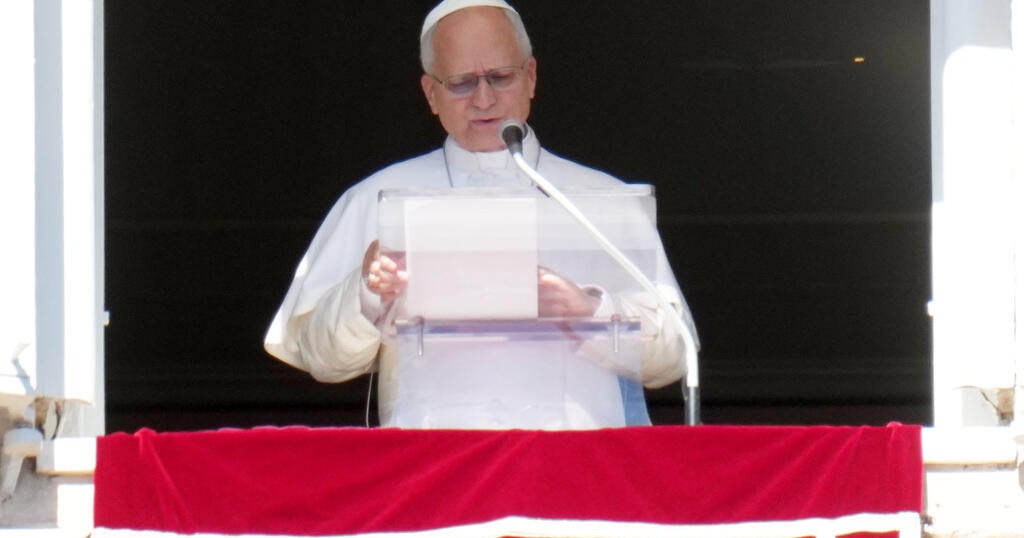
Pope Leo XIV will undergo surgery this week after a nodular lesion was found in his lung, the Vatican said. Recovery is expected to take a week.
Leo, 71, said Sunday that doctors recently discovered the nodular lesion during medical checks. He said it was found in an early stage and was “circumscribed.”
“The doctors believe it’s best to take action, so, following their advice, I’ve decided to have surgery to remove it,” Leo said in remarks during his Sunday noon blessing. “Thank you for your spiritual support, and I entrust myself to your prayers.”
A statement by Vatican spokesperson Matteo Bruni didn’t say when the pope would be hospitalized but that it would be in the “first days” of the week. He was expected to be treated at Rome’s Gemelli Hospital, which has a special apartment for the pope.
A lung nodule is a small abnormal area measuring less than 1 inch that sometimes appears on a CT scan of the chest or abdomen, according to the American Cancer Society. Often, the scans are done to investigate trauma or a lung infection, unrelated to a lung cancer screening.
“Lung nodules are fairly common and are often benign, but benign and cancerous nodules can have a similar appearance on imaging,” said Dr. Stephen Liu, a lung cancer expert at Georgetown’s Lombardi Comprehensive Cancer Center.
“When there is sufficient concern, and when it is safe to do so based on the location of the nodule and the overall health of the patient, surgical removal can provide a definitive diagnosis,” he said in an email.
The pope has a major trip planned Nov. 6-17 to Uruguay, Argentina and Peru. It’s unclear whether the planned surgery and recovery would affect the itinerary, but Leo said earlier in his remarks Sunday that he planned to go.
The American pope has no previously known health problems and is known to be physically active, with weekly tennis games and swimming at the papal summer retreat in Castel Gandolfo. This, Dr. Massimo Di Maio, president of the Italian Association of Medical Oncology, said, is “an important starting point for coping as well as possible with treatment, including surgery.”
Di Maio said it will be important to determine if the nodule is benign or malignant, and if it is malignant, whether it has spread. When the disease is detected at an early stage, “the aim … is curative,” he added.
Depending on what is found, possible treatments can include chemotherapy and radiation therapy, Di Maio told Italy’s private Sky TG24.
“When we talk about something being localized, that can also refer to the need to establish whether the disease is confined to that one site or whether scans show signs of disease elsewhere,” he said, adding that he has not treated the pope and was speaking about the disease in general.
Leo’s predecessor, Pope Francis, died April 21, 2025, of a stroke following a long hospitalization brought on by a respiratory crisis that developed into double pneumonia. Francis suffered from chronic lung disease and had part of one lung removed as a young man.
Pope Leo XIV: The First American Pope
More
Go deeper with The Free Press