

Want to bookmark your favourite articles and stories to read or reference later? Start your Independent Membership today.
Already a member?
Log in
How can a motley group of rebels shut down the airports and kill more than a dozen people in the capital of their neighbour – and regional superpower – Saudi Arabia?
Yemen’s Houthis, a family-led movement on the peninsula, which juts out into the Red Sea, have not only closed down Riyadh city’s airspace; they have captured an increasing amount of coastline recently, with their claws closing on the windpipe of east-west trade through the Bab al-Mandeb Straits.
Their sudden successes have come as a result of their own intense focus on victory while their local enemies have spiralled into corruption and incompetence – with plenty of help from friends.
Regional turmoil set off by the Israel-American war against Iran has sent the Middle East into a chaotic vortex that big players, like the Saudis and Emiratis, struggle to control, and which the Americans cannot understand, but which gives motivated groups like the Houthis boundless strategic opportunities.
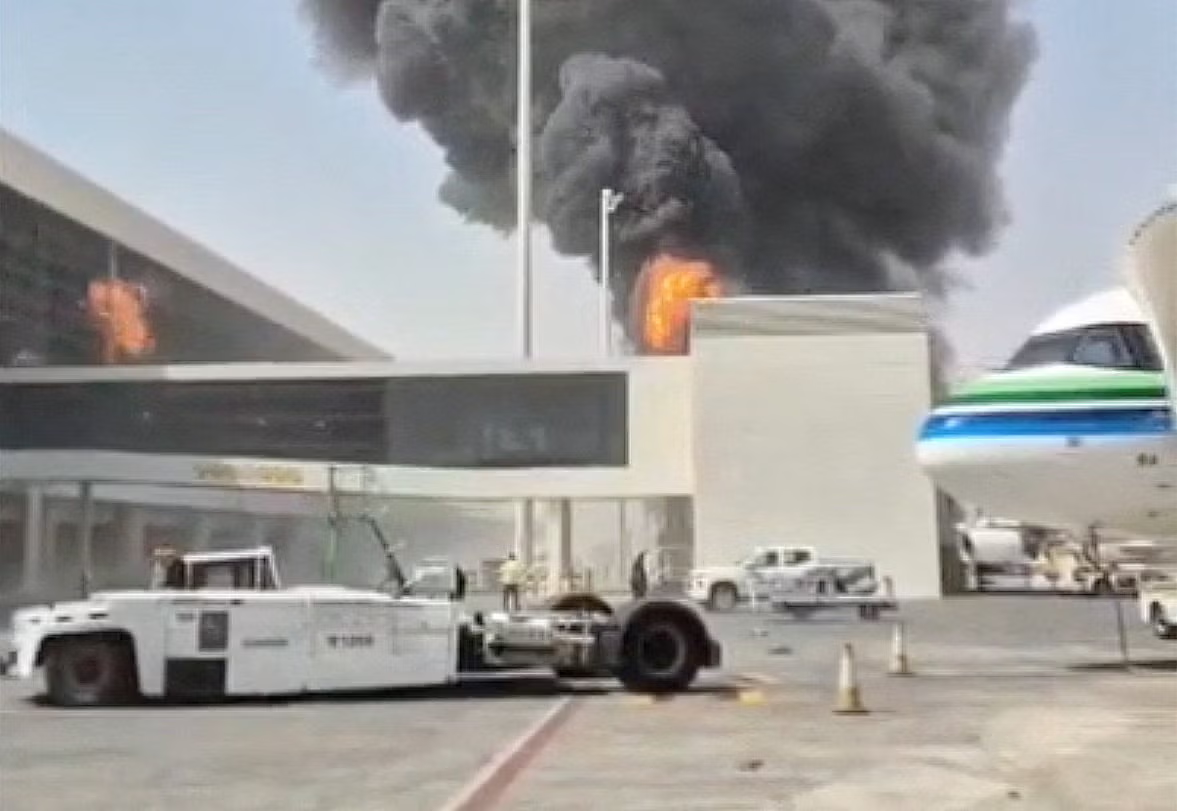 Smoke and flames rise from King Khalid Airport, after Yemen’s Iran-backed Houthis said they attacked the airport, in Riyadh, Saudi Arabia, 8 October (Reuters)
Some of this derives from a temptation to underestimate the Houthis as the unruly tribesmen of Arabia. They are not.
They are a wily and skilled organisation that has played alliances with Iran, Russia and China with finesse, which has meant they can fly a missile onto Riyadh airport and batter Saudi’s oil production facilities.
The Houthis are Zaydi Shi’a, different from the Twelver Shi’a who rule Iran, but they have enjoyed support from Tehran as anti-Western and anti-Israeli. They are also deeply antagonistic to the Wahhabi tradition that underpins Sunni Islam in Saudi Arabia.
Marginalised after centuries at the helm of what is now much of northern Yemen, the Houthis launched a rebellion in the 1990s.
The areas they dominate, which are expanding again, are ruled by a mixture of authoritarianism and cynicism.
The Houthis claimed their population was starving when Saudi Arabia led international embargoes against them and paraded “starving” children for successive TV crews for years.
People were hungry but the kids were not dying from lack of food. Part of the problem was that the Houthis had dedicated 80 per cent of their agricultural production to the narcotic khat plant.
The Houthis have attacked Israel, Saudi Arabia, the UAE and shipping in the Red Sea. They developed unmanned sea drones long before Ukraine did the same to overcome Russia’s dominance of the Black Sea.
During a civil war in which they toppled the dictatorial and corrupt president Ali Abdullah Saleh in the capital, Sanaa, which they still retain, they absorbed much of his military infrastructure, his long-range missiles, and his know-how.
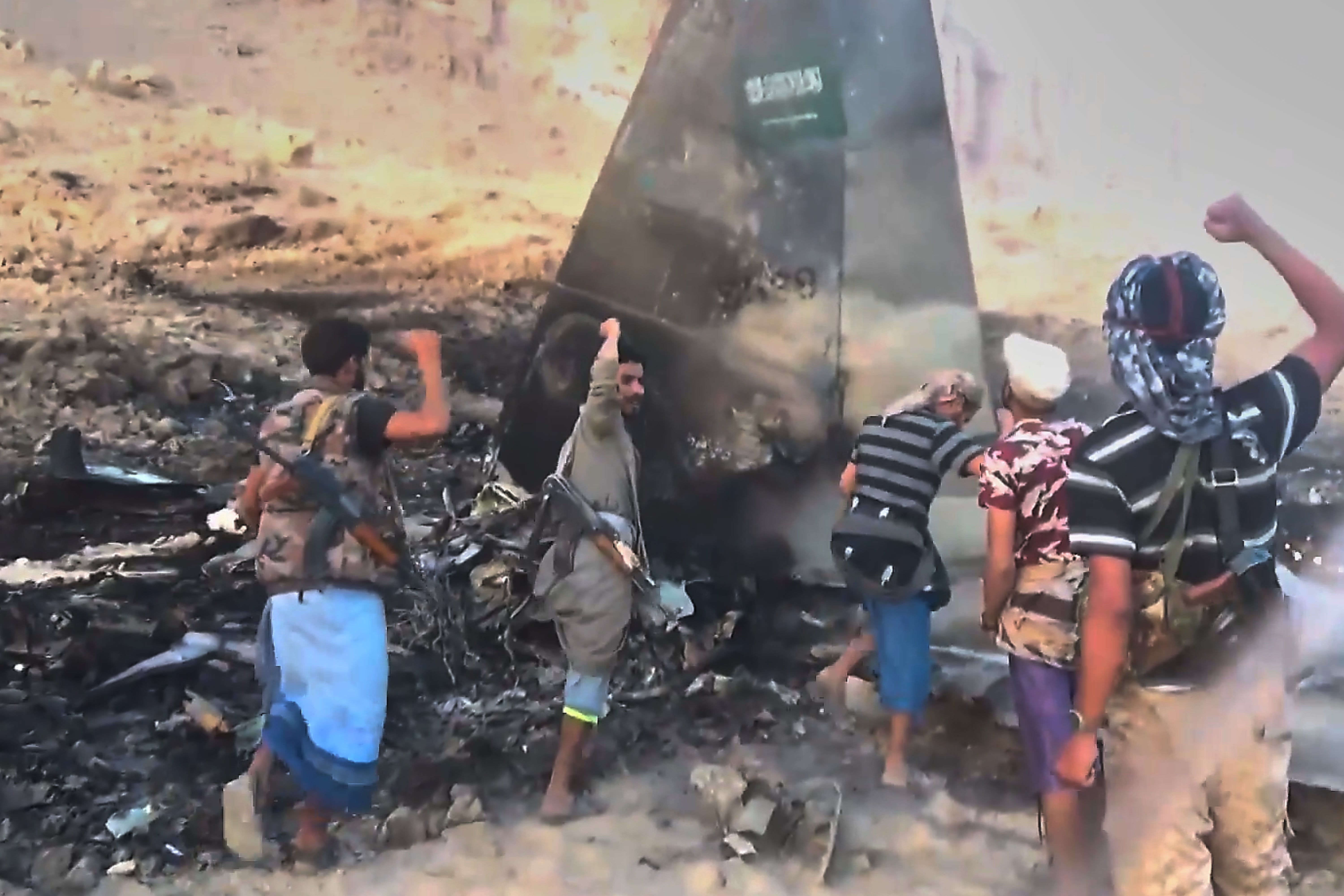 Houthi fighters chant and raise their fists beside what the group described as the wreckage of a downed Saudi F-15 fighter jet (AP)
This has been reinforced during a long campaign to rid Yemen of the Houthis led by Saudi Arabia. Intercepts of Iranian military advisers have sometimes shown that they held their Houthi hosts in disdain and derided their Arab ethnicity.
But they have also proved successful strategic partners for Iran’s counterattack against the US and Israel in the Straits of Hormuz, where the throttling of fossil fuel shipments has caused a global price spiral in energy and other oil products.
Russia has been exposed as sending secret intelligence to Iran that has been used to target Gulf allies and even American military assets in the Persian Gulf. Russian military intelligence officers from the GRU are regular visitors to Tehran. Iran and Russia have joint programmes to develop the long-range, cheap Shahed cruise missiles used against Ukraine, as well as ballistic missiles.
China also has been a major supplier of parts that can be used in weapons to both Russia and Iran.
In July this year, Reuters reported that China was in direct negotiations with the Houthis to allow its shipping through the sea lanes it controlled. Chinese parts are essential to the Houthi armoury which, although it has been attacked in hundreds of American and Israeli air strikes, has shown remarkable resilience.
Using the Houthis to undermine Saudi Arabia, and therefore US influence, has served Iran, Russia, and China pretty well.
Iran wants to see Donald Trump further humbled by his war against it. Russia, which now dominates White House thinking, wants to undermine US influence, and the power of the West, over the long term to account for a post-Trump world.
Ensuring that the Houthis, like Iran, can hit America’s Gulf allies with ballistic and cruise missiles also soaks up American air defences that might otherwise be sold for use in Ukraine against Russian attacks.
This, in the short term, is Vladimir Putin’s most important play. This year Ukraine’s supplies of Patriot air defence weapons have almost dried up, and the result has been a huge increase in successful attacks on Ukraine by Russia’s missile armoury.
China is playing an even longer game. Keeping good relations with Russia and Iran is part of its goal to see its power rise globally through commerce and proxy relationships rather than conquest.
Some 12-15 per cent of global trade and up to 22 per cent of container shipping goes through the Red Sea and must squeeze through the Bab al-Mandeb. Closing it would give Iran, via its proxies, a staggering grip on the world’s economy, as Tehran already controls the Straits of Hormuz and around 20 per cent of global oil shipments.
Far from being the unhinged bandits their enemies would like them to be seen as, the Houthis have harnessed the destabilising influences of global powers to their own advantage.