

Listen to this article
Estimated 4 minutes
The audio version of this article is generated by AI-based technology. Mispronunciations can occur. We are working with our partners to continually review and improve the results.
When Dalhousie University professor Isaac Saney walks on the Halifax waterfront, he sees a harbour he knows once bustled with trade based on slavery.
Saney, a professor of Black and African Diaspora Studies, wants a public memorial on the waterfront recognizing that history.
He said the province’s early roads, universities and public institutions were built directly on the proceeds of Caribbean plantation labour.
“Put a memorial, a plaque that acknowledges it,” he said. “How Atlantic Canada … is tied into the trade routes, the ships, the enslaved Africans that were bought and sold.”
Saney said that while it is well known that slavery existed in the province, the extent to which early Nova Scotia relied on other slave-derived income is less understood.

Isaac Saney is a historian and professor at Dalhousie University. (Dalhousie University)
He is not alone in wanting attention drawn to the historical evidence.
Shirley Tillotson, a professor emeritus at Dalhousie and Inglis Professor at the University of King’s College, has studied the period.
She said her research reveals that between 1789 and 1835, up to two-thirds of Nova Scotia’s provincial revenue came from trade taxes.
At the time, Halifax was the main British North American entry point for goods coming from the Caribbean and the United States.
Tillotson said that at the Halifax customs house, between 38 and 73 per cent of those trade taxes came from slave-produced goods: sugar, rum, molasses, cocoa and coffee from the Caribbean.
“The import taxes were a very large part of Nova Scotia’s public revenue — somewhere around half to two-thirds,” she said.

Shirley Tillotson is a historian in Halifax. (Shirley Tillotson)
“And of that, most of it, in some years, and always a substantial portion, came from import taxes on slave-produced goods.”
The government opted to rely largely on trade taxes, she said, because direct taxes, like property taxes and poll taxes, were more difficult to administer. They were also a disincentive to getting people to settle in Nova Scotia.
Tillotson said the money paid for roads, bridges, public buildings and militia weapons. It funded education, salaries for government officials, fishery support and the postal service. It built Province House.
It also funded some of the province’s premier educational institutions.
King’s College Academy, now named King’s-Edgehill School, got a new building in 1811 from a rum tax, Tillotson said.

In this file photo, students play on the grounds of King’s-Edgehill School in Windsor. (Paul Darrow/Reuters)
The University of King’s College, founded in 1789, received 400 pounds annually from sugar duties.
Dalhousie College, established in 1818, was funded partly by the Castine Fund, based on customs revenue seized during the War of 1812, a third of which came from taxes on rum.
Tillotson said her research shows that even Nova Scotians who were “just farmers or fishers” benefited.
“Your farmer ancestor might have been on one of the road crews paid for by provincial money,” she said. “If you had any benefit of government in these years, then you were benefiting from the slave plantations of the West Indies.”
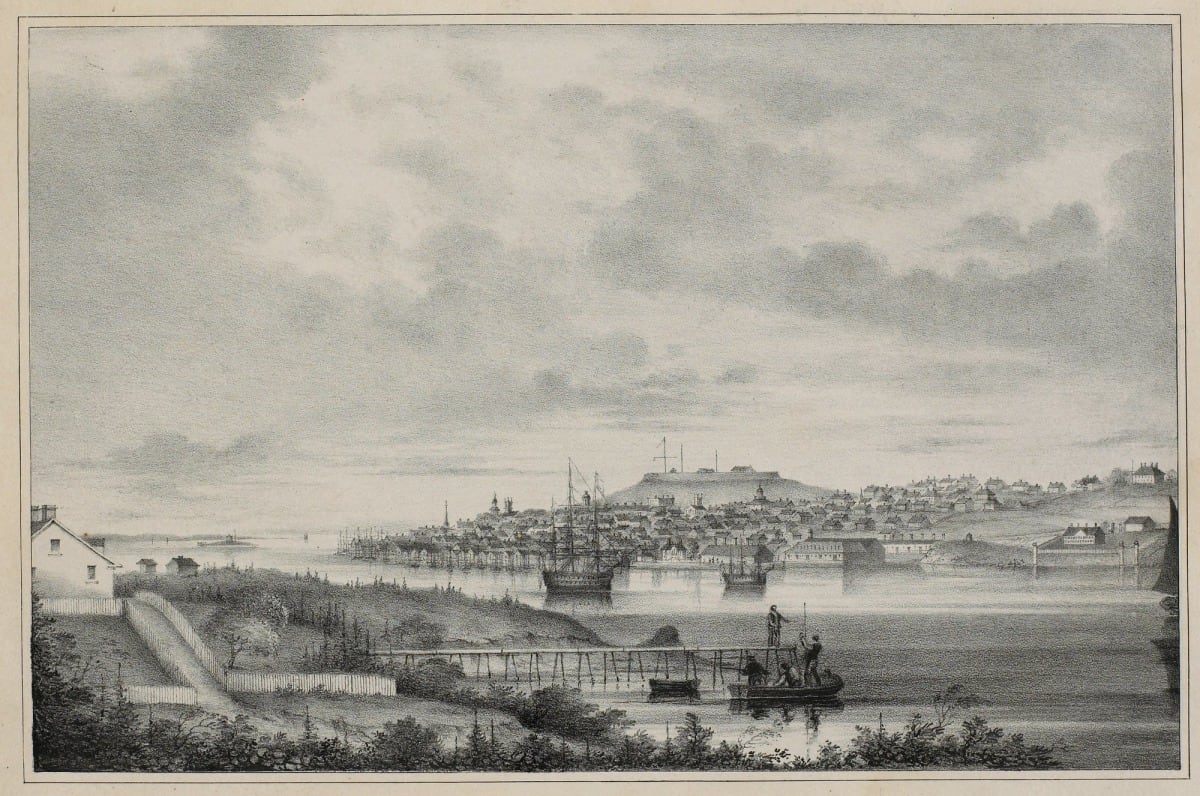
An 1839 lithograph of Halifax harbour and the town skyline by artist William Eagar. (William Eagar/National Gallery of Canada)
Tillotson said Halifax merchants and the public in general either didn’t care how the imported goods were produced or mentally separated the products from their origin.
She likened it to the modern world, where we buy a smartphone as a necessity of daily life, knowing materials extracted to make it may have involved human suffering.
For Saney, these fiscal records shatter the long-standing myth that Nova Scotia existed only on the innocent periphery of the transatlantic slave system.
History demands more than acknowledgment, he said, pointing to the need for dedicated research and public education on Atlantic Canada’s links to the slave trade.
MORE TOP STORIES