
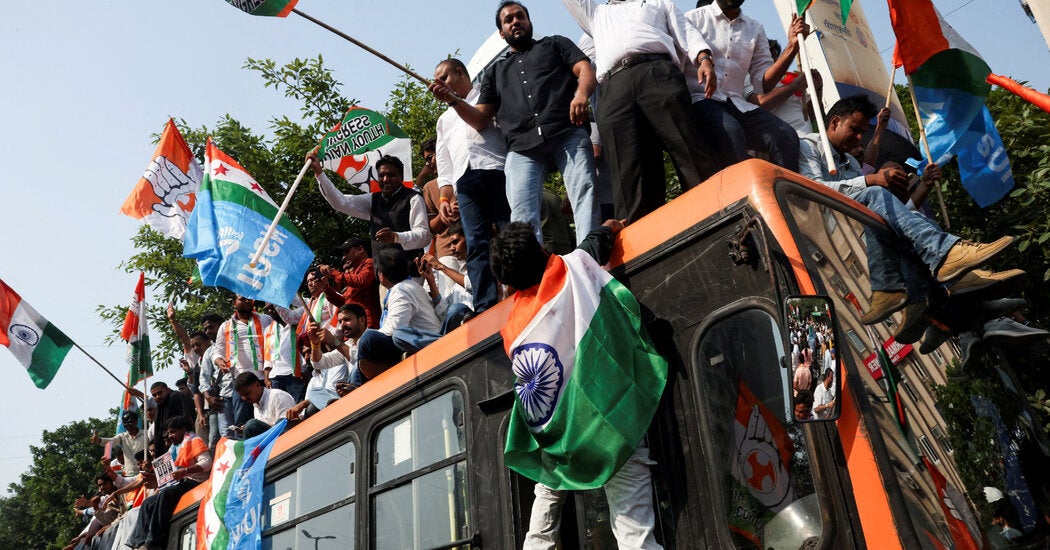
Thousands of opposition political party supporters marched along a busy thoroughfare in central Delhi to challenge sweeping revisions of the nation’s voter roll.
In a contrast to a week of lockdowns and detentions by the authorities, the demonstrators on Monday far outnumbered security forces stationed on the road. They stood atop orange buses, waving the flags of the opposition Indian National Congress party. Columns of police and other security officials, dressed in riot gear, watched.
The turnout signaled a show of strength for the long-beleaguered Congress party leader, Rahul Gandhi. He marched with a rambunctious crowd, at times flanked by his sister, Priyanka Gandhi Vadra. In an effort to portray a unified front against the ruling Bharatiya Janata Party, Mr. Gandhi was also joined by Neha Bora, a leftist student activist, along with regional politicians from North India.
Mr. Gandhi’s lawyer filed a petition on his behalf in the Supreme Court, calling for an inquiry into the proceedings of the election commission. Its chief, Gyanesh Kumar, has been the target of more than a week of protests across India, by youth groups, opposition politicians, and ordinary citizens who say the election commission’s revision of the voter roll is a politically motivated purge of critics of the ruling party. Since it began last summer, the revision has expunged over 130 million names.
Together, months of protests over a wide range of frustrations about poor education and a lack of job opportunities represent the biggest challenge to Prime Minister Narendra Modi in his 12 years in office.
The government’s tactics on Monday, allowing the march to proceed mostly unimpeded, were a stark contrast to the intense crackdown on protests over the course of the last week, when would-be demonstrators were grabbed and stuffed into police vans.
The crowd was so thick at Monday’s march that it could barely move. There were several moments when Mr. Gandhi was just pushed along through a sea of people.
In a news conference earlier, the opposition, who was detained in demonstrations in Delhi last week, vowed to continue to protest.
“We will do it today, they will stop us. We will do it tomorrow, they will stop us. We will do it the day after tomorrow. They will stop us,” he said. “Let them stop us.”
By evening, there was no sign of the mass detentions of recent days.
Rather, politicians from the B.J.P., the ruling party, fired back with political invective.
“Congress is a group of hooligans trying to spread chaos on the streets and oppose the system,” a B.J.P. minister, Shivraj Chouhan, said.
Anurag Thakur, a B.J.P. member of parliament, said: “Rahul Gandhi and the Congress Party’s motto is — if not in power, then spread anarchy. “
The march came as the government declared that protests can no longer be legally held inside the small area in central Delhi that is the seat of government power.
What had been the capital’s most popular protest site for decades — an 18th-century monument called Jantar Mantar that sits less than a mile from India’s Parliament — would no longer be used for demonstrations, the government said in its “guidelines for holding protests or demonstrations in Delhi.”
The government said permission for protests can only be sought at three other sites: one about 3 miles from parliament, another further away in the east of the city, and the third to the north. Critics said the change effectively sidelines dissent, moving it away from the halls of power.
“Peaceful assembly & protest is a fundamental right of people,” Prashant Bhushan, a lawyer and civil rights activist, said in a social media post. “The govt cannot confine to ‘Designated sites.’”
Removing Jantar Mantar as a protest site came two days after the youth movement known as the Cockroach Janta Party had called for nationwide protests to be held there on Saturday. The Delhi police denied permission for the protest and took extraordinary measures to prevent people from assembling, canceling trains to the capital, closing metro stations and shutting off the internet in the city center.
Jantar Mantar, distinguished by its ocher-colored sundial, is a relatively small venue with two entrance and exit gates and the government had begun looking for alternate sites for sanctioned protests several years ago. The Supreme Court on Saturday recommended that the government look for alternate protest sites.
Anjani Anand, 29, came to the march Monday afternoon on Barakhamba Road, less than a mile away from Jantar Mantar, with a few friends. “I think people feel safer to come out onto the streets,” she said.
“There’s strength in numbers here,” said Shubhayan Sengupta, 30, who had joined her. He had been detained twice on Saturday and escaped both times. He didn’t want to be detained again, but he and his friends were prepared. They had the numbers of lawyers.