
The October 1 event, dubbed “Jan-Fadayan,” or “Those Willing to Sacrifice Their Lives,” brought together members of the Basij paramilitary force, religious organizations and other participants, according to Iranian state media.
Organizers described the gathering as a demonstration of public readiness and mobilization capabilities.
Iranian lawyer Ali Mojtahedzadeh described the public display of bladed weapons as a “show of force with weapons” and called on local security authorities to explain why it had been permitted.
A review of statements by senior Islamic Revolutionary Guard Corps (IRGC) commanders and former security officials shows that the use of unofficial groups, including individuals described as criminals and street thugs, to confront protesters dates back decades.
From the 1999 student protests to the 2009 crackdown
One of the earliest documented accounts dates to July 1999, when security forces and allied groups attacked Tehran University student dormitories, triggering widespread demonstrations.
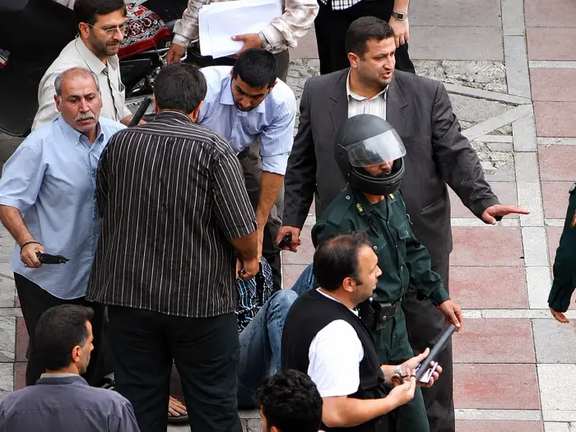 Iranian security and plainclothes forces confronting protestors during the 2009 Iranian election protests following the disputed presidential election.
Ali Hashemi, a former deputy security minister at Iran’s Intelligence Ministry, said in an audio recording published by Iran International that approximately 250 individuals described as “thugs and hooligans” were organized during the student protests.
Hashemi said the experience later served as a model for deploying similar groups during the mass demonstrations that followed Iran’s disputed 2009 presidential election.
He also described the use of individuals with criminal records to beat detainees, including at the notorious Kahrizak detention center, referring to authorization from judicial authorities.
Hashemi said similar individuals were subsequently deployed during protests in 2017, 2018 and November 2019.
One of the most explicit accounts came from Hossein Hamedani, a senior IRGC commander responsible for security operations in Tehran during the 2009 unrest.
 Iran’s then Supreme Leader Ali Khamenei (L) receives a gesture of respect from Islamic Revolutionary Guard Corps (IRGC) Brigadier General Hossein Hamedani (R) during a meeting in Tehran, Iran, in this handout photo released by the official website of the Leader on October 10, 2015.
Hamedani said the Revolutionary Guards identified approximately 5,000 people who had participated in disturbances but were not affiliated with political parties or movements. He described them as “criminals and thugs.”
According to Hamedani, these individuals were initially prevented from leaving their homes on days when protests were planned, but some were later recruited and organized into three battalions.
“I then made them members of the battalions,” he said.
Explaining the strategy, Hamedani said that training fighters required recruiting individuals accustomed to handling “blades and machetes.”
Hamedani also described preparations to confront protesters during Ashura, a major Shiite religious observance, in December 2009.
He said cinemas, schools and religious halls were made available to pro-government forces, while approximately 30 religious groups were mobilized in Tehran.
“On Ashura, these same three battalions put an end to the unrest,” Hamedani said, adding that approximately 45,000 Basij members had also been deployed.
Following Hamedani’s death in Syria in 2015, Mohammad Ali Jafari, then commander-in-chief of the IRGC, credited him with helping suppress the 2009 protests, saying his leadership had been crucial to ending what Iranian authorities described as “sedition.”
Hamedani had also played a central role in organizing local militias supporting Syrian President Bashar al-Assad during the country’s civil war.
Jafari later said Hamedani had organized approximately 100,000 local fighters in Syria.
Allegations of machete-wielding clerics in 2022 protests
Similar allegations emerged following the nationwide protests triggered by the death of Mahsa Jina Amini in morality police custody in September 2022.
In 2024, former lawmaker Mohammad Ashrafi Esfahani accused a group of clerics associated with influential religious figure Alireza Panahian of attacking protesters with knives and machetes while dressed as civilians.
He alleged that the men returned from the streets wearing bloodstained clothes before changing into clerical robes.
Ashrafi Esfahani also said members of the group operated in plainclothes and changed into clerical attire, including turbans, when police officers appeared to avoid being confronted.
The allegations emerged amid a legal and financial dispute between Ashrafi Esfahani and Panahian over a religious complex in Tehran and have not been independently verified.
Renewed scrutiny of unofficial armed groups
Nearly three decades after the 1999 student protests, the images from Isfahan have again raised questions about the role of unofficial groups operating alongside Iran’s formal security forces.
Although the names, structures and political circumstances of the groups involved in past crackdowns have varied, accounts by former security officials and IRGC commanders describe the repeated recruitment and deployment of individuals capable of using violence against demonstrators.
The available evidence does not establish that the groups involved in different periods belonged to a single organization or were directly connected.
Nor has any organizational link been established between those previously deployed against protesters and the men seen carrying machetes and swords at the Isfahan rally.
The identities and affiliations of the armed men have not been independently verified.
Their appearance at an IRGC-backed event has nevertheless renewed attention to the Islamic Republic’s documented history of mobilizing forces outside conventional security structures during periods of political unrest.