
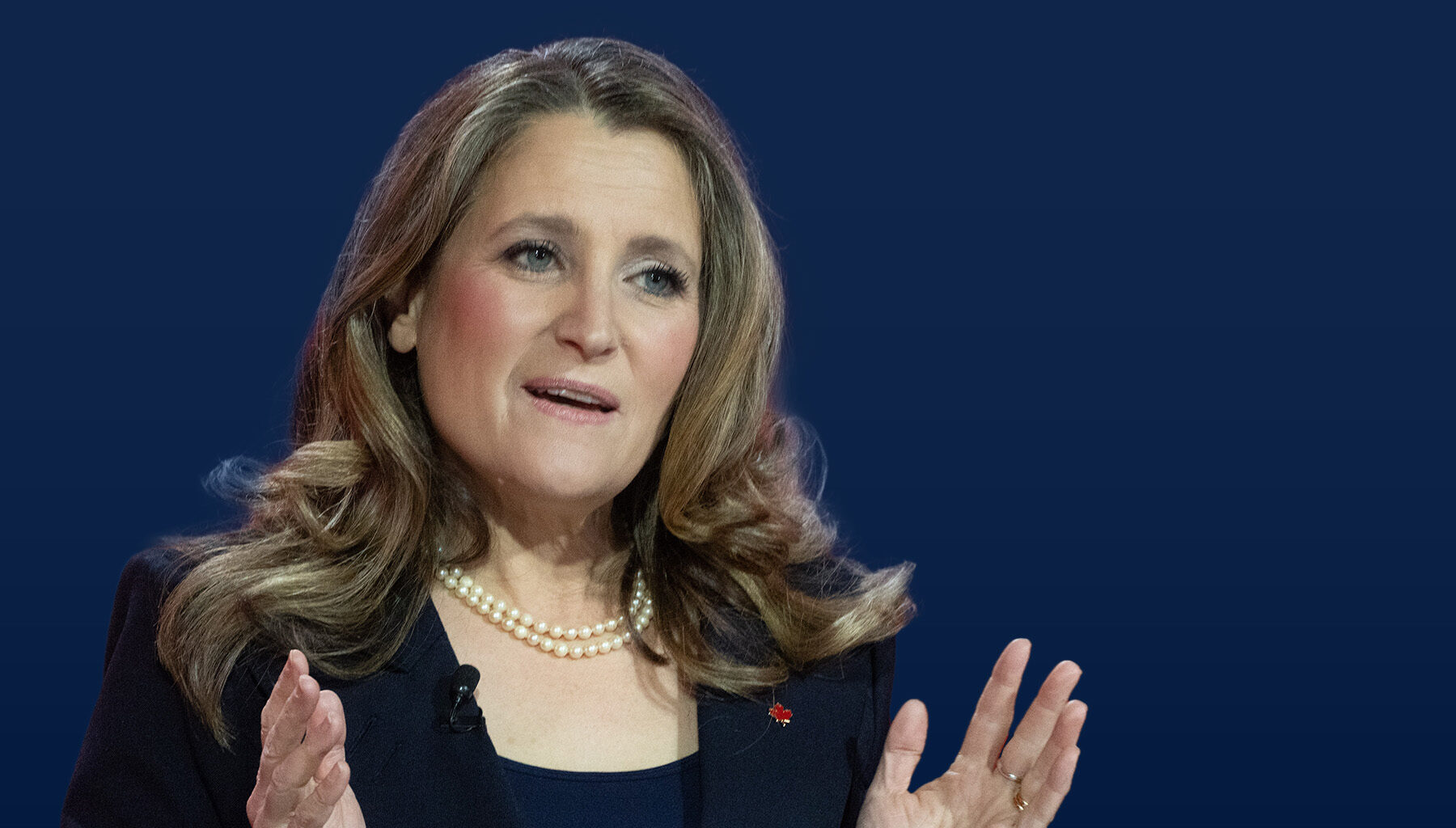
This past February, former deputy prime minister Chrystia Freeland made an appearance on Real Time with Bill Maher and joked that under United States president Donald Trump, America was not being a “very reliable boyfriend” to Canada.
The quip caught on so widely that Freeland, who served as finance minister under Justin Trudeau, used it as the title of her political memoir. Unreliable Boyfriend: An Insider’s View of Dealing with a Chaotic Superpower, Plutocrats, and Other Complicated People is, in part, a polemical account of diplomatic turmoil and trade wars Canada has faced since Trump’s return to power.
But Freeland’s subject is bigger than Trump: it’s the problem of living next door to a superpower whose affections you can never count on. Trump’s America may be Canada’s unreliable boyfriend for now, but the United States has always been our “Uncle Sam,” she writes. “Uncle Sam wants to be loved—and feared. And, sometimes, he’s just not that into you.”
Her advice for those moments? Go around him. Freeland’s “doughnut strategy” means dealing with a hostile US administration by courting the Americans around it, rather than relying on the White House at the centre. During the first Trump-era North American Free Trade Agreement negotiations, Canada cultivated Congress, governors, mayors, unions, businesses, and ordinary Americans, emphasizing how much their communities benefited from trade with Canada. The goal was to build enough support around the president that domestic interests would push Washington to moderate its position toward Canada.
Would that work now? Freeland reminds us that when the North Atlantic Treaty Organization secretary general called him “Daddy,” Trump was thrilled. “He craves the approval of what he sees as the world’s other daddies—Xi Jinping, Putin, and sometimes Kim Jong-Un,” she writes. “The rest of us are his harem—or maybe the better, genuinely American metaphor is sister wives. He wants our adoration—and our abject capitulation.”
The Walrus met with Freeland in Toronto to discuss what Canada can do when America goes “from being a kindly trad husband to a violent one.”
You renegotiated NAFTA with Trump’s first administration. What did you take away from that?
My theory about negotiating with him is about three things. One, do you find areas where you can generally agree? We found some areas like that in the NAFTA negotiation.
Second—and this is maybe the most important thing—is something we called the doughnut strategy. The White House was effectively the hole in the doughnut; the rest of the American political and economic system was the doughnut itself. I think telling Canada’s story to all of America is tremendously important. It’s why I tell the story of the Ronald Reagan ad; I thought it was brilliant. I think we should have run it for months, and I think that we should be running ads exactly like that—because broadly, Americans are good people, smart people, who recognize the relationship with Canada is fundamentally great, and so we need to tell our story.
The third thing that’s equally important is that we simply cannot capitulate to President Trump. With some people, maybe you make a compromise, and that’s how you get the relationship off to a good start. That is not Trump. He doesn’t read capitulation as a generous gesture in the service of relationship building. He reads it as capitulation and submission, and he pushes even further.
What do Canadians still misunderstand about what motivates him?
I do think that some Canadians have sometimes not understood that third point. They sometimes felt that you can kind of sweet-talk him into something. They feel that if we’re too aggressive with him, we’ll just set him off; it’s the “don’t poke the bear” idea. I’m in favour of not operating at a high emotional pitch with the US administration. I want us to be very sensible and level-headed but also very firm and clear. For example, I don’t think it was the right decision to drop the Digital Services Tax. I don’t think it was the right decision to drop some of the retaliation. I think a view a lot of people had was “Oh we’ll do this, and then he’ll be nice to us.” That we’ll be able to charm him into a good relationship. But he doesn’t work that way.
Explain why?
I think he divides the world into two categories. The first are vassals. Vassals must totally submit—and you see that with Venezuela. And you see it with the Republican Party; there is no level of degradation to which Republicans will not be subjected to if they want to be in the court of President Trump. The other category is people and countries who he sees as legitimate partners. But to get to that, you have to get through some tough times with him, because he only elevates you to partnerhood if you’ve stood up to him. I don’t think this is a great way to negotiate, but that’s how he operates.
Is it possible to go back to the old relationship?
Yes, it’s possible. I think the main factor will be what the US decides. I also think it’s possible that we don’t go back to the old relationship but get to a good relationship. But in order to get to a good relationship, America has to become sane again. Or the Trump administration has to effectively back down.
In the first NAFTA negotiation, they did back down. We didn’t brag about that because we wanted to give them room to claim a win. Despite Trump having made horrible threats against us, we preserved our free trade deal and, in some ways, improved it. The elements we added were good for Canada. The US did, in Trump’s first administration, impose tariffs on Canadian steel and aluminum just as they’re doing now, and they lifted those tariffs with no concessions from us. So it is possible to get them to back down, and that would be great for the longer term for Canada. But to have a relationship with the US as a true partnership—which I think is the kind of relationship we’ve had for many decades—the United States would need to change.
And you think they can?
I don’t think that the outcome is preordained. I do think that there’s a possibility the US sorts itself out. It’s important to remember that they’ve had some terrible periods of polarization and some pretty terrible political ideologies. Things can change.
Mark Carney ultimately walked away from negotiations, saying the Americans “asked too much and offered too little.” Knowing Trump as you do, was walking away the right move?
I was so happy and relieved when that happened. I think that was absolutely the right thing for Canada to do. I was quite anxious in the days before, and I gave an interview to Bloomberg on the Thursday before that Saturday-morning deadline when it looked as if there would be a deal. We had heard from a lot of people that a deal was happening. I said in that interview that I was concerned that the deal that was on the table then would not be in Canada’s interests and would be crossing the Rubicon from free trade to managed trade and that it would be particularly harmful to Canadian manufacturing.
With relations this hostile, is there still room for a trade agreement that benefits both countries?
We have to move out of the framework Trump wants us to be in. He wants it to be a zero-sum game; he wants it to be a relationship of dominance. But a win-win outcome is possible. It’s what we had before he was re-elected. Because America is being so vile right now, it can be tempting to think someone has to win and someone has to lose. The reality is we can both win, and that’s a really important message for Americans.
How do you square that optimism with the seriousness of the moment Canada is facing?
Let’s be honest: I think this is a very dark time. We shouldn’t be in denial about that. We need to recognize that this is not a “business as usual” moment in the life of Canada and the world.
But there are reasons to be hopeful: I’m hopeful when I see opinion polling in the US and see how Americans think about Canada and this trade war. I’m hopeful when I see opinion polling in Canada and see how strong Canadians are. I also have to really give a shout-out to Canada’s premiers: I think that they have played a really important role. I think of Wab Kinew, in that week before things broke down, when he said “You can’t do a good deal with a bad person.” I thought that was really well said, and I think it influenced people a lot. Premier Doug Ford has been a really important voice for Canada. It’s important for Americans to see that a small-c conservative leader also thinks capitulation is wrong.
When a country is successful in doing a hard thing, it’s usually because the whole country wants to do it. Even though this is a dark time, I’m proud to be Canadian.
What role does Canada have in all this?
I think Canada can play a role in where America ends up. That’s one of the reasons that I felt the international capitulation to the US administration after the “liberation day” was such a historical error, because it allowed President Trump and MAGA to think that maybe he was right. Trump wrote this op-ed in the Wall Street Journal saying that he was right about everything. One of the points he made there was that “Look, countries said they would retaliate when I imposed these tariffs, and no one has, apart from China.” So the world, by not retaliating, helped to create the monster. I think that by fighting back, Canada is helping to make things better.
