

Rezaei, secretary of Iran’s Supreme National Security Council, told state-owned Press TV on Sunday night that Tehran was prepared for renewed conflict and could target critical technology infrastructure across the Middle East.
He said valuable American assets in the United Arab Emirates and around the Strait of Hormuz had not yet been included among Iran’s targets, but Tehran was prepared to demonstrate new capabilities to strike them. He claimed those assets and the region’s digital infrastructure were worth more than $2 trillion.
“Every miscalculation by the enemy against Iran has resulted in a heavy defeat for them; the next mistake will bring new fronts and greater surprises,” Rezaei wrote on X on Monday.
Hardliners urge pressure on US technology interests
Tasnim News Agency, which is affiliated with the Islamic Revolutionary Guard Corps, argued in an article titled “Why Is Artificial Intelligence on the Target List?” that attacks on AI centers could undermine US technological competition with China, deter investment and put pressure on US stock markets.
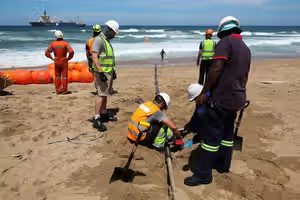 Iran finds a new weapon beneath Hormuz
Hossein Shariatmadari, editor-in-chief of the hardline Kayhan newspaper and the supreme leader’s representative at the publication, welcomed Rezaei’s threat in an article titled “Well Done, Brother Mohsen!”
He called for using fiber-optic cables running through the Persian Gulf and the Strait of Hormuz to pressure Washington and its allies. He claimed that nearly seven major international cable systems pass through the region and that damage to them could disrupt more than 80 percent of commercial, banking, military and AI-related communications.
Kayhan also accused what it called “Western-oriented” political factions of double standards over internet access. It quoted Shariatmadari as predicting that politicians and parties “not fully aligned with the revolution” would oppose Rezaei’s threat and portray it as fueling war.
“The reformists had previously described internet shutdowns [in Iran] as a cause of deep dissatisfaction and called for stable, free and secure internet access for the public. But now that this same internet has become a strategic weapon for Iran against the United States, they have either remained silent or opposed it in the language of peace,” the article said.
Political analyst Ruhollah Rahimpour, however, told Iran International that while Iran could technically and operationally damage data centers and communications infrastructure in the Persian Gulf, the impact would primarily fall on regional networks rather than seriously affect the global internet.
Such attacks could raise the cost of war for other countries, he said, but also widen the conflict and impose greater security and economic costs on Iran.
Mohsen Zanganeh, a member of parliament’s knowledge-based companies and technology faction, endorsed Rezaei’s warning in an interview with ANA news agency, saying it reflected technological realities.
He said many data centers operated by major technology companies, most of them American, and the main communications routes connecting them were located in countries along the southern coast of the Persian Gulf.
Attacks could damage equipment, cloud networks and processing systems while disrupting US military operations, Zanganeh argued. Because Arab countries host both US bases and American technology infrastructure, he said, the consequences could spread to other countries and increase the global economic cost of war, as had happened in the energy sector.
WANA News described Rezaei’s remarks as an attempt to deter military action by raising its potential cost, saying a declaration of readiness did not necessarily signal a decision to launch operations.
Warnings amid strained diplomacy
Rezaei’s threats came alongside indications of continued differences between Tehran and Washington.
In a separate post on X on Sunday, he said the United States had accepted some of Iran’s seven conditions, but Tehran considered its response insufficient.
“Iran’s diplomacy has changed, and we will not return to the previous situation,” he wrote.
Mostafa Najafi, a commentator supportive of Rezaei, interpreted the remarks as a sign that the two sides remained far from an agreement.
“This position by the secretary of the Supreme National Security Council means that negotiations between Iran and the United States are a long way from an agreement and much closer to tensions,” he wrote on X.
The infrastructure threats also drew criticism on social media.
One user, Mohammad Nikbakht, questioned why Rezaei was announcing potential targets and argued that attacks would encourage Arab countries to unite against Iran.
Another commenter warned that threats without the capability to carry them out could backfire, drawing a comparison with Iran’s efforts to close the Strait of Hormuz, which the commenter said had resulted in a naval blockade of Iran.
“We are much more worried about miscalculations by our country’s executive officials than about miscalculations by the enemy,” a different user wrote.