
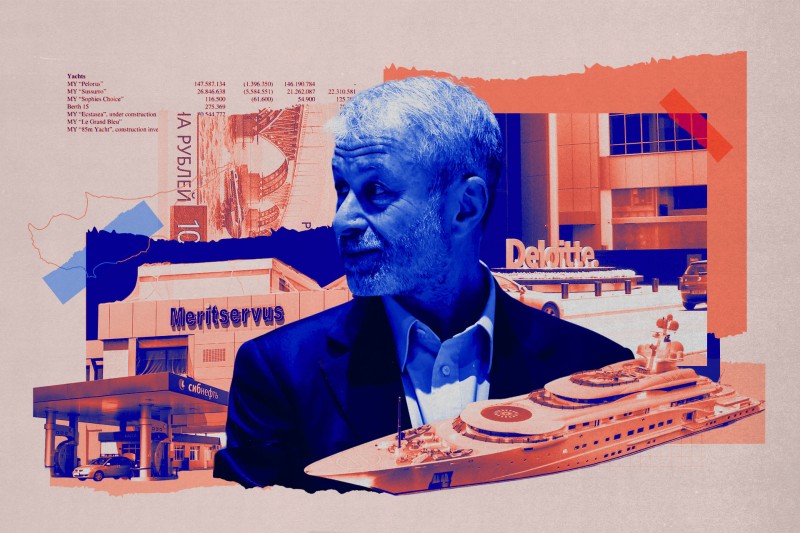
(Abramovich had acquired Sibneft from the Russian state in the mid-1990s for $248 million after gaining control of the company through an auction in which Abramovich’s company’s bid faced “no genuine competition,” according to an English High Court judge. He would go on to sell his remaining stake in Sibneft in September 2005 to Russia’s state-owned energy conglomerate Gazprom for $13 billion. Abramovich’s lawyers said the High Court judgment “made no finding that any auction was corrupt or unlawful” and denied Abramovich was “party to unlawful transactions in Sibneft shares.”)
In mid-2005, Deloitte Cyprus, Millhouse, and MeritServus started discussing how funds sent by Yukos to Kravin after the Sibneft share sale had accumulated millions of dollars in interest. Draft financial statements for 2003 show these funds amounted to around $1.8 billion on December 31, 2003.
The email exchanges state that interest earned on Kravin’s bank deposits was subject to Cypriot corporation tax and a newer additional levy which required foreign-owned Cyprus companies to pay tax on interest earned on their passive income. That legislation had come in just before the 2003 Sibneft payout.
An email exchange showing the agenda for a meeting in Moscow in June 2005 shows that Deloitte Cyprus, MeritServus, and Millhouse were due to discuss “tax risks and the options available to eliminate them in past periods,” as well as “disclosures for the Sibneft/Yukos deal.”
Then, in August 2005, Deloitte Cyprus’s partner Antonis Taliotis sent an email to MeritServus’ Ioannides saying that the interest on Kravin’s income for the first six months of 2005 alone was $10 million. That interest “will suffer a 15% effective taxation” Ioannides said, urging a discussion.
By then, MeritServus’s Ioannides and Natalia Khudyk from Millhouse were discussing an idea first floated by Ioannides in 2003 which he had said at the time would “avoid the payment of tax.” According to Ioannides’s suggestion, the funds held by Kravin should be paid out as an interim dividend to its holding company in the BVI, where it would not be subject to tax. Kravin would then agree to invest the dividend on behalf of the holding company.
In the leaked correspondence from 2005, Ioannides detailed the need to create a series of documents that would make it look as though Kravin had paid the Sibneft proceeds as a dividend in May 2003 to its shareholder Kelvedon Worldwide Limited, another company beneficially owned by Abramovich and managed by MeritServus. The paper trail would indicate that Kravin then held onto the funds on Kelvedon’s behalf.
Abramovich’s lawyers said he denied evading taxes. “If an arrangement was proposed by professional advisers of Deloitte’s standing, it would have been entirely proper for companies linked to [Abramovich]…to rely on it,” they said.
In an email to Khudyk in August 2005, Ioannides said the idea had already been agreed with Taliotis and another Deloitte Cyprus partner, Nicos Charalambous.
“If you agree, it will be necessary to change the financial statements and the accounting records accordingly for 2003 and 2004,” Ioannides wrote to Khudyk.