
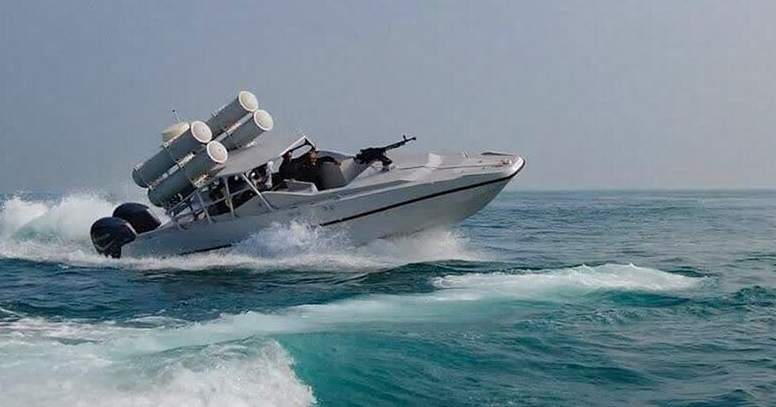
A Houthi missile strike on Riyadh’s King Khalid International Airport on Saturday killed 13 people and injured more than 300, according to Saudi authorities. A follow-up attack on Sunday killed one and wounded 11 others, prompting officials to extend flight suspensions on Monday.
Among the dead were an Indian national traveling with his family for Umrah, an Egyptian flight attendant and a Saudi pilot. Footage released by Saudi authorities shows passengers waiting inside a terminal before an explosion sends them fleeing through smoke and debris.
The attacks came weeks after Tehran warned it would disrupt regional aviation if US sanctions isolated Iranian airlines. No public evidence has established that Iran ordered the strikes, but analysts said they were consistent with its threats.
Yemeni-American analyst Fatima Abo Alasrar described the escalation as part of a familiar pattern in which Tehran seeks to export its economic hardship to its neighbors.
“Just as the United States said that it’s going to conduct Operation Economic Outcast and impose sanctions on Tehran, Tehran is also doing economic outcast for Saudi Arabia through this pressure,” said Abo Alasrar, a scholar at Ideology Machine.
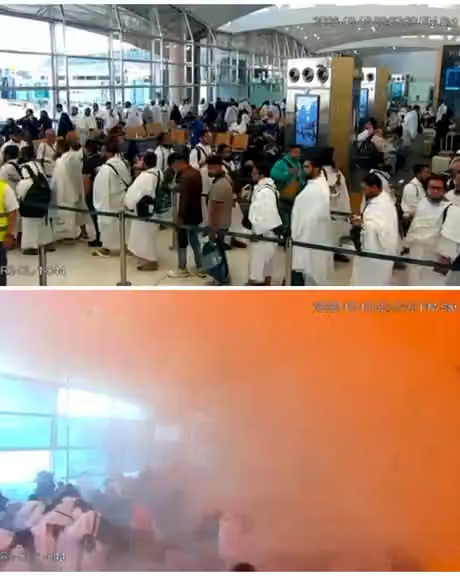 A combination picture shows surveillance footage of people in a queue right before the moment of an attack (top), and people reacting amid smoke at the moment of an attack (bottom), at King Khalid International Airport in Riyadh, Saudi Arabia, October 10, 2026, in these screengrabs from a handout video.
Tehran’s aviation threats
Senior Iranian officials issued the warnings as Washington intensified its economic campaign against Tehran.
US Treasury Secretary Scott Bessent recently announced measures aimed at shutting Iranian airlines out of global airspace, warning foreign airports, ground crews and fuel suppliers that aiding Iranian carriers would trigger exclusion from the dollar-based financial system.
“If they land, you cannot provide them with fuel, you cannot provide them with landing services, you cannot sell them tickets, or you will be knocked out of the dollar system,” Bessent said.
Tehran responded with direct threats.
“If Iran cannot fly and receive airport services, no country in the region will have that possibility either,” Mohammad Mokhber, an adviser to Iran’s supreme leader, wrote on social media.
Mohsen Rezaei, secretary of Iran’s Supreme National Security Council, similarly warned that neighboring airports would be forced to shut down if they complied with US restrictions.
Behnam Ben Taleblu, Iran Program director at the Foundation for Defense of Democracies, placed the subsequent airport attacks within Tehran’s broader efforts to recover regional influence.
“This is a game of cross-domain escalation,” he told Iran International.
“We can’t forget that the strategic backdrop is Iran losing leverage in the Persian Gulf and Strait of Hormuz and trying to gain it back via proxy.”
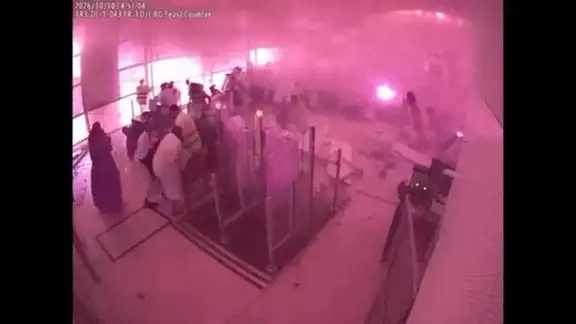 Surveillance footage shows smoke and fire as people react at the moment of an attack at King Khalid International Airport in Riyadh, Saudi Arabia, October 10, 2026, in this frame from a handout video. Saudi Ministry of Media
Iran has played a major role in developing the Houthis’ military capabilities since the group seized Yemen’s capital, Sanaa, in 2014.
A 2024 United Nations report found that the Houthis’ transformation into a powerful military organization was made possible by weapons transfers, training and technical assistance from the Islamic Revolutionary Guard Corps’ Quds Force, Lebanon’s Hezbollah and Iraqi specialists.
In July, Reuters reported that Iran had flown IRGC commanders, military advisers and missile- and drone-related equipment into Yemen during the current war, according to sources familiar with the transfers.
Tehran has repeatedly denied supplying the Houthis with weapons, while the group maintains that it makes its own military decisions.”
The battle for Bab al-Mandab
The airport attacks coincide with military setbacks for the Houthis along Yemen’s Red Sea coast, where Saudi-backed government forces have recaptured territory near the strategic Bab al-Mandab Strait.
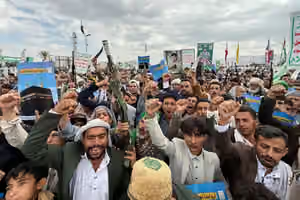 Houthi gains reversed at Bab al-Mandab, but Iran’s leverage runs deeper
Abo Alasrar said the Houthis have an immediate objective of their own: forcing Riyadh to reconsider its support for Yemen’s internationally recognized government.
“The Houthis have both Tehran’s intentions and their own aims on the ground,” she said.
In her assessment, a sustained government advance toward Hodeidah, a major port on Yemen’s western coast, could threaten Houthi access to the sea and restrict routes used to move weapons and military components into their territory.
Losing their remaining coastal access could leave the Houthis effectively landlocked, a development Abo Alasrar described as a worst-case scenario for both the group and Tehran.
While Riyadh has strong incentives to de-escalate, she warned that concessions intended to secure a short-term settlement could allow the Houthis to rebuild their military capabilities.
Restoring access to airports or coastal territory, she argued, could reopen routes for smuggling missile components and other military supplies, setting the stage for another round of escalation.
A battle for public opinion
The killing and endangering of civilians in Saudi Arabia also risk undermining the Houthis’ efforts to portray themselves as defenders of Muslims, Abo Alasrar said.
“It exposed the hypocrisy of the Houthis, who have continuously been saying death to America, death to Israel, but then they’re lobbing the missiles towards Muslim population,” she said.
Images of passengers fleeing explosions have also become part of an information war unfolding alongside the military confrontation.
“The Saudi news channel Al Arabiya has adopted an unusually graphic approach, broadcasting harrowing footage of explosions and destruction reportedly inside Riyadh airport,” Middle East political analyst and journalist Mohamed Fahmy told Iran International.
Fahmy said footage of the attacks, along with social media clips of Crown Prince Mohammed bin Salman offering condolences to a slain pilot’s father, appeared intended to prepare Saudis for further confrontation and reinforce confidence in the kingdom’s leadership.
Increased firepower alone was unlikely to end the confrontation, he said. A durable outcome would require deterrence, intelligence cooperation, political engagement and a military strategy for ending Yemen’s civil war.
Diplomacy amid escalation
Even as the Houthis continue their attacks, Tehran has sought to present itself as a potential diplomatic intermediary.
Iranian Foreign Minister Abbas Araghchi spoke with his Saudi counterpart, Prince Faisal bin Farhan, on Sunday about the conflict.
A senior Houthi official subsequently claimed that Saudi Arabia had considered proposals for a temporary ceasefire, although the group rejected them.
Fahmy said Tehran’s diplomatic outreach allows it to project an image of regional engagement while distancing itself from the actions of its armed partners.