
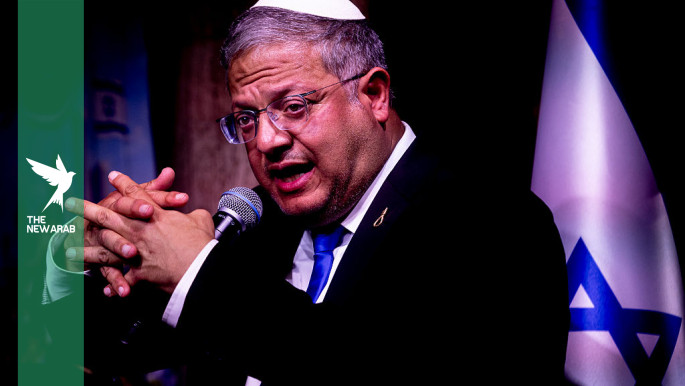
Itamar Ben-Gvir, Israel’s security minister and leader of far-right Otzma Yehudit party, speaks during a political rally ahead of the legislative elections in Israel. [GETTY]
A Muslim woman on a Tel Aviv beach, a hijab in a crowded street, “Arabs and Jews” sharing public spaces. It is precisely this imagery of everyday coexistence that Israelis often invoke to rebut accusations of apartheid. Yet the country’s electoral politics tell a more complicated story.
On 23 September, Israel’s Central Elections Committee voted to disqualify Ra’am and the Joint List, seeking to exclude the principal vehicles of Israel’s Palestinian parliamentary representation from the upcoming end-of-October election. The petitions invoked provisions intended to protect Israel’s Jewish and democratic character, including prohibitions on supporting armed struggle.
Furthermore, the Balad Party leader, Sami Abu Shehadeh, was banned from the upcoming Knesset elections.
The same elections committee that had issued all these decisions also rejected attempts to disqualify far-right Jewish parties, including Itamar Ben-Gvir’s Otzma Yehudit.
Although the Supreme Court overturned the decision, as it has repeatedly done over the past two decades, the irony remains hard to miss.
In 2021, against Arab consensus, Ra’am helped sustain an Israeli governing coalition, breaking a longstanding convention that kept independent Arab parties out of government. Yet five years later, the same party and its controversial leader, Mansour Abbas, found themselves fighting for the right to contest an election.
Exclusion
Today, as Israel swiftly shifts rightward, the boundaries of such participation are narrowing, bringing into sharper focus patterns of exclusion rooted in the state’s earliest years, and potentially signalling a reversal in their political status.
Palestinians who remained after the 1948 Nakba, roughly 150,000, were incorporated into the electoral system while much of their population lived under military rule until 1966. They could vote for a parliament whose government restricted their movement, expropriated their land and treated them as a security and demographic threat.
The state wasn’t required to abandon the distinction between individual citizenship and nationality, which was reserved for Jews.
Therefore, Palestinian participation didn’t come with an equal claim to defining what Israel was, or the power to meaningfully improve their status. Nor did Palestinians have the right to return to the villages from which they had been expelled, while a Jew from Warsaw or Brooklyn could immigrate to Israel, acquire citizenship and enjoy preferential access to land and settlement opportunities.
Even in ethnic terms, they were reduced to merely “Arabs”, a generic label devoid of a distinct Palestinian identity, rendering them naturalised citizens in their own land. And simultaneously, or rather ironically, they were cast as an extension of the Arab World, while being severed from the wider cultural and linguistic environment to which they belonged.
Vote but not have a say
For decades, to maintain the state’s democratic image, the system managed this tension through legal restrictions, political bargaining, and institutional accommodation. It worked as long as institutions could absorb political challenges without fundamentally altering Jewish national primacy, while keeping the lid on the underlying conflict. This was, in effect, the achievement of what might be called suits-and-ties Zionism, largely associated with the Labour Party.
The occupation of the West Bank and Gaza in 1967 altered that environment profoundly. Territory that had occupied a central place in religious-nationalist imagination was now under Israeli control.
The impact on Palestinians in the West Bank and Gaza was immediate, through military occupation and land seizures, whilst for Palestinian-Israelis the implications continued to be obscured by the longstanding arrangement that allowed them to “vote but not have a say”. A form of forced social bribe, so to speak.
Nevertheless, Israel has always had the power to withdraw the apparent “privilege” at its discretion. Over the past two decades, exclusionary politics have gradually gained freer rein. What has emerged, especially, is a more “unapologetic Zionism”. The religious-nationalist movements have moved from pressuring governments to exercising authority within them.
For Palestinian-Israelis, this convergence brought together ideological entitlement and the instruments of state power. What religious nationalism advanced as a matter of principle could brazenly be pursued through legislation, backed by the secular language of security and demography. This alignment found expression in electoral campaigns, such as “No loyalty, no citizenship” by the right-wing party Yisrael Beitenu in 2009, or a clip released on election day in 2015, in which Netanyahu warned that “the right-wing government is in danger. Arab voters are heading to the polling stations in droves.”
Protecting the Jewish state
Importantly, these campaigns coincided with, and were followed by, a growing body of discriminatory Israeli legislation, most notably the 2018 Nation-State Law, which reserved national self-determination exclusively for Jews and elevated Jewish settlement to a national value.
When the Arab party Balad submitted a proposed Basic Law entitled A Country of All Its Citizens, challenging the constitutional principle underlying the then-proposed Law, the Knesset Presidium refused to allow it to proceed to parliamentary debate. Supreme Court President Esther Hayut subsequently characterised Balad’s submission as crossing a red line, on the grounds that it negated Israel’s existence as a Jewish state.
Yet the significance of these proposals cannot be measured solely by their legislative success. From the perspective of “discursive institutionalism” and the political psychology of intergroup dynamics, political discourse both reflects and shapes collective attitudes.
Even unsuccessful bills, of which the Knesset has seen many, can signal a growing tolerance for exclusion, weakening social restraints on discriminatory behaviour and making previously contentious measures more politically conceivable. In this sense, the parliamentary arena becomes not merely a site of law-making, but a mechanism for renegotiating intergroup relations.
Such attitudes long predate the war in Gaza, although recent polling suggests they have intensified. A 2014–15 Pew Research Center survey found that 48% of Jewish Israelis supported expelling or “transferring Arabs from Israel”. Meanwhile, the 2025 Israeli Democracy Index found that support for government measures encouraging Arab citizens to emigrate had risen from 36% in 2019 to 53% in 2025. Only 16% of Jewish respondents believed Palestinian national identity was compatible with loyalty to Israel.

The irony is that Palestinian citizens have spent decades seeking to expand their influence within Israeli democracy, while movements determined to restrict that influence have gained power through the same institutions.
This contradiction has sharpened a longstanding Palestinian debate: whether electoral participation offers a way to change the system from within or merely legitimises its inequalities.
Mansour Abbas’s entry into the governing coalition in 2021 tested the former proposition and yielded very few results. And today’s attempt to disqualify the principal Arab electoral lists, albeit overturned by the judiciary, marks a further step backwards.
Apartheid does not necessarily require the disappearance of democratic institutions; it can coexist with elections, courts and parliamentary representation when those institutions operate within an entrenched hierarchy of collective rights.
What Israel effectively operates on is a normalised two-tier conception of democracy. It is where political equality is recognised at the level of individual suffrage, however contested in practice, while remaining constrained by the institutional privileging of one national group over another, a principle treated as fixed and non-negotiable.
The legal significance, let alone the everyday implications for Palestinian-Israelis, lies not in individual instances of discrimination, but in whether they form part of an institutionalised system of domination, within which further exclusion can be pursued without fundamentally altering the existing political order. In other words, this version of ethno-democracy becomes the means of administering and perpetuating that hierarchy rather than a mechanism for overcoming it.
The late-October election may reveal just how far that transformation has gone, although the growing vulnerability of Palestinian-Israelis is already more apparent than ever.
Dr Emad Moussa is a Palestinian-British researcher and writer specialising in the political psychology of intergroup and conflict dynamics, focusing on MENA with a special interest in Israel/Palestine. He has a background in human rights and journalism, and is currently a frequent contributor to multiple academic and media outlets, in addition to being a consultant for a US-based think tank.
Follow him on Twitter: @emadmoussa
Have questions or comments? Email us at: editorial-english@newarab.com
Opinions expressed in this article remain those of the author and do not necessarily represent those of The New Arab, its editorial board or staff.